Electromagnetic Waves: Class 12 CBSE Assessment Guide and Key Ideas
CBSEPhysicsElectromagnetic Waves
This guide explains the ideas tested in a 110-question Class 12 CBSE assessment on Electromagnetic Waves. It covers Maxwell's displacement current, the generalised Ampere's law, fields inside a charging capacitor, wave energy and momentum, and how the three NCERT topic sets are organised for practice.
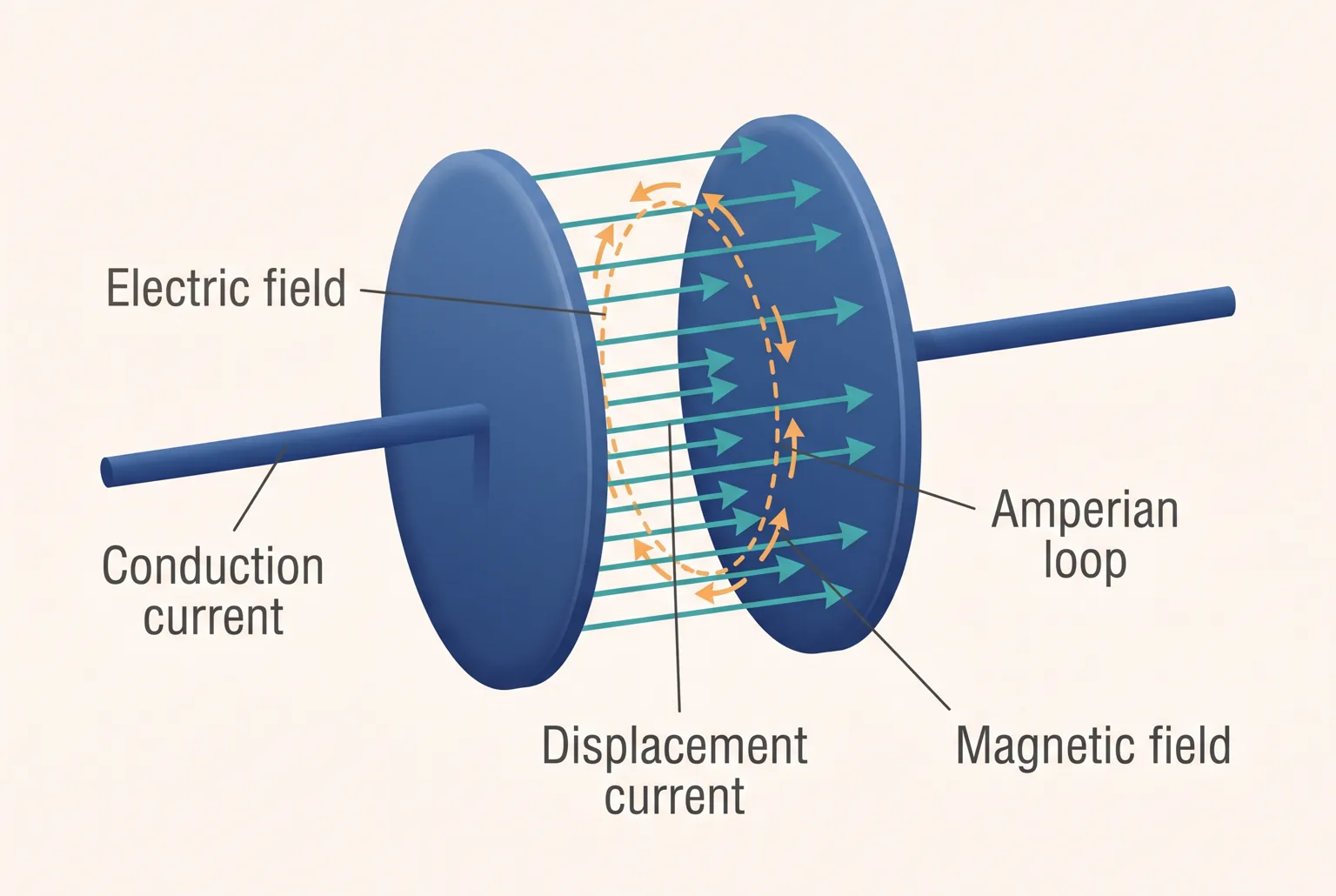
Why Maxwell had to add displacement current
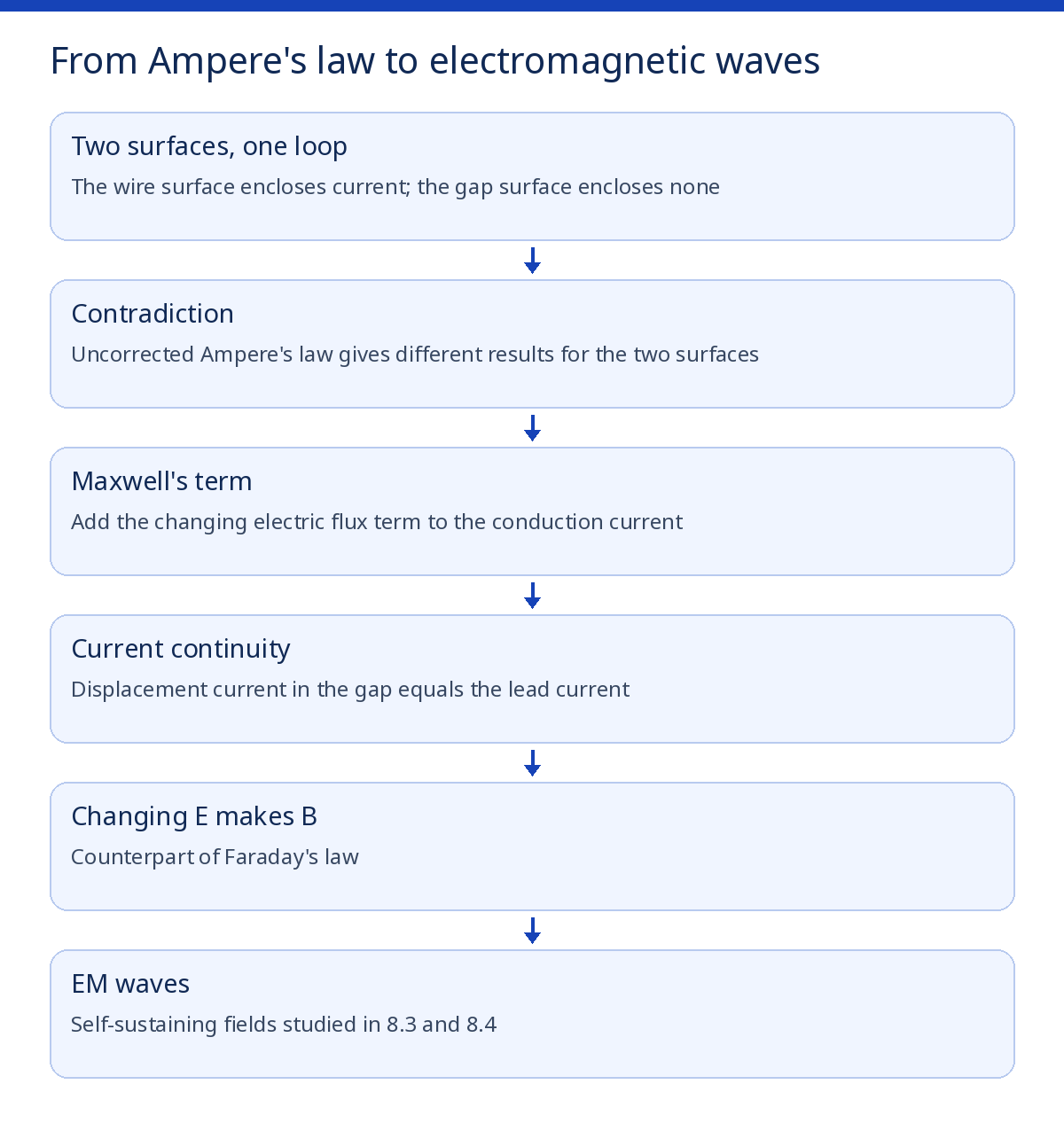
The first topic set (NCERT 8.2, 23 questions) starts from a contradiction in Ampere's circuital law. Take an Amperian loop around the lead of a charging capacitor. Then compare two surfaces that share that boundary.
- One surface cuts the wire and encloses the conduction current .
- The other bulges through the gap between the plates, where no conduction current flows.
The circulation depends only on the boundary, so it must be the same for both surfaces. The uncorrected law, however, gives zero on the right-hand side for the gap surface.
Maxwell resolved this by adding a term for the changing electric flux through the gap:
The quantity is the displacement current. The assessment's worked solutions stress three consequences of this added term:
- It makes the law consistent with charge conservation.
- It shows that a changing electric field produces a magnetic field, the symmetrical counterpart of Faraday's law.
- It leads directly to self-sustaining electromagnetic waves.

Electromagnetic Waves | Class 12 | CBSE Assessment
In the StudentCurio app
110 Class 12 Physics questions on electromagnetic waves, arranged by NCERT topic, with step-by-step worked solutions. Three topic sections (displacement current; electromagnetic waves, their sources, energy and momentum; the electromagnetic spectrum), each with MCQs, 2-, 3- and 5-mark questions and a 4-mark case-based question, plus assertion-reason items.
Displacement current in a charging capacitor
Most numerical questions in this set reduce to a short chain of reasoning. For plates of area carrying charge , and neglecting fringing:
- The field between the plates is .
- The flux through the gap is .
- Differentiating gives .
So for an ideal capacitor, the displacement current in the gap equals the conduction current in the leads. The generalised current is therefore continuous around the circuit. When the field is uniform and normal to the plates, the same idea appears as , and through capacitance as .
DC and AC behave differently, and several 2- and 3-mark questions test this contrast.
- DC source: current flows only while the charge, and hence the flux, is changing. Once the capacitor is fully charged, and are both zero.
- AC source: the voltage, charge and flux change continuously, so current keeps flowing even though no conduction charge crosses the gap.
For a sinusoidal source , start from and differentiate. This shows how the current amplitude depends on frequency, which is what the frequency-scaling questions ask you to reason out.
Finding B between circular plates with an Amperian loop
The 3-, 4- and 5-mark questions ask for the magnetic field inside the gap. The method is the same each time:
- Choose a circular Amperian loop of radius , concentric with plates of radius .
- Use symmetry: is tangential and constant around the loop, so the left side becomes .
- Work out how much displacement current the loop encloses.
For , the loop encloses only the flux through area . This gives the result stated in one question:
This result assumes a uniform field in a vacuum gap. The case-based question extends the method to a point outside the plate edge, and to a statement about how varies across the mid-plane. Decide carefully what fraction of each loop encloses before you substitute numbers.
Common slips with capacitor fields
The worked solutions correct several recurring errors:
- Assuming the gap field is zero because no conduction current crosses it. The changing flux produces , just as a conduction current would.
- Using the full for a loop inside the plates. Only the enclosed fraction counts.
- Mixing rms and amplitude values in AC problems. Convert with before finding a field amplitude.
- Treating Kirchhoff's junction rule as failing at a plate. It holds when the current at each plate is taken as conduction plus displacement current.
Energy, momentum and propagation in section 8.3
The second set (NCERT 8.3, 40 questions) covers:
- the sources and nature of electromagnetic waves;
- the relations between the electric and magnetic fields of a wave;
- energy density and intensity;
- momentum and radiation pressure.
The cover diagram shows the central picture: the electric and magnetic fields oscillate in phase, perpendicular to the direction of travel.
The early MCQs ask you to:
- identify the correct expression for total energy density, which combines an electric and a magnetic contribution;
- fix the propagation direction from a cross product of the two fields;
- find the speed in a non-magnetic medium of given relative permittivity;
- compute radiation pressure on a surface that completely absorbs normally incident radiation;
- say which kind of charge can produce a propagating wave.
The absorption condition is stated explicitly in the radiation pressure question, so read such conditions before choosing a relation. Then check every option for correct dimensions and factors.
How the spectrum set and question formats fit together
The third set (NCERT 8.4, 47 questions) covers the spectrum from radio waves to gamma rays: their ranges, production and uses. It is the largest set and includes twelve 5-mark long-answer questions.
Every topic follows the same board-exam ladder:
- MCQs at 1 mark;
- very short answers at 2 marks;
- short answers at 3 marks;
- one case-based question at 4 marks;
- long answers at 5 marks.
Assertion-reason items appear among the MCQs. The case-based questions give five subparts and ask you to attempt any four, mirroring internal choice. Questions are numbered 1–110 continuously, and each links to a step-by-step worked solution.
Before you move on to mixed practice
Work topic by topic in NCERT order. Displacement current comes first because 8.3 builds on the idea that a changing electric field sources a magnetic field.
Within each set, attempt the MCQs and very short answers before the case-based and long questions. Write every step an examiner expects: the flux expression, the enclosed current and the symmetry argument. Then compare your working with the solutions.
A quick self-check: can you explain, without numbers, why the ammeter in a DC capacitor circuit deflects only momentarily, and why an AC circuit keeps current flowing? If not, revisit the 8.2 set before attempting 8.3.
Frequently asked questions
Is this assessment meant for JEE preparation?
It is CBSE Class 12 material arranged by NCERT topic and following the board pattern of 1-, 2-, 3-, 4- and 5-mark questions.
Does every question have a solution?
Yes. The index states that every question links to a step-by-step worked solution.
Spotted an error? Report a correction. Practise this in the app: notes, formula sheets and mind maps.













































































































































































Loading comments…