Electromagnetic Waves: CBSE Class 12 Physics NCERT Notes
CBSEPhysicsElectromagnetic Waves
These CBSE Class 12 Physics notes use a charging capacitor to explain why Maxwell extended Ampère’s law, then connect that correction to electromagnetic waves. The file brings together derivations, worked examples, wave properties and a spectrum reference.
Why a charging capacitor exposes a gap in Ampère’s law
While a capacitor charges, conduction current flows in the leads, but no charge crosses the insulating gap. The notes use this setup to compare two surfaces bounded by the same circular loop. A flat surface cuts through the wire, while a bulged surface passes between the plates without cutting the wire. Applied using conduction current alone, the original Ampère’s law gives a nonzero magnetic circulation for one surface and zero for the other. Yet the circulation is evaluated along the same loop in either case.
Maxwell’s correction adds displacement current, , to the conduction-current term. For large parallel plates with vacuum in the gap and negligible fringing, the electric flux between the plates is proportional to the plate charge. As that charge changes, the displacement current in the gap matches the conduction current in the leads when the signs are assigned consistently. The correction accounts for the circulation without requiring charges to cross the gap.

Electromagnetic Waves | Class 12 | NCERT Notes
In the StudentCurio app
These revision notes cover displacement current, Maxwell’s equations, electromagnetic-wave generation and propagation, key wave properties, and the electromagnetic spectrum with its applications. They help Class 12 students review the chapter’s core concepts, formulas, and examples.
Read Maxwell’s equations as two flux laws and two circulation laws
The two Gauss laws concern flux through closed surfaces. The net outward electric flux depends on the charge enclosed, whereas the net magnetic flux is zero. Zero net magnetic flux does not mean the magnetic field vanishes on the surface: flux entering and leaving can cancel.
The other two laws concern circulation around closed paths. For a fixed contour, Faraday’s law links electric circulation to the negative rate of change of magnetic flux; the minus sign expresses Lenz’s law. The Ampère–Maxwell law links magnetic circulation to both conduction current and changing electric flux. Comparing these two laws shows what Maxwell’s correction adds: a changing magnetic flux is linked to electric circulation, and a changing electric flux contributes to magnetic circulation.
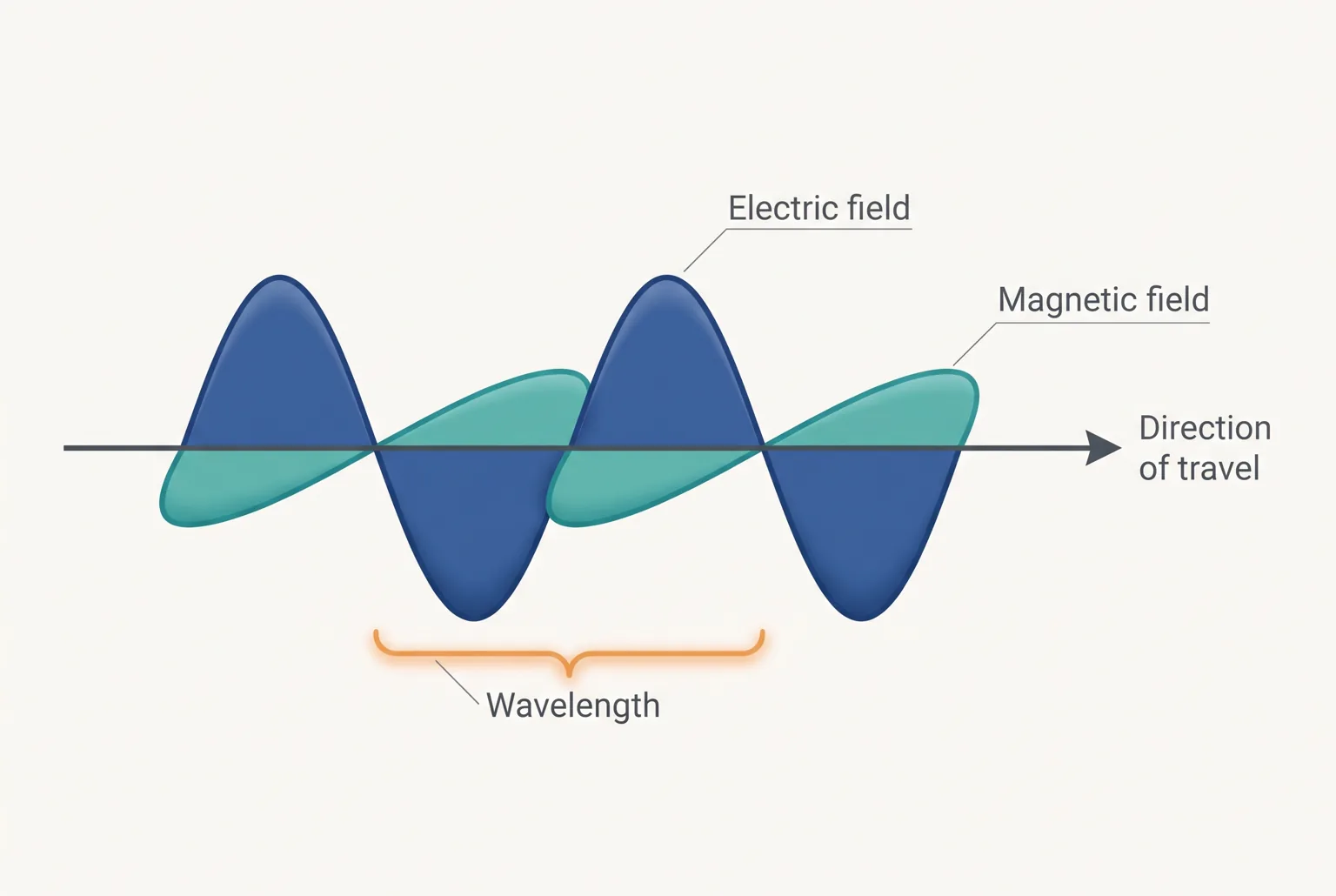
What the plane-wave diagram shows
The notes distinguish how a wave is produced from how it travels. Accelerating charges radiate, and for a sinusoidally oscillating source the radiated frequency equals the oscillation frequency. Once produced, an electromagnetic wave can propagate through vacuum without a material medium.
In the plane-wave diagram, the electric field, magnetic field and direction of travel are mutually perpendicular. The electric and magnetic fields reach their maxima and pass through zero together. The figure is a snapshot at a fixed instant: its horizontal axis shows position, so the spacing between successive crests gives the wavelength, not the period. The direction of energy flow is along ; the direction of the electric field instead specifies the wave’s linear polarisation.
When the speed and energy formulas apply
Use to relate speed, frequency and wavelength. To find speed from a material’s electrical and magnetic properties, the notes use for a homogeneous, isotropic, lossless medium. In vacuum, this reduces to . The notes give for a plane wave in vacuum; do not substitute the vacuum speed into a calculation that calls for the speed in a material.
For a travelling plane wave in vacuum, the electric and magnetic energy densities are equal at each point, so their averages are equal too. The wave also transports momentum and can exert radiation pressure. The relation is given for energy fully absorbed from a wave in vacuum. At a receiving antenna, a different property matters: a straight antenna responds to the electric-field component along it, so turning it perpendicular to the incident linear polarisation weakens reception.
Use the spectrum table to compare bands
The spectrum runs in order of increasing frequency from radio waves through microwaves, infrared, visible light, ultraviolet and X-rays to gamma rays. In vacuum, all these bands travel at the same speed, so wavelength decreases as frequency increases. Within visible light, that makes red longer in wavelength than violet. The band boundaries are approximate, and the equal-width boxes in the diagram do not represent equal frequency or wavelength intervals.
The table separates production, detection and application. For example, oscillating charges in transmitting aerials produce radio waves, receiving aerials detect them, and broadcasting is an application. X-rays can be produced by electron deceleration or inner-shell transitions, detected with film or ionisation chambers, and used for medical imaging. This distinction helps you read each row as more than a list of uses.
Use the worked examples to check your setup
The clickable index lets you go directly to the worked examples on an AC capacitor, a voltage ramp and wave speed in a medium. Before reading each derivation, identify what kind of quantity the problem asks for. In the AC example, the supply rating is interpreted as an RMS voltage, so the calculated current is also RMS. The voltage-ramp example concerns an instantaneous current and uses the rate of change of voltage, not the voltage alone.
For the wave-speed example, check whether the quantities supplied are absolute or relative permittivity and permeability before choosing the form of the speed equation. Then use the chapter recap to test whether you can explain why the capacitor needs a displacement-current term and what changes across the spectrum even though the vacuum speed stays the same.
Spotted an error? Report a correction. Practise this in the app: notes, formula sheets and mind maps.













































































































































































Loading comments…