CBSE Class 12 Physics 2026 Previous Year Paper (55/3/2)
CBSEPhysics2026 Previous Year Paper
Paper code: 55/3/2 · 2026Use the full English-language 2026 CBSE Class 12 Physics main examination paper for a three-hour practice attempt. Then use the worked solutions to check not just your calculations, but why each method fits the question.
This set is one of the year's papers. See every set from 2026, grouped by series.
Know the format before you start
Paper 55/3/2 carries 70 marks and contains 33 compulsory questions across five sections. Section A has 16 one-mark multiple-choice questions, including assertion–reason items. Sections B and C have five two-mark very short answers and seven three-mark short answers, respectively. Section D has two four-mark case studies, and Section E has three five-mark long-answer questions.
There is no overall choice: internal choices occur in some questions outside Section A. For a timed attempt, answer only the required alternative. Afterward, try the other branch as a separate revision exercise. Keep the printed constants available and leave the calculator aside, as the instructions require. In assertion–reason items, judge the truth of each statement before deciding whether the reason explains the assertion.

Physics 2026 | Class 12 | Previous Year Paper | Code 55/3/2
In the StudentCurio app
Complete CBSE Class 12 Physics paper 55/3/2 for 2026, with questions and worked solutions across the syllabus, including optics, electrostatics, magnetism, semiconductors, nuclear physics and AC circuits. Helps students practise board-exam questions and review solution methods.
Optics: choose the model before the formula
The paper moves between ray optics and wave optics. A telescope diagram needs to show the specified final-image position; a spherical refraction derivation needs a consistent sign convention for distances and curvature. For lens combinations, check whether the lenses are thin and in contact before adding their powers. A formula for a combination should not be used simply because two lenses appear in the same diagram.
In Young’s double-slit experiment, think in terms of interference between coherent waves. Keep slit width separate from slit separation: they describe different features of the apparatus, and it is the separation that enters the usual fringe-width expression. The critical-angle question calls for another distinction: total internal reflection is possible only when light travels from a higher to a lower refractive index and the angle of incidence exceeds the critical angle.
Common mistakes in circuit questions
The diode questions distinguish junction formation, biasing and resistance over a change in operating point. A junction-formation diagram should help explain what happens near the boundary, whereas a biasing diagram should make the connections clear. To classify bias, compare the potentials at the two terminals rather than looking at either sign alone. If the question supplies changes in voltage and current, their ratio describes the resistance over that interval, not the ratio of voltage to current at one operating point.
For AC questions, distinguish peak from rms values: the coefficient of the sine in a voltage expression is its peak value, not its rms value. When reviewing a series circuit, check which quantity leads before interpreting the phase angle. In the capacitor case study, the phrase for a long time matters: analyse the DC steady state, not the initial charging transient.
Fields and forces: read the geometry first
The magnetic-motion case study separates acceleration through a potential difference from subsequent motion in a uniform magnetic field. Keep those stages separate in your reasoning: an electric field can do work, whereas the magnetic force alone cannot change a particle’s kinetic energy. In the coil question, check whether the stated angle is measured from the plane of the coil or from its normal before using a torque expression.
The electrostatics questions also depend on geometry. For the concentric conductors, redraw the radial regions and identify what a Gaussian surface in each region encloses. Flux through a closed surface and electric field at a point are different quantities. Gauss’s law relates net flux to enclosed charge; using it to find the field directly also requires suitable symmetry. This distinction helps explain why the paper asks about different regions separately.
Modern physics: keep the quantities distinct
The modern physics questions call for different starting points even when they use similar units. In a photoelectric setup, compare photon energy with the surface work function before discussing emitted electrons. For a de Broglie question, wavelength is tied to the particle’s momentum. An energy stated in electronvolts does not by itself tell you which relation applies; the physical setup does.
The nuclear questions ask you to connect mass defect with binding energy, distinguish fission from fusion, and interpret a potential-energy plot for a pair of nucleons. On that plot, pay attention to the slope, not just whether the potential energy is positive or negative. The force is related to the negative gradient of potential energy, so its direction cannot be inferred from the sign of the plotted energy alone.
Quick self-check for reviewing the worked solutions
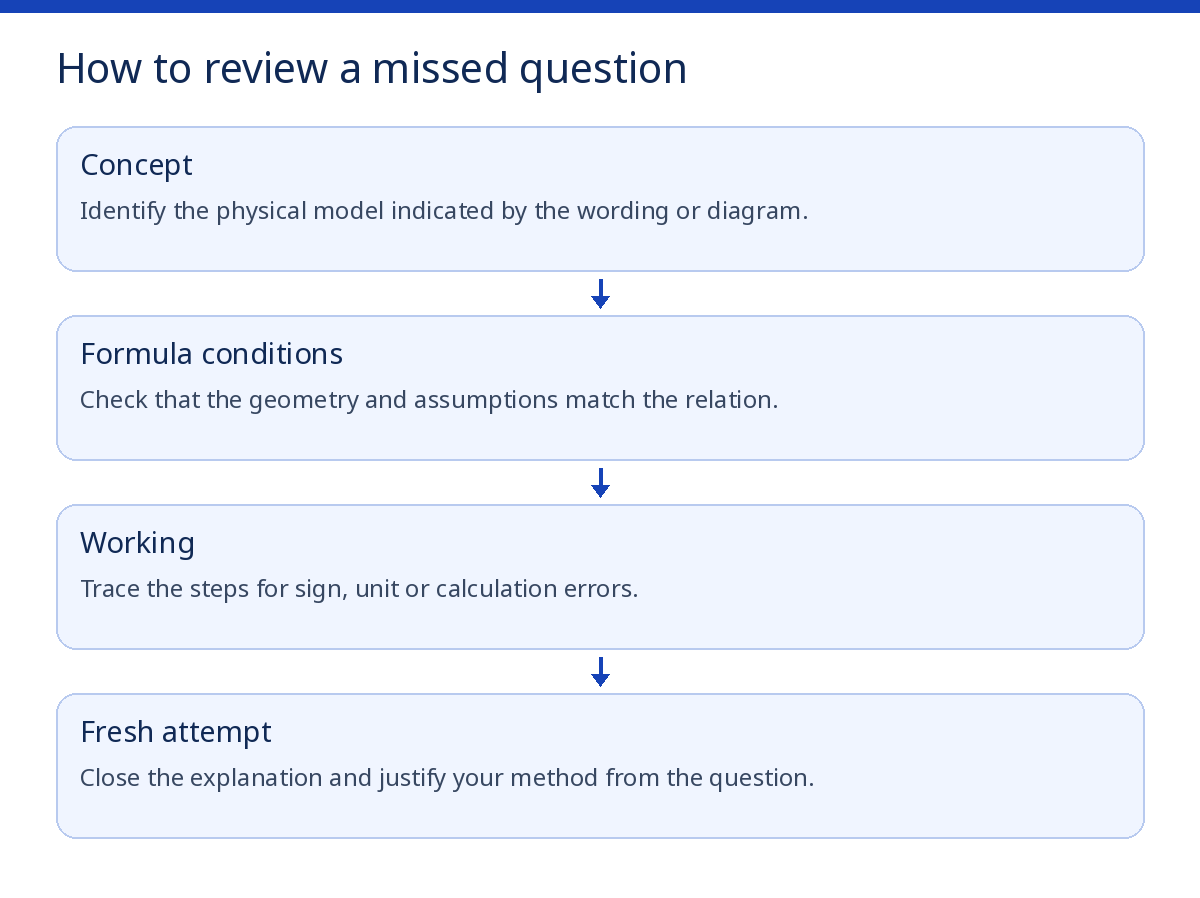
The file retains the original English questions, options and diagrams. Its question-number links let you move between the paper and explanations organised by formula, concept and steps. Attempt the paper before opening the solution pages. On review, use those three parts to locate your first mistake: did you choose the wrong model, miss an assumption, or make an error after setting the problem up correctly?
Before moving on from a missed question, ask: Can I point to the wording or diagram feature that tells me which method applies? For a case study, distinguish information given in the passage from what each subpart asks you to establish. For a long answer, check that you supplied the requested diagram, derivation or justification rather than only a final result.
This guide omits one disputed subpart of Question 29; the rest of the paper can still be used for practice.
Spotted an error? Report a correction. Practise this in the app: notes, formula sheets and mind maps.













































































































































































Loading comments…