CBSE Class 12 Physics 2023 Previous Year Paper (55/1/3)
CBSEPhysics2023 Previous Year Paper
Paper code: 55/1/3 · 2023Practise with the complete English version of the 2023 CBSE Class 12 Physics main examination, paper code 55/1/3. Use the worked solutions after your attempt to check how you chose a principle, interpreted a diagram or carried a calculation through.
This set is one of the year's papers. See every set from 2023, grouped by series.
Know the format of this 70-mark paper
The paper gives you three hours for 35 questions across five sections. Section A contains eighteen one-mark multiple-choice questions, including three assertion–reason items. Section B has seven two-mark very short answers, and Section C has five three-mark short answers. Section D contains three five-mark long answers, while Section E ends the paper with two four-mark case-based questions.
There is no overall choice: you cannot drop a numbered question in favour of another. Internal choices apply where an alternative is printed. Look at exactly what the OR replaces: in the case-based section, it replaces the final subpart, not the whole case. Calculators are not allowed, so attempt the paper under the same restriction if you are using it as a mock exam.

Physics 2023 | Class 12 | Previous Year Paper | Code 55/1/3
In the StudentCurio app
The complete 2023 CBSE Class 12 Physics paper (code 55/1/3) includes worked solutions and questions across the syllabus, including electricity, magnetism, optics, semiconductors, and atomic and nuclear physics. It helps students practise the board-exam format and review solution methods.
Electricity and magnetism: identify what you need to find
The electricity questions move between charge transport in a conductor, electrostatic interactions and circuits. A coordinate-based electrostatics question may require a scalar quantity or a vector, depending on what it asks for. Potential energy is a scalar, whereas electric force and electric field have directions. Before calculating, decide whether your result needs signed scalar contributions, vector components or a magnitude with a direction.
The magnetism questions distinguish between finding a field produced by a current and finding the force due to a field. For a force question, mark the directions of the field and the motion or current before substituting magnitudes. In alternating-current questions, distinguish an amplitude from an instantaneous value: a peak value describes the size of the oscillation, while a time-dependent expression must also account for phase.
When a simplified formula applies
The dipole questions make the distinction between an exact setup and a far-field approximation useful. A far-field expression assumes that the distance from the dipole’s centre is much greater than the separation of its charges. If a problem changes the observation distance, check whether that assumption still holds before using the same approximation.
The alternating-current questions also use two distinct models: a pure capacitor and a series LCR circuit. Capacitive reactance describes the capacitor’s contribution, not the impedance of the whole series circuit. A phasor diagram helps you keep track of which voltage contributions are in phase with the current and which are not.
Optics: decide what the diagram must show
The optics questions range from lenses, telescopes and refraction at a spherical surface to wavefronts, interference and diffraction. In ray optics, a sketch can help you identify the interface, the direction in which light travels and the reference point for each distance. In wave optics, you may instead need to represent a wavefront or distinguish an angular separation from a distance measured on a screen.
When a question moves from a derivation to a numerical application, keep the two tasks distinct. State the notation and sign convention in the derivation, then use the geometry of the particular setup to assign values. A correct relation does not compensate for measuring a distance from the wrong point.
Modern physics and semiconductors: read the quantities carefully
The paper tests hydrogen energy levels, the photoelectric effect, de Broglie wavelength and nuclear binding, alongside semiconductor doping and p–n junction behaviour. In atomic questions, distinguish the energy assigned to a level from the energy transferred in a transition. An energy-level diagram helps you track the initial and final states before you relate the transition to a wavelength. In nuclear physics, check whether a graph refers to total binding energy or binding energy per nucleon; those are different quantities.
For semiconductors, each representation has a different purpose. An energy-band diagram describes energy levels, a circuit diagram shows how components are connected, and a voltage–current graph shows the device response under bias. Practise explaining what each representation tells you that the other two do not.
Common mistakes in assertion–reason and case-based questions
In assertion–reason questions, deciding whether both statements are true is only part of the task. You must also decide whether the reason actually explains the assertion. Read the response codes printed in this paper rather than assuming they follow the same order as another practice set.
The case-based questions use a resistor network and a prism to test several prompts against a shared setup. Before answering any subpart, locate the relevant labels on the original diagram: circuit nodes and branches in one case, faces and boundaries in the other. Then read the command in each prompt. A calculation needs a traceable setup, while a ray trace or a statement of conditions requires a different kind of response.
Review your first wrong step, not just the final answer
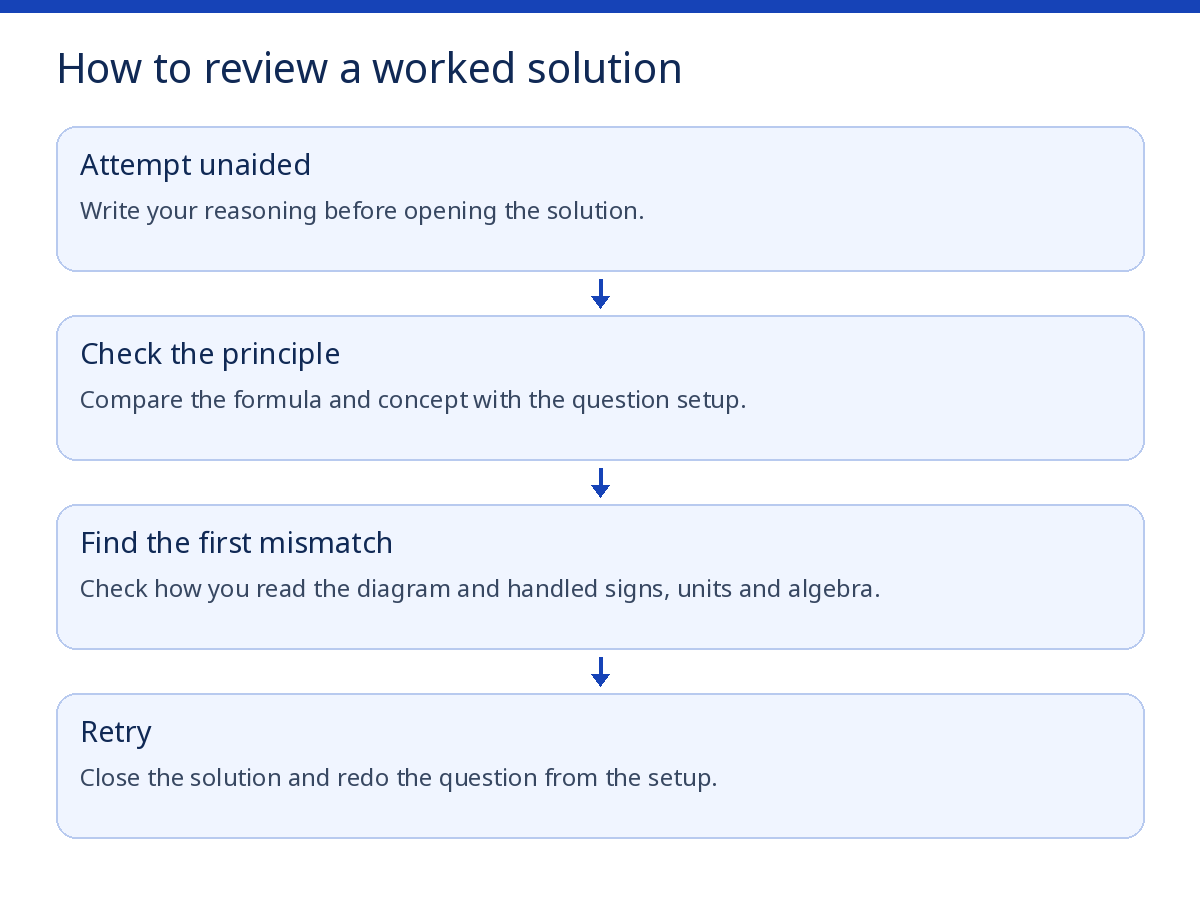
Attempt the question pages before following the file’s question-number links to the worked solutions. The explanations are organised around the formula used, the concept used and the steps. Compare your work at each level: did you choose an applicable relation, interpret the setup correctly and then handle signs, units and algebra consistently? That comparison helps you tell a modelling error from a calculation error.
After a timed attempt, try the internal alternatives you did not choose. The file includes explanations for the printed alternatives, so you can use them for a second round of practice without changing the conditions of your first attempt. Consult the original PDF when a symbol is unclear in the extracted text. This guide omits the rotating-coil calculation because the angular-speed notation is unclear in the transcription, and leaves out the prism passage’s claims about gemstone identification.
Spotted an error? Report a correction. Practise this in the app: notes, formula sheets and mind maps.













































































































































































Loading comments…