Dual Nature of Radiation and Matter: Class 12 NCERT Notes
CBSEPhysicsDual Nature of Matter and Radiation
These CBSE Class 12 Physics revision notes connect photoelectric experiments to Einstein’s equation, then extend the link between momentum and wavelength to matter. Use the graphs and worked examples to distinguish what controls electron emission, what sets photoelectron energy and when each wavelength formula applies.
From wave evidence to electron emission
The notes open with a distinction that runs through the chapter: evidence for the wave character of light does not rule out particle-like transfers of energy and momentum. Maxwell’s theory and Hertz’s electromagnetic-wave experiments establish the wave side of the discussion. The photoelectric effect then raises a different question: how does light transfer enough energy to an electron for it to escape a surface?
An electron can move within a metal without being able to leave it. The work function is the minimum energy needed for escape, and its value depends on the material and the condition of its surface. The notes contrast photoelectric emission, in which suitable light supplies energy, with thermionic emission due to heating, field emission in a strong electric field and secondary emission caused by incoming particles. The distinction is how the electrons are released, not whether the emitted particles are electrons.

Dual Nature of Matter and Radiation | Class 12 | NCERT Notes
In the StudentCurio app
These revision notes cover the experimental basis of the photoelectric effect, Einstein’s equation and related concepts, and matter waves including the de Broglie relation. They help Class 12 students review wave–particle duality and practise related calculations.
Read the photocurrent graph from the apparatus
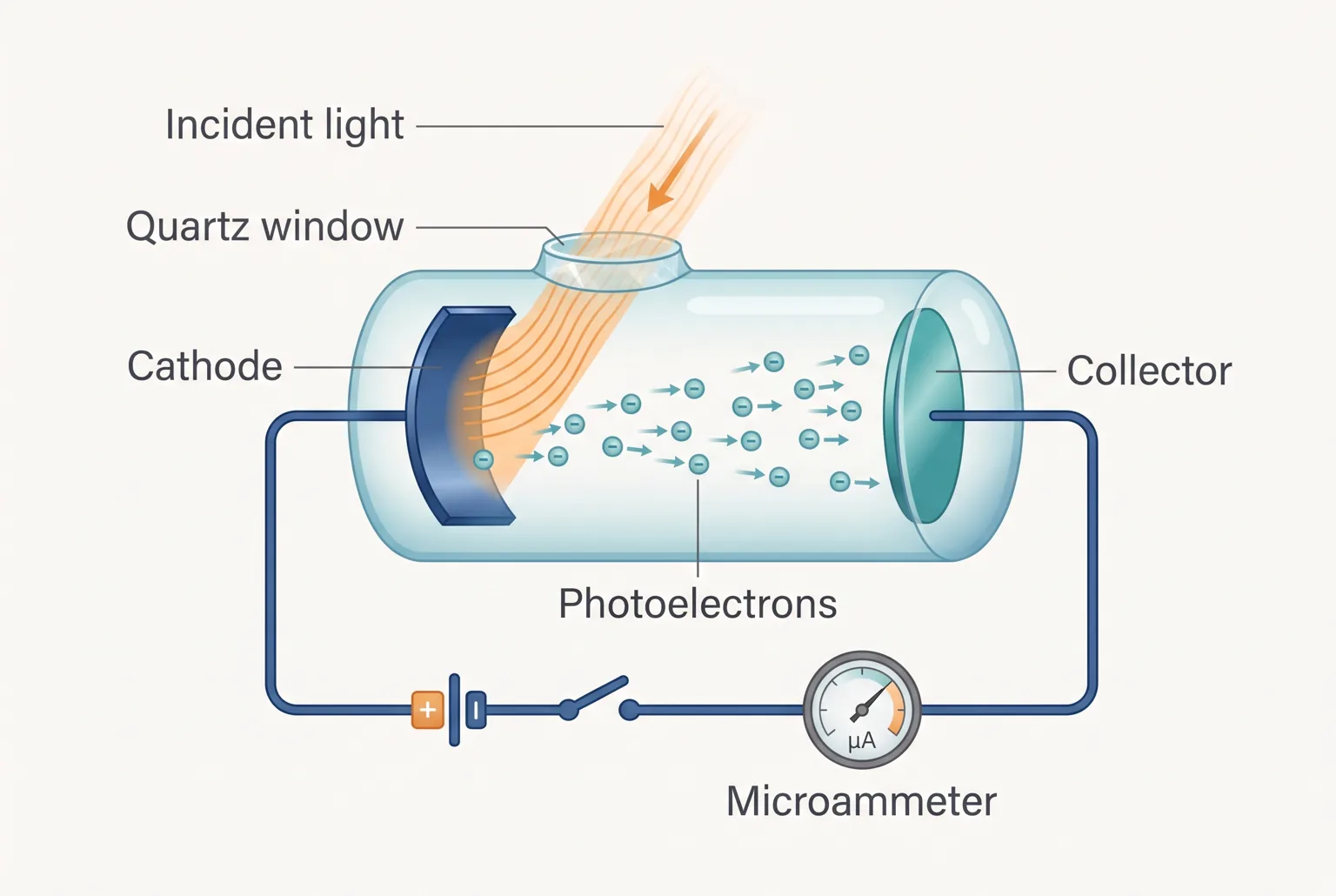
In the evacuated tube shown in the notes, light enters through a quartz window and falls on the photosensitive cathode. A second electrode collects emitted electrons. The microammeter measures the resulting photocurrent, while the reversible bias changes the collector potential relative to the cathode. That arrangement lets the experiment separate the production of photoelectrons from their collection.
At zero bias, some electrons can already reach the collector. A sufficiently positive collector bias collects all the emitted electrons, so the current reaches a plateau called the saturation current. Making the collector negative instead retards the electrons. The current vanishes at a bias of , where is the positive magnitude of the stopping potential. The plateau tells you about the rate of emission; the stopping point tells you about the maximum kinetic energy, .
Common graph mistake: changing two variables at once
For the same surface and a fixed frequency above threshold, increasing light intensity increases the saturation current but does not shift the stopping potential. A brighter beam supplies more photons per second at that frequency, not more energy per photon. Increasing the frequency, by contrast, increases the stopping potential for the same surface. The notes draw some frequency curves with equal saturation levels for illustration; equal optical intensity at different frequencies does not guarantee equal photocurrent, because photon flux and the surface response can change.
These comparisons show where a classical picture of continuous energy absorption fails. Below the threshold frequency, higher intensity does not produce ordinary single-photon emission. Above threshold, emission begins without an appreciable delay even in dim light, rather than waiting for an electron to accumulate enough energy gradually.
When Einstein’s equation describes emission
In Einstein’s single-photon model, an absorbed photon transfers energy to one electron. An electron that escapes at the minimum energy cost carries the largest possible remainder, so . This is a maximum, not the kinetic energy of every emitted electron. The threshold frequency satisfies . Below it, a negative result from the equation does not represent negative kinetic energy; it means ordinary single-photon emission cannot occur. In vacuum, the threshold wavelength is the longest wavelength that can cause emission.
Compare the two straight-line graphs in the notes: maximum kinetic energy against frequency has slope , whereas stopping potential against frequency has slope . The kinetic-energy graph’s vertical intercept, , is an extrapolation, not a measured kinetic energy below threshold.
A useful connection: same wavelength, different energy rules
The notes use the vacuum photon relations and to connect the wave description of light to its energy and momentum. A photon has zero invariant mass; the energy equivalent discussed in the notes is not a rest mass. The photocell provides a practical connection to the earlier experiment: it uses photoemission and collection to convert incident light into an electrical signal.
De Broglie’s relation extends the momentum–wavelength link to material particles. An electron and a photon with the same wavelength therefore have the same momentum magnitude, but their energies must be calculated differently. For the photon, ; for a nonrelativistic electron, . The shared wavelength relation does not make matter waves electromagnetic waves.
Choose the momentum model before using de Broglie’s relation
For a nonrelativistic particle, the notes use when speed is known and when kinetic energy is known. An electron starting from rest and moving through an accelerating potential difference of magnitude gains kinetic energy . Substituting that energy gives in the nonrelativistic limit. Here the voltage supplies kinetic energy; in the photoelectric experiment, the stopping voltage measures how much energy the fastest electrons already have.
The thermal-neutron example starts from temperature instead. It uses the mean translational kinetic energy of a classical gas to find the momentum corresponding to the root-mean-square speed. The resulting wavelength is an estimate at that speed, not an average of the wavelengths of all the particles.
Before you move on: use the clickable index to test your setup
The index separates topic pages from worked examples, so you can revisit a graph or derivation without searching through the file. Try the caesium example before reading its working: identify which part asks for the onset of emission and which requires a nonzero stopping potential. Check that the work function and kinetic energy are in consistent units before combining them.
For matter waves, compare the thermal-neutron and accelerated-electron examples. Before substituting any numbers, explain what gives you the momentum in each case. If you can name the physical assumption behind that step, you are using the notes to check the model, not just to match a formula to a set of quantities.
Spotted an error? Report a correction. Practise this in the app: notes, formula sheets and mind maps.













































































































































































Loading comments…