CBSE Class 12 Physics 2025 Previous Year Paper: Set 55/5/1
CBSEPhysics2025 Previous Year Paper
Paper code: 55/5/1 · 2025Use the complete English-language CBSE Class 12 Physics main examination paper from 2025 to practise a three-hour board exam. Then use the worked solutions to check not just your results, but whether your diagrams, assumptions and equations match the questions.
This set is one of the year's papers. See every set from 2025, grouped by series.
Know the paper before you start
Set 55/5/1 carries 70 marks across 33 questions. Section A has 16 one-mark multiple-choice questions, including assertion–reason items. Section B has five two-mark very short answers, and Section C has seven three-mark short answers. Section D contains two four-mark case studies, while Section E has three five-mark long answers. Calculators are not allowed.
There is no overall choice: you cannot skip a question and substitute another from the same section. Where an internal choice is printed, choose an alternative within that question. These choices appear in some questions outside Section A. Keep the original diagrams and options visible during your attempt; a circuit connection or the orientation of a surface can be as important as the numbers in the question.

Physics 2025 | Class 12 | Previous Year Paper | Code 55/5/1
In the StudentCurio app
The complete 2025 CBSE Class 12 Physics paper, set 55/5/1, with worked solutions across topics including electricity, magnetism, optics, modern physics and semiconductors. Helps students practise the full board exam and review solution methods.
Electricity: read the arrangement before using a formula
The paper moves from capacitor and resistor questions in Section A to dielectric arrangements in Section C and multi-part circuit work in Section E. In a resistor network, identify the nodes first. Components drawn next to each other are not necessarily in series or parallel. Two resistors are in parallel if they connect across the same pair of nodes, so trace the wires and account for any open switch before reducing the network.
For capacitors, the metal-sheet question and the dielectric question involve different physical models. An isolated conductor has no electric field inside it in electrostatic equilibrium; a dielectric polarises rather than acting as an equipotential conductor. For the dielectric diagrams, inspect whether the material occupies part of the gap thickness or part of the plate area. The geometry determines how to model the regions.
A useful connection: torque, current and meter range
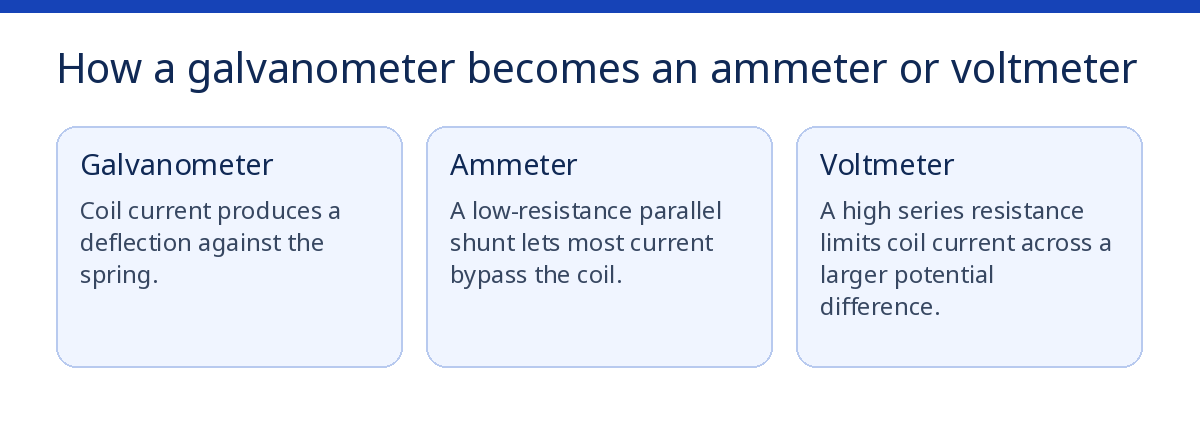
The galvanometer case study links magnetism to an instrument you also encounter in circuit questions. A current-carrying coil experiences a deflecting torque in a magnetic field. At equilibrium, the spring provides an opposing torque of equal magnitude. That balance connects the current through the coil to its angular deflection in the radial-field arrangement described in the passage.
Keep full-scale coil current separate from the range of the converted instrument. An ammeter uses a low-resistance shunt in parallel so that most of the current can bypass the coil. A voltmeter uses a high resistance in series so that a larger potential difference can be measured without exceeding the coil’s full-scale current. When reviewing the case study, use a circuit sketch to explain why the added resistance is connected differently in the two instruments.
Optics: separate ray geometry from wave reasoning
The optics questions call for different representations. At a refracting boundary, mark the local normal before assigning any angles. If a ray grazes a surface, it runs along the surface, so its angle with the normal is a right angle. In an instrument diagram, identify the objective and eyepiece, then check the requested final-image condition. The paper includes telescope and microscope tasks for which that condition matters.
In interference, use path difference to reason about phase and fringe position rather than treating the question as an image-formation problem. The two-wavelength task distinguishes the separation between bright fringes of a specified order from the location where bright fringes from both wavelengths coincide. In the second situation, the two wavelengths need not produce a bright fringe of the same order at the shared position.
Common mix-ups in modern physics and semiconductors
In photoelectric calculations, work function is the minimum energy required to remove an electron from the metal. It is not the maximum kinetic energy of an emitted electron. For one-photon emission, the incident photon must supply at least the work function; above threshold, the excess determines the maximum kinetic energy. Keep that energy accounting separate from questions about photocurrent, which concerns the flow of charge.
For nuclear physics, distinguish total binding energy from binding energy per nucleon: the first applies to the whole nucleus, while the second is an average. In semiconductor diagrams, keep band structure separate from carrier production. The paper asks for band diagrams at absolute zero and then asks how an electron–hole pair forms at room temperature. Those two parts require you to pay attention to the stated temperature.
Use the worked solutions for a second pass
Attempt the paper under the printed time and calculator conditions before opening the linked solutions. The file separates the question paper from the explanations, which are organised around the formula used, the concept used and the steps. On review, locate the first point where your reasoning diverged: did you misread the diagram, choose an inapplicable relation, lose a unit or sign, or stop before justifying the result?
For a long answer, check each requested part separately. A definition, derivation and graph serve different purposes; a correct numerical result does not replace a requested diagram or explanation. Save the unattempted internal alternatives for later practice; the resource includes explanations for those choices too. This guide omits incomplete wording and answer options from isolated items in the text extract, as well as garbled entries in the constants list. Read those details on the original paper pages in the file.
Spotted an error? Report a correction. Practise this in the app: notes, formula sheets and mind maps.













































































































































































Loading comments…