CBSE Class 12 Physics 2024 Previous Year Paper (55/4/2)
CBSEPhysics2024 Previous Year Paper
Paper code: 55/4/2 · 2024Practise the full English-language 2024 CBSE Class 12 Physics main examination, set 55/4/2, under its three-hour, 70-mark format. Then use the worked solutions to check whether your reasoning, not just your final answer, holds up.
This set is one of the year's papers. See every set from 2024, grouped by series.
What this year-wise paper contains
This file brings together one complete board examination paper and its worked solutions. It retains the original English questions, options and diagrams, and the explanations cover the printed internal choices. The question-number index lets you jump to a solution when reviewing a specific item. Since this is a year-wise paper, the topics appear together as they did in the exam rather than in separate chapter exercises.
The paper spans electrostatics, current electricity, magnetism, optics, modern physics and semiconductors. The visible solutions also illustrate alternating current and electromagnetic induction. This mix makes the paper useful for testing whether you can identify the relevant concept from the wording or diagram without a chapter heading to prompt you.

Physics 2024 | Class 12 | Previous Year Paper | Code 55/4/2
In the StudentCurio app
Complete 2024 CBSE Class 12 Physics paper (set 55/4/2) with worked solutions, covering topics across electrostatics, current electricity, magnetism, optics, modern physics and semiconductors. Helps students practise the board examination and review solution methods.
Attempt the paper before opening the solutions
For an exam-style attempt, set aside the stated three hours and work from the question pages. Follow the printed directions on internal choices instead of answering both alternatives during the timed attempt. Where a diagram supplies the geometry or shows a field direction, read it alongside the text before writing an equation. For calculations, leave enough working to show what each quantity represents and how you handled its units or sign.
Afterwards, open the solutions for questions you skipped, guessed or could not justify. The explanations separate the formula used, concept used and steps. Use those labels to locate the first difference between your method and the worked approach. A correct numerical result is not much help in revision if you cannot say why the relation you chose applies.
Common mistakes: Mixing up electrical quantities
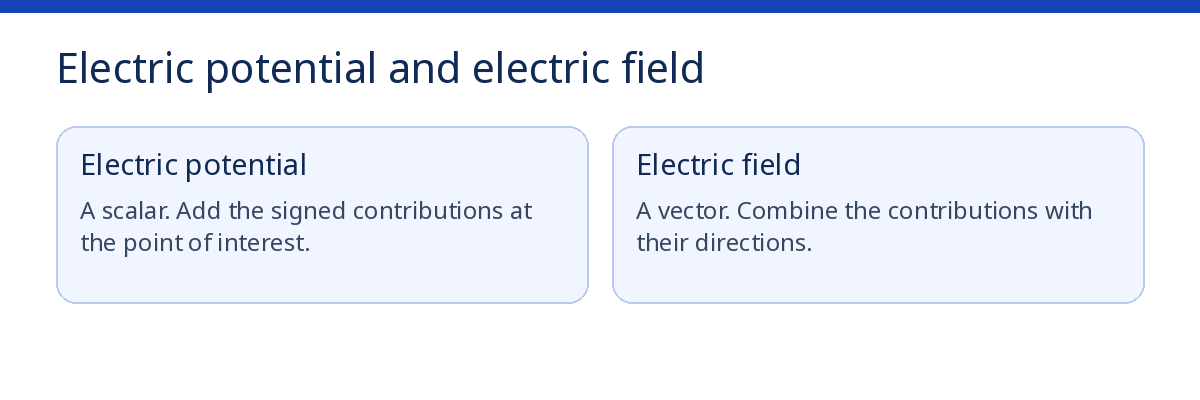
In electrostatics, distinguish potential from electric field before combining contributions. Potential is a scalar: a point charge contributes , with the charge sign retained and measured from that charge to the point of interest. You add the potentials algebraically. Electric field is a vector, so its contributions instead have to be combined with their directions. A neat sketch can help with both tasks, but it does not make the two addition rules interchangeable.
In alternating current, check whether a stated voltage is a peak or an RMS value. For a capacitor of capacitance driven by a sinusoidal voltage of angular frequency , . If the question asks for RMS current, the sinusoidal peak current is divided by . Do not make that conversion again if you have already worked with RMS quantities.
A useful connection: From magnetic field to flux
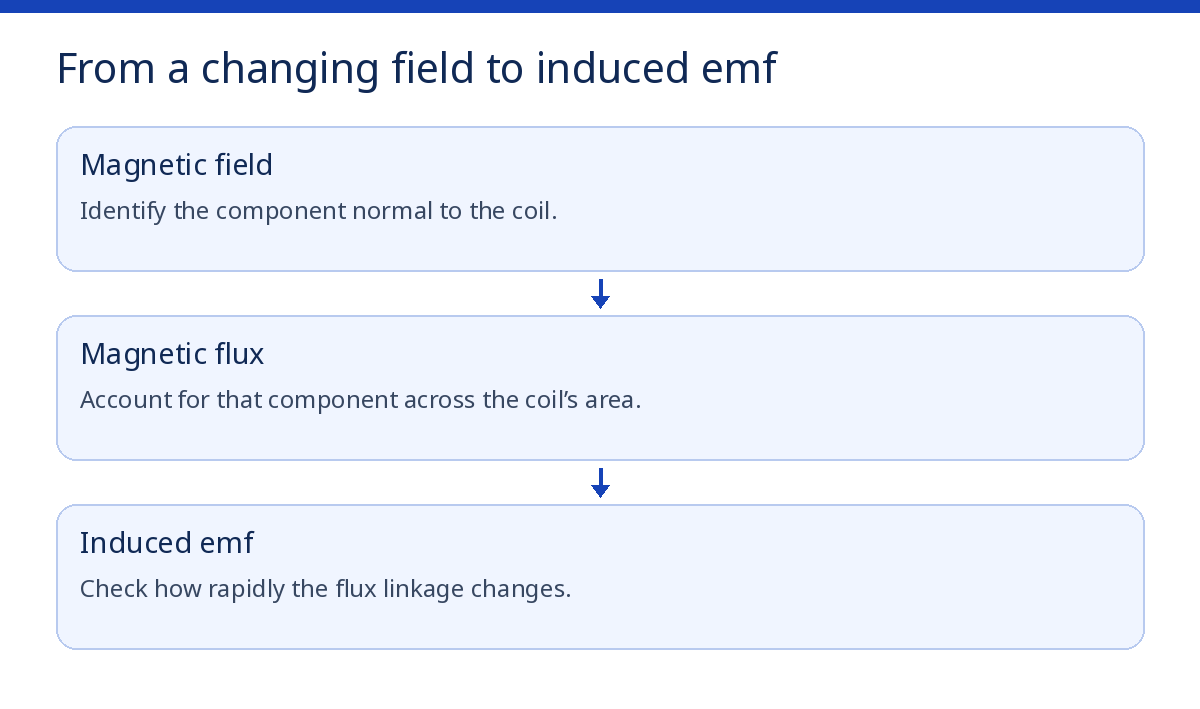
The magnetic field at the centre of a current loop and the magnetic flux through a surface are different quantities. Flux depends on the component of the field normal to the surface across its area. The shortcut works when the field is approximately uniform across the surface and normal to it. If the geometry changes, checking only the centre field can miss the accompanying change in area.
Induction adds a time question: what matters for the magnitude of the induced emf is the rate of change of flux linkage, not the flux value alone. When reviewing a time-dependent field, identify what is changing and what is fixed. In particular, check whether the coil’s area and orientation stay constant before treating the field as the only time-dependent quantity.
Optics: State the sign convention before substituting
The optics material includes refraction at a spherical surface and an astronomical telescope in normal adjustment. In spherical refraction, identify the incident and refracted media in the order light encounters them. Measure the object and image distances from the refracting surface, and assign the sign of the radius using the position of the centre of curvature under the same convention. That setup is what lets you interpret a signed image distance as a location, rather than treating it as an error to erase.
The telescope alternative calls for a different starting point. Normal adjustment means the final image is at infinity. When reviewing the two printed alternatives after the timed attempt, ask what condition fixes the setup in each one. Both belong to ray optics, but they do not call for the same equation.
Quick self-check: Identify what the model holds fixed
Modern physics offers a useful check on formula choice. The de Broglie relation links wavelength directly to momentum. Rewriting it as introduces the non-relativistic relation between momentum and kinetic energy. Before comparing two particles, ask whether the question fixes momentum or kinetic energy. Those are different conditions, and the rewrite is useful only when its assumptions apply.
Try the same check with the discussion of metals and semiconductors. Is the explanation about how often carriers scatter, or about how many carriers are available? The sign of the carriers alone does not account for how resistance changes with temperature. In an assertion–reason item, check not only whether each statement is true but also whether the proposed reason actually explains the assertion.
Review ambiguous items separately
The supplied explanations flag issues involving signed charge order versus magnitude order, the wording of a single-choice photoelectric item, the distinction between galvanometer-coil current and total ammeter current, and the integer restriction in an induction option. This guide omits the disputed option letters and worked conclusions for those items. It also leaves out the isolated claim about the relative intensities of Balmer lines; the guide does not need it to describe the paper’s study value.
If an item admits competing readings, set it aside from straightforward right-or-wrong checks. Note the wording that changes the interpretation, then review the underlying physics separately. That keeps an ambiguous option from obscuring whether you understood the topic.
Spotted an error? Report a correction. Practise this in the app: notes, formula sheets and mind maps.













































































































































































Loading comments…