Moving Charges and Magnetism: Class 12 NCERT Notes
CBSEPhysicsMoving Charges and Magnetism
These CBSE Class 12 Physics notes connect the magnetic fields produced by currents to the forces those fields exert on charges and wires. Use the derivations and worked examples to see how geometry determines which rule or formula applies.
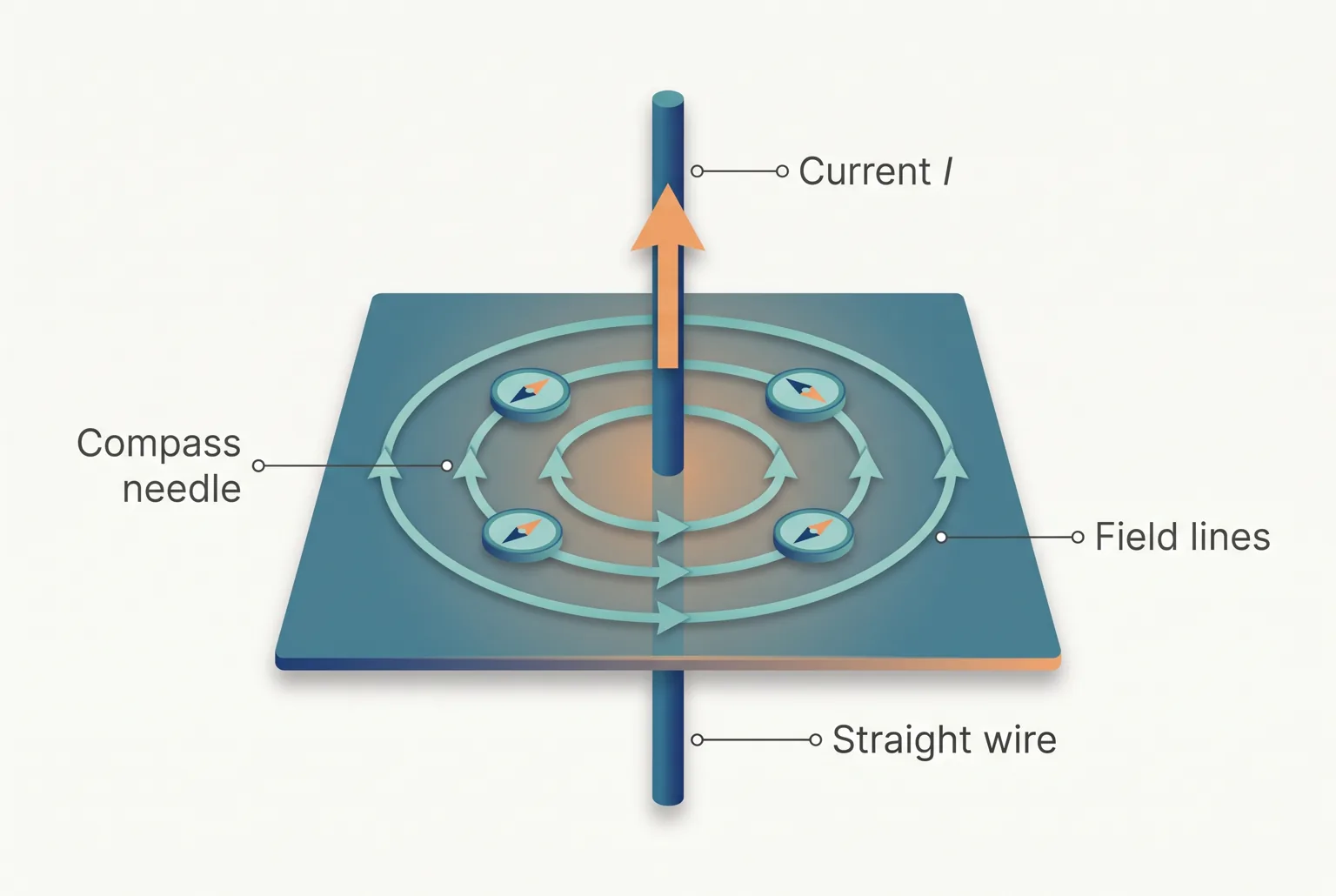
Two questions organise the chapter
The first question is what produces the magnetic field? The notes start with Oersted’s observation that a compass needle deflects near a current-carrying wire. Reversing the current reverses the deflection. Around a straight wire, the field lines form concentric circles, so the field at a point is tangent to a circle centred on the wire, not directed towards or away from it.
The second question is what does the field act on? The notes move from calculating fields to finding forces on moving charges and current-carrying conductors. The clickable index separates topics from worked examples, so you can jump to a derivation when you need to check an assumption or to an example when you need to see how that assumption is used.

Moving Charges and Magnetism | Class 12 | NCERT Notes
In the StudentCurio app
These revision notes cover magnetic fields produced by currents, Biot–Savart and Ampere’s laws, motion and forces on charged particles and current-carrying conductors, current loops, and moving-coil galvanometers. They include key results and worked examples to help Class 12 students revise the chapter.
Biot–Savart law: from one element to a whole wire
The Biot–Savart law gives the field contribution from a small current element. Its magnitude depends on the current, the element’s length, the inverse square of its distance from the observation point, and the sine of the angle between the element and the vector pointing from it to that point. The field is perpendicular to the plane containing those two vectors. At a fixed nonzero distance, the contribution is greatest when they are perpendicular and zero when they are parallel or antiparallel.
The distinction between an element’s field and the total field matters. The inverse-square factor belongs to the element law; it does not give the distance dependence of every conductor. For the complete wire, add the contributions as vectors. The notes’ finite-wire derivation also shows why its end angles, measured from the perpendicular to the wire, matter before taking the infinitely long limit.
A useful connection: symmetry in a circular loop
The circular-loop derivation shows why equal contributions do not always add directly. At a point on the axis, two diametrically opposite current elements produce fields of equal magnitude. Their transverse components cancel, while their axial components reinforce each other. This leaves a field along the axis. The centre is the zero-axial-distance case of the same result, and the field decreases symmetrically on either side.
The worked examples distinguish a centre-field calculation from a comparison between the centre field and the field farther along the axis. In the latter, lengths can remain in centimetres when they occur only in a dimensionless ratio and use the same unit. For direction, curl your right-hand fingers with the loop current: an anticlockwise current as seen from your side gives an axial field towards you.
When Ampere’s law simplifies the calculation
For steady currents in vacuum, Ampere’s circuital law relates the magnetic field integrated along a closed path to the net current through the surface bounded by that path. The current is counted with a sign determined by the direction of traversal. The law holds for any closed path under these conditions, but symmetry is what lets you extract the field from the integral. Around an infinitely long straight wire, for instance, the field is tangent to a centred circular path and has the same magnitude everywhere on it.
For a long air-core solenoid, the interior result applies well away from the ends when the length is much greater than the radius. Here is turns per unit length, not the total turn count. In an ideal air-core toroid, by contrast, the field within the winding region varies inversely with distance from the toroid’s centre; treating it as nearly uniform uses the thin-toroid approximation.
Common mistakes: charge sign and orbital radius
Use the signed charge in the magnetic force vector , but its magnitude in the force magnitude and orbital radius. For a negative charge, reverse the direction given by the velocity–field cross product. A stationary charge, or one moving parallel or antiparallel to the field, has no magnetic force.
Do not use the full speed in the radius formula unless the velocity is entirely perpendicular to the field. With only a uniform magnetic field acting, the perpendicular velocity component produces circular motion and determines the radius; a nonzero parallel component carries the particle along the field, making the path helical. The distance advanced along the field in one turn is the pitch. The magnetic force alone does no work: it can change the direction of motion without changing the speed or kinetic energy.
From force on a wire to galvanometer deflection
The second index page brings together force on a current-carrying wire, force between parallel conductors, and torque on a rectangular loop. Keep force and torque distinct: opposite forces on a loop can cancel as a net force yet still turn it. The current loop’s magnetic moment connects that turning effect to the direction convention introduced in the circular-loop derivation.
For instrument revision, the index points to the relation between current and deflection in a moving-coil galvanometer, then separates current sensitivity from voltage sensitivity. These describe deflection per unit current and per unit voltage, respectively. Compare the two conversion examples by looking first at where the resistance goes: an ammeter uses a low-resistance shunt in parallel with the galvanometer, whereas a voltmeter uses a high resistance in series.
Spotted an error? Report a correction. Practise this in the app: notes, formula sheets and mind maps.













































































































































































Loading comments…