CBSE Class 12 Physics 2026: Solved Previous Year Paper
CBSEPhysics2026 Previous Year Paper
Paper code: 55/5/2 · 2026Practise the full English-language 2026 CBSE Class 12 Physics main examination paper, code 55/5/2. Use the worked solutions to check not only your calculations, but also whether you chose the right principle, interpreted the diagram correctly and explained your reasoning.
This set is one of the year's papers. See every set from 2026, grouped by series.
Know the five-section format before you start
This is a year-wise previous year paper, not a chapter-wise exercise set. The exam lasts three hours, carries 70 marks and contains 33 compulsory questions. There is no overall choice. Where an internal choice is printed, attempt one alternative during your timed sitting; use the other as a fresh question during review. Section A has no internal choices.
Section A contains 16 one-mark multiple-choice questions, including four assertion–reason items. Sections B and C contain five two-mark very short answers and seven three-mark short answers, respectively. Section D contains two four-mark case studies, while Section E contains three five-mark long answers. Keep the printed constants page available and work without a calculator, as the instructions require. In assertion–reason items, check the truth of each statement separately before deciding whether the reason explains the assertion.

Physics 2026 | Class 12 | Previous Year Paper | Code 55/5/2
In the StudentCurio app
A solved CBSE Class 12 Physics paper for the 2026 examination, covering questions and worked solutions across the syllabus, including electrostatics, current electricity, optics, and modern physics. It helps students practise board-exam questions and review solution methods.
Common mistakes: reading the wrong angle or direction
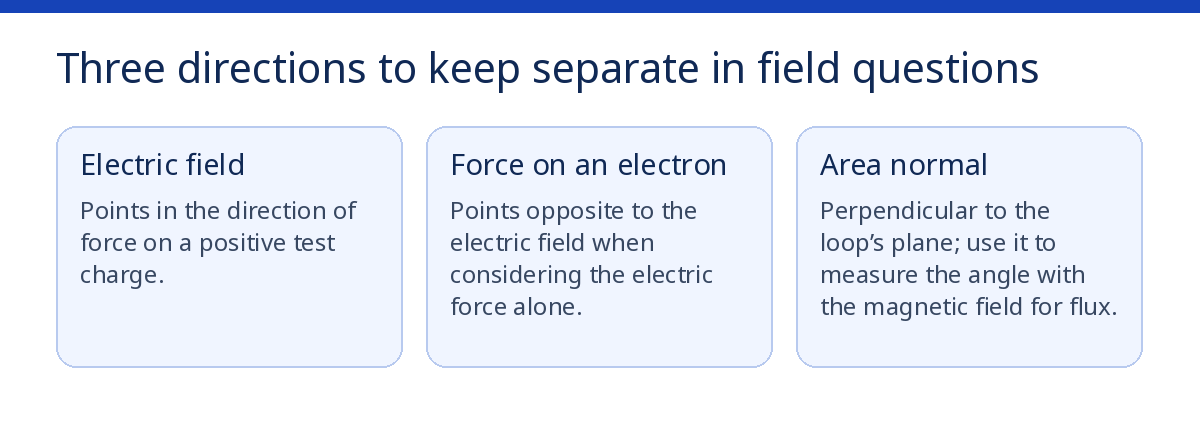
The paper tests direction in several settings: fields due to point charges, electron motion in an electric field and the turning effect on a current loop. Start by identifying what each arrow represents. An electric-field arrow gives the direction of force on a positive test charge; an electron experiences force in the opposite direction. In the parallel-plate case study, keep the electron’s initial velocity separate from the direction of its acceleration.
For magnetic flux through a flat loop in a uniform field, the angle in is measured from the area normal, not from the plane of the loop. Sketch the normal before assigning the angle. Also distinguish flux from its rate of change: a large steady flux does not, by itself, induce an emf. This distinction connects the paper’s flux and induction questions without treating them as the same task.
Circuits: distinguish what the question is asking for
The current electricity questions move between appliance ratings, wire resistivity, the Wheatstone bridge and the connection between conductivity and electron drift. Resistance describes a particular component or sample; resistivity is a material property at a specified temperature. For a uniform wire, connects them through length and cross-sectional area. That distinction helps you identify whether the geometry belongs in the calculation or is part of the quantity you are trying to separate out.
The alternating-current questions require another distinction. Inductive and capacitive reactances vary differently with frequency, while impedance describes the circuit’s overall opposition to alternating current. When reviewing the graph question, check what is on the vertical axis: a signed net reactance can cross zero, whereas an impedance magnitude cannot become negative. Labelling the quantity clearly is part of explaining what the graph means.
Optics: use the diagram to identify the model
Optics appears in short, case-study and long-answer formats. The paper includes refraction at a spherical surface, Young’s double-slit interference, single-slit diffraction and a compound microscope. For the interference case study, read the figure alongside the text: slit separation, screen distance and position on the screen are different lengths with different roles. The standard fringe-width expression uses the small-angle approximation, with the screen far from the slits compared with their separation.
Do not classify a pattern as double-slit interference just because it has bright and dark regions. The long-answer comparison asks you to distinguish superposition from two coherent slits from diffraction due to contributions across a single slit. For ray optics, the diagram serves a different purpose: it shows how rays travel and whether they actually meet or only appear to come from a point.
Modern physics: keep the physical quantities distinct
The paper moves between hydrogen energy levels, nuclear properties, photon momentum, photoemission and semiconductors. In the Bohr model, a negative energy is measured relative to the zero for a separated electron and proton. The signed level energy and the energy needed to remove the electron from that level are therefore not interchangeable. In photoemission, distinguish the energy delivered by one photon, the metal’s work function and the maximum kinetic energy of an emitted electron. Comparing energies in the same unit makes the energy balance easier to check.
Semiconductors appear through both diode bias and carrier concentrations in doped silicon. Bias describes how the applied voltage is oriented across a junction; doping changes the carrier populations in the material. Identifying which of these the question concerns helps you avoid applying a junction explanation to a carrier-concentration calculation.
Quick self-check: can you justify your first step?
After the timed attempt, use the PDF’s question-number links to review selected responses. The worked solutions separate the formula used, the concept used and the explanation in steps. Compare your response in that order: did you recognise the principle, choose a relation that fits the stated conditions and carry it through with consistent units and signs? A correct final result can still hide a missing justification in a derivation or an unlabelled direction in a diagram.
Before opening a solution, ask yourself: Which detail in the wording or figure tells me how to begin? What assumption makes my chosen relation applicable here? If your error was in the setup, redraw the figure or rewrite the opening equation from the question alone. If it was in execution, redo the calculation without looking at the worked steps.
Spotted an error? Report a correction. Practise this in the app: notes, formula sheets and mind maps.













































































































































































Loading comments…