CBSE Class 12 Physics 2026 Supplementary Paper Guide
CBSEPhysics2026 Previous Year Paper
Paper code: 55/7/3 · 2026Use the full 2026 CBSE Class 12 Physics supplementary paper to practise under the printed three-hour limit, then use the worked explanations to review how you chose a model, set up a calculation or drew a diagram.
This set is one of the year's papers. See every set from 2026, grouped by series.
What the 2026 paper contains
This year-wise resource is the English-language CBSE Class 12 Physics Supplementary / Compartment paper, code 55/7/3. The paper carries 70 marks and contains 33 compulsory questions across five sections. There is no overall choice, but some questions in Sections B to E offer an internal choice. Attempt one of the printed alternatives where a choice is given; do not treat the whole question as optional. Calculators are not allowed, and the instruction page supplies physical constants for use where needed.
The file retains the original questions, options and diagrams. Its question-number index provides access to the worked solutions, which are organised around the formula, the underlying concept and the steps of the explanation. The solutions also cover the printed internal choices.

Physics Supplementary 2026 | Class 12 | Previous Year Paper | Code 55/7/3
In the StudentCurio app
Solved CBSE Class 12 Physics supplementary examination paper with worked answers, covering topics including electrostatics, current electricity, magnetic effects, optics, atomic physics, semiconductors, AC resonance and electromagnetic induction. Helps students practise board-exam questions and review solution methods.
What changes from Section A to Section E
Section A has sixteen one-mark multiple-choice questions, including four assertion–reason items. For those items, judge the truth of each statement separately before asking whether the reason explains the assertion. Two true statements need not have the explanatory link the question asks you to identify.
Sections B and C contain five two-mark very short answers and seven three-mark short answers, respectively. Read the verbs carefully: a request to justify a result or draw a labelled diagram calls for more than a number. Section D has two four-mark case studies, on forces in electric and magnetic fields and on the photoelectric effect. Section E has three five-mark long-answer questions. Read all parts of an internal alternative before choosing it: being comfortable with its first part does not mean the remaining parts use the same skill.

Electrostatics and magnetism: separate magnitude from direction
The electrostatics questions move between fields due to charge distributions and the energy of charge arrangements. Start by identifying whether the question asks for a field, a potential or a potential energy. Electric fields add as vectors, so opposing contributions may cancel only after you account for direction. Electric potential adds as a signed scalar. For an arrangement of point charges, count each distinct pair once when finding the mutual electrostatic potential energy; a prescribed external potential contributes separately.
The magnetism questions use straight wires, coils, a current loop and moving charges. Sketch directions before combining magnitudes. For a long straight wire, the distance in the field expression is the perpendicular distance from the wire. A magnetic force on a moving charge also depends on the angle between its velocity and the field, so speed alone does not determine the force.
Common mix-ups: ray diagrams, angles and fringe widths
The paper tests both ray optics and wave optics. In ray optics, the paper includes lenses in contact, separated lenses and a lens–mirror arrangement. Treat these as distinct setups. When optical elements are separated, first locate the image that the initial element would form, then determine how it acts as an object for the next element along the light path. Measure distances from the relevant element and keep the sign convention consistent. At a boundary, the critical-angle condition applies only when light travels from higher to lower refractive index.
In wave optics, distinguish a linear spacing measured on a screen from an angular separation measured from the slit. Single-slit diffraction minima depend on wavelength and slit width. In Young’s double-slit experiment, the usual linear fringe-width expression also involves the screen distance and slit separation under the small-angle approximation. Identify the experiment and the requested quantity before selecting a relation.
When a circuit relation applies
The electrical questions span resistor networks, a cell with internal resistance, diode circuits and series LCR circuits. For a bridge network, check whether the two ends of the bridge branch are at the same potential before treating that branch as carrying no current. For a cell delivering current, distinguish its emf from the terminal potential difference across the external load. In the rectifier question, the labelled circuit and the input and output waveforms are separate parts of the explanation.
For a series LCR circuit, resonance means the inductive and capacitive reactances are equal, so their contributions to the impedance cancel. At resonance, the impedance reduces to the series resistance. When using an AC power relation, check whether the voltage and current are RMS or peak values. The paper also includes an AC generator alternative, where flux and induced emf are distinct: induced emf depends on the rate of change of flux linkage.
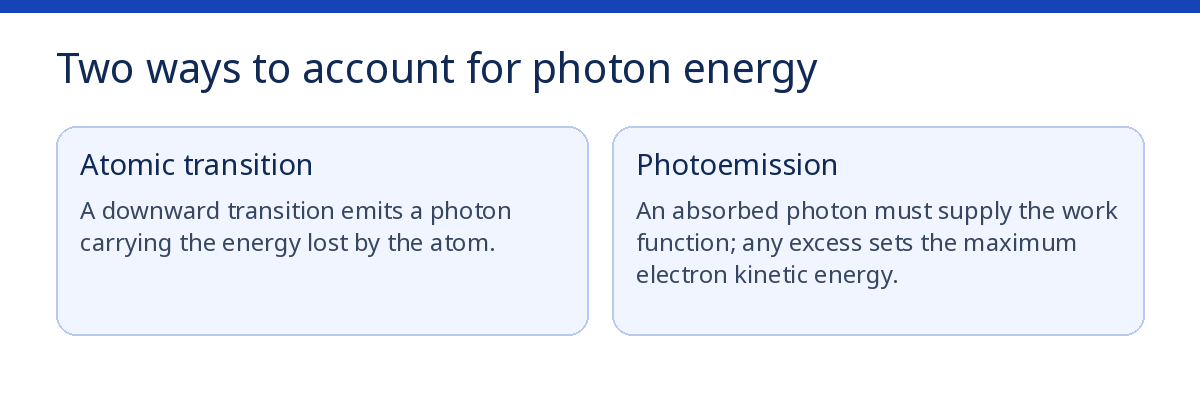
A useful distinction: atomic transitions and photoemission
Atomic physics and the photoelectric effect both use photon energy, but they ask different energy-accounting questions. In a Bohr-model transition, the energy of an emitted photon is the difference between the initial and final atomic energy levels. In photoemission, the incoming photon must supply at least the metal’s work function for emission to occur. Above threshold, the excess determines the maximum kinetic energy of the emitted electrons. The stopping potential measures that maximum energy per unit charge, not the number of electrons emitted.
Before attempting the photoelectric case study, check that you can distinguish the threshold condition from a measurement made after emission occurs. Keep energy units consistent when moving between photon energy in joules, work function in electronvolts and a stopping potential in volts.
Use the worked solutions to locate your first error
For a timed attempt, start with the question pages and leave the linked solutions closed. Afterward, compare your setup with the worked explanation before looking at the final result. Check whether your first difference was the chosen model, a missing diagram label, a vector sign, a unit conversion or the arithmetic. If you took the wrong approach, redo the question from that point rather than copying the calculation. Then try an internal alternative you left unanswered to see whether it calls for a different method.
This guide omits answer selections and worked results for the two magnetic-field subparts on PDF page 11 and the ratio evaluation in Q30(iii) on PDF page 13. It also leaves out the individual worked examples on grazing incidence and electromagnetic-wave direction, where the supplied question text does not establish the stated setup unambiguously.
Spotted an error? Report a correction. Practise this in the app: notes, formula sheets and mind maps.













































































































































































Loading comments…