CBSE Class 12 Physics 2026 Previous Year Paper: Set 55/2/2
CBSEPhysics2026 Previous Year Paper
Paper code: 55/2/2 · 2026Practise the full English-language CBSE Class 12 Physics 2026 main examination paper, set 55/2/2, under its three-hour, 70-mark format. Then use the worked solutions to review how each method connects the question’s conditions to a physical principle.
This set is one of the year's papers. See every set from 2026, grouped by series.
Know the paper before starting the clock
This year-wise file contains the full paper, not a chapter-wise selection. The original English questions, options and diagrams are retained, and the cover provides question-number links for navigating to the worked explanations. For a timed attempt, start with the question paper and leave those links for the review.
There are 33 compulsory questions across five sections. Section A has sixteen one-mark multiple-choice questions, including assertion–reason items. Section B has five two-mark very short answers, and Section C has seven three-mark short answers. Section D contains two four-mark case studies, while Section E has three five-mark long answers. There is no overall choice: choose between alternatives only where the paper prints an internal choice. Section A has none. Calculators are not allowed, and the instructions supply physical constants for use where needed.

Physics 2026 | Class 12 | Previous Year Paper | Code 55/2/2
In the StudentCurio app
Complete CBSE Class 12 Physics 2026 question paper (set 55/2/2) with worked solutions, covering questions across electrostatics, optics, modern physics, magnetism, electromagnetic induction, alternating current and semiconductors. It helps students practise the full board-exam paper and review solution methods.
Connect fields, circuits and induction
The electricity and magnetism questions move between diagrams, calculations and derivations. Electrostatics includes electric field lines and equipotential surfaces for a pair of opposite charges. In current electricity, the Kirchhoff’s rules question asks you to turn a circuit diagram into equations. During review, trace each loop on the printed diagram and check that your signs follow your chosen traversal direction. That makes it easier to distinguish a sign error from an error in the circuit model.
Magnetism and induction cover fields due to currents, mutual inductance and an AC generator. The series LCR alternative uses a phasor diagram to connect impedance with the phase difference between voltage and current. When reviewing that derivation, check which voltages are represented by phasors before comparing the algebra. Their relative phases matter; adding the voltage magnitudes as ordinary scalars does not represent the circuit correctly.
Common mix-ups in optics and modern physics
In ray optics, start with the geometry: locate the object, optical element and image or screen before assigning signed distances. The paper includes a mirror problem in which the object extends along the principal axis, so its two ends do not share a single object distance. In wave optics, keep path difference and phase difference distinct. Young’s double-slit questions use those ideas to connect a position on the screen with the superposition of waves.
In modern physics, avoid carrying a condition from one comparison into another. The de Broglie question separately considers particles with the same kinetic energy and particles accelerated through the same potential difference. Those are different starting conditions, so identify how momentum is determined before comparing wavelengths. Likewise, in a Bohr-model transition, distinguish the energy of an individual level from the energy difference involved in the transition.
Read the case studies as setups, not formula lists
The first case study describes a convex lens moving between a fixed object and screen. Sketch the arrangement before reading the subparts. Mark the object-to-screen distance separately from the distance between the two lens positions: both are lengths, but they describe different features of the setup. A labelled sketch gives you a reference when a subpart changes what is given or what must be found.
The second case study concerns a p–n junction diode. Its passage distinguishes diffusion associated with majority carriers from drift associated with the barrier electric field. It also distinguishes an unbiased junction from one connected to a biasing battery. Before using a statement from the passage, check which junction condition the subpart specifies. This matters because a statement about equilibrium does not automatically carry over to a biased junction.
Review the method before checking the result
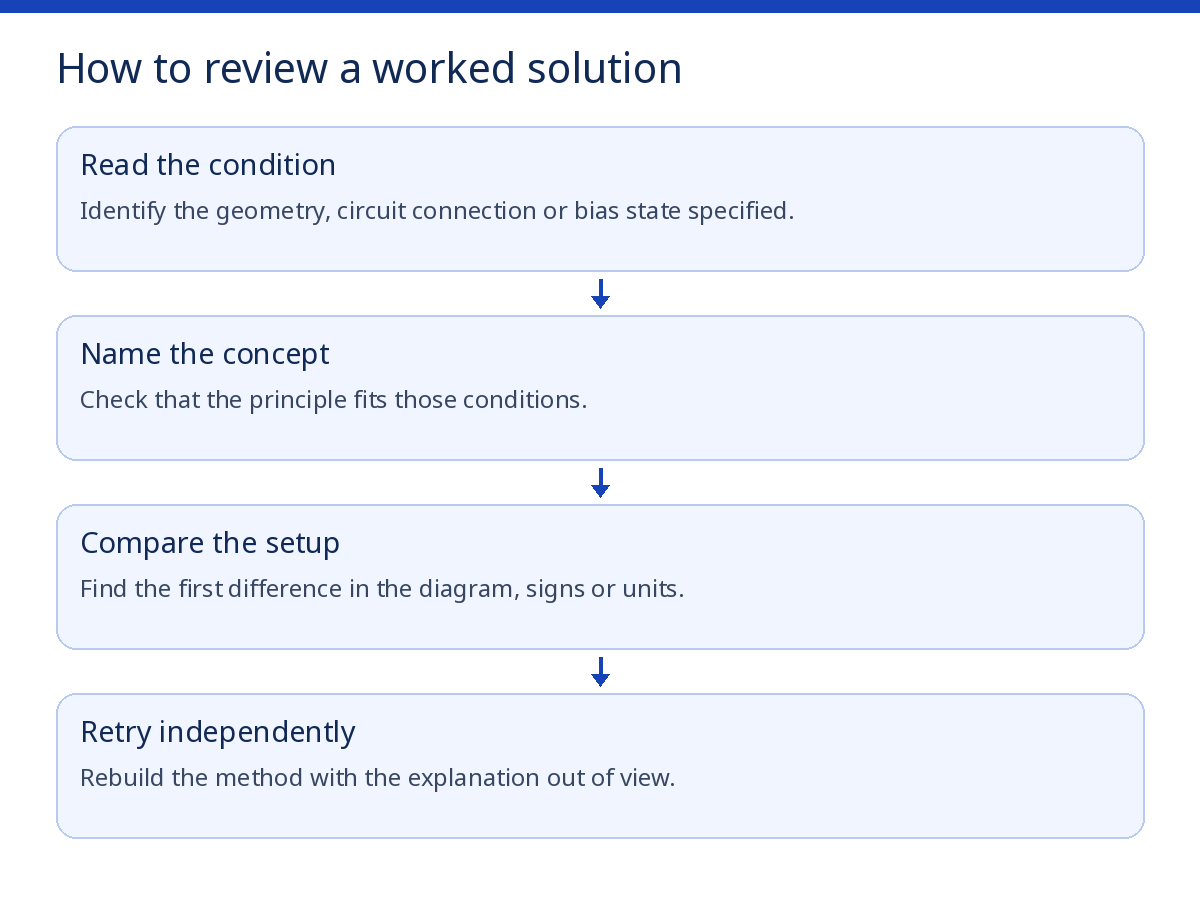
The worked explanations distinguish formula used, concept used and explanation in steps. Start with the concept rather than the final line. If you chose the same principle but reached a different result, compare your setup and intermediate steps for a mismatch in signs, units or assumptions. If you chose a different principle, return to the prompt and identify the condition that makes one method appropriate.
The resource also includes explanations for the printed internal choices. In your timed attempt, answer only the branch you select; afterwards, use the other branch as a separate practice task. For example, the long-answer optics choice lets you move from interference to a telescope ray diagram without treating them as the same skill. This guide omits answer options, numerical worked results and the ambiguous wording of the lens-position subpart.
Quick self-check before a second attempt
For an assertion–reason item, can you assess each statement independently before deciding whether the reason explains the assertion? For a derivation, can you name the assumption or geometrical relationship that lets you move from one line to the next? For a diagram-based question, can you point to the feature that fixes a direction, distance or sign?
Use the first step you cannot explain to choose what to retry. If it is the setup, redraw the circuit or optical arrangement from the original question. If it is a condition, state it in words before writing an equation. Then reattempt the item without the worked steps in view. The useful test is whether you can reconstruct the method, not whether you recognise the result.
Spotted an error? Report a correction. Practise this in the app: notes, formula sheets and mind maps.













































































































































































Loading comments…