CBSE Class 12 Physics 2023 Previous Year Paper
CBSEPhysics2023 Previous Year Paper
Paper code: 55/4/1 · 2023Practise the full 2023 CBSE Class 12 Physics main examination paper (55/4/1), then use the worked explanations to check how you chose a principle, read a diagram or justified a result.
This set is one of the year's papers. See every set from 2023, grouped by series.
What this 2023 paper contains
This year-wise resource contains the English version of the 2023 CBSE Class 12 Physics main examination paper. The file retains the questions, options and diagrams, and provides step-by-step worked solutions, including explanations for the printed internal choices. The cover has a question-number index so you can move to an explanation after attempting the corresponding question.
The paper allows three hours, carries 70 marks and does not permit calculators. It is a full board paper, not a chapter-wise worksheet: a single sitting takes you from short selections to calculations, derivations, diagrams and case-based reasoning. Use the question pages for the timed attempt and leave the worked explanations for a separate review.

Physics 2023 | Class 12 | Previous Year Paper | Code 55/4/1
In the StudentCurio app
Complete CBSE Class 12 Physics examination paper for 2023 with step-by-step solutions, including questions across multiple chapters and a lens-power problem on refraction. Helps students practise the board-paper format and review solution methods.
How the 35 questions are organised
Section A has 18 one-mark questions, including assertion–reason items at the end. Section B has seven two-mark very short answers, Section C has five three-mark short answers, and Section D has three five-mark long answers. Section E has two four-mark case-based questions, one on electrostatics and the other on lenses.
The instructions make all 35 questions compulsory and give no overall choice. Internal choices appear in two questions in Section B, two in Section C, all three in Section D and both in Section E. An internal choice lets you select a printed alternative at that point; it does not let you drop the question. In a timed attempt, answer one alternative where offered. Save the other for revision so it does not distort your timing.
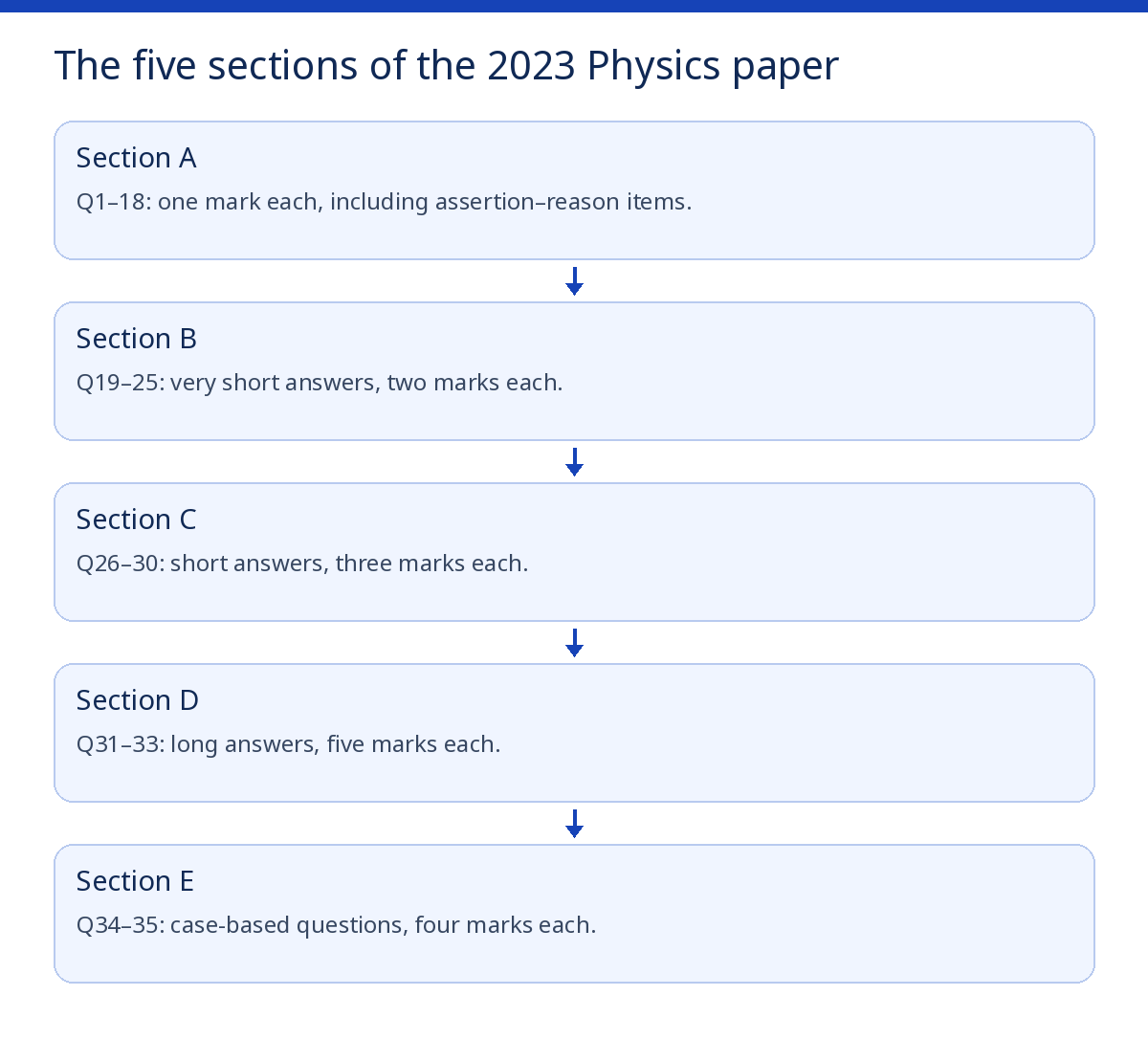
What changes as you move through the paper
The shorter questions sample topics such as magnetic fields, electromagnetic waves, the photoelectric effect, atomic and nuclear physics, and semiconductor devices. Section A is not just a recall exercise: some questions require reading a graph or circuit, while assertion–reason items ask you to judge not only the statements but also whether one explains the other.
The written sections make more of your reasoning visible. In magnetism, for instance, the paper moves between a setup with two current loops and a graph involving induced emf in solenoids. In optics, it asks for both diagram-based explanations and calculations. Read the instruction verb in each subpart: a definition, a derivation and a justification are different tasks, even when they share the same topic.
Common mix-ups in circuits and graphs
Keep emf and terminal potential difference distinct. A cell’s emf is the energy it supplies per unit charge; the terminal potential difference is measured across its terminals. In the simple cell model with internal resistance, the terminal voltage is below the emf when the cell delivers current. That condition matters: a measured terminal voltage is not automatically the emf.
In AC circuits, do not treat voltage magnitudes as signed instantaneous values. For a sinusoidal series circuit, individual voltage drops may be out of phase, so their magnitudes are combined using phasors rather than simply added. When reviewing a graph, read both axes before interpreting its slope. An induced-emf graph against rate of change of current is not an emf-versus-time graph.
When a lens formula applies
The lens case study links focal length to surface curvature and to the refractive indices of the lens material and its surroundings. The key distinction is between changing the lens itself and changing the medium around it. Immersion leaves the surface curvatures unchanged, but the refractive index of the lens relative to the surrounding medium can change. At a specified wavelength, use that relative index when applying the thin-lens maker’s formula in a uniform surrounding medium.
Lens power is the reciprocal of the signed focal length in metres, , with power expressed in dioptres. Before comparing powers, check that you are using the focal length for the stated medium and that your sign convention is consistent. This is a separate check from converting centimetres to metres.
Quick self-check for case-based questions
In the electrostatics case, the subparts shift between an electric-field graph, a potential graph and dipole reasoning. Keep the quantities separate: a graph of field magnitude does not show field direction, and an electric potential graph does not directly show the potential energy of a dipole. If the task concerns dipole orientation, identify the angle between the dipole moment and the field rather than its angle to an arbitrary axis on the page.
Before opening the explanation, ask yourself: Could I name the quantity on each axis, including what is held fixed? For a diagram-based subpart, check whether your sketch shows the directions or reference points your reasoning depends on.
Use the worked pages to diagnose mistakes
The worked pages separate the formula used, concept used and explanation in steps. Compare your setup before checking the final line. If your calculation went wrong, find the first place where your work diverged: did you select the wrong principle, misread a diagram, lose a sign or substitute a value in the wrong unit? For a written answer, check whether your explanation connects the principle to the actual conditions in the question instead of merely naming it.
Try the unused internal choices later, especially where the two branches call for different skills. This guide leaves out the individual MCQs with ambiguous electrostatics or nuclear-force wording, the mirror-wavefront wording and the unrealistic nuclear mass-defect example. For missing symbols or units in extracted text, consult the printed PDF page rather than guessing.
Spotted an error? Report a correction. Practise this in the app: notes, formula sheets and mind maps.













































































































































































Loading comments…