Magnetism and Matter: Class 12 Physics NCERT Solutions
CBSEPhysicsMagnetism and Matter
This CBSE Class 12 Physics solutions file follows Chapter 5 of NCERT, from Earth’s magnetic field to the torque on dipoles and the fields of short bar magnets. Use the worked steps to check your choice of angle, field direction and formula before comparing numerical results.
How to use the Chapter 5 solutions file
The exercise index runs from 5.1 to 5.15, with links from questions to worked solutions and back. The early exercises concern Earth’s magnetism. The middle group moves from a bar magnet in an external field to current-carrying solenoids and a rotating coil. The later exercises return to Earth’s field, first to describe its components and then to combine it with the field of a bar magnet.
Use the index to revisit a specific decision in your attempt. If your calculation disagrees with the worked result, compare your sketch and first equation before checking the arithmetic. In this chapter, a correct magnitude can still be paired with the wrong direction.

Magnetism and Matter | Class 12 | NCERT Solutions
In the StudentCurio app
Worked NCERT solutions cover magnetic dipoles, bar-magnet fields, torque and magnetic moment, along with Earth’s magnetic field and related calculations. They help Class 12 students practise applying magnetism concepts step by step.
Read Earth’s magnetic field in two views
Declination, inclination and the horizontal field magnitude describe different features of the local field. Declination is the bearing of its horizontal component relative to geographic north. Inclination, also called dip, is the angle the full field makes with the horizontal. The file’s plan and side views help separate the compass bearing from the upward or downward tilt seen in the vertical magnetic meridian.
The horizontal component is , where is the inclination and is the total field magnitude. Recovering by division requires . With downward inclination taken as positive, an upward tilt has a negative inclination. The cosine does not distinguish between equal upward and downward tilts, so the sign or a stated direction must accompany the magnitude.
What the centred-dipole model leaves out
The worked material uses a dipole at Earth’s centre to estimate the surface field and compare its order of magnitude with observations. Read this as a test of the model’s scale, not as a claim that it predicts the field at every location. The file distinguishes the poles of the fitted dipole from the real dip poles, where the local field is vertical. It also discusses how magnetised mineral deposits can add local anomalies to the main field.
The chapter’s curiosity exercise asks a different kind of question: how the field is generated, how it changes, and what rocks can reveal about its past. Its textbook note flags that some answers are tentative or unknown. That makes this exercise useful for distinguishing a calculation from a physical explanation.
Common mistake: treating torque and work as interchangeable
For a magnetic dipole in a uniform external field, the torque magnitude is , where is the angle between the magnetic moment and the field. The potential energy is . Read the torque and energy graphs together: the torque depends on the dipole’s current orientation, whereas the energy curve shows how its energy changes as it turns.
Zero torque alone does not establish stability. Check whether a small displacement raises or lowers the potential energy: a minimum is stable and a maximum is unstable for the rotation considered here. When an external torque turns the dipole slowly with negligible change in kinetic energy, the external work equals the change in potential energy. It is not the magnetic torque at the final angle. Keep their units distinct in your reasoning: torque is expressed in newton metres and work in joules.
From solenoid current to coil oscillations
For a coil of turns, each enclosing area and carrying current , the moment magnitude is . The solenoid diagram connects this moment to the current direction and the poles: the moment lies along the axis from the south end to the north end. For a flat coil, measure the angle to the normal to its plane, not to the plane itself. The uniform-field exercise also separates force from torque: a coil can have zero net magnetic force and still tend to rotate.
The oscillation problem adds a condition the static torque problems do not need. Near stable equilibrium, the restoring torque is approximately proportional to angular displacement because for small measured in radians. The resulting frequency relation is a small-oscillation result, not a rule for an arbitrary release angle.
When the short-magnet field formulas apply
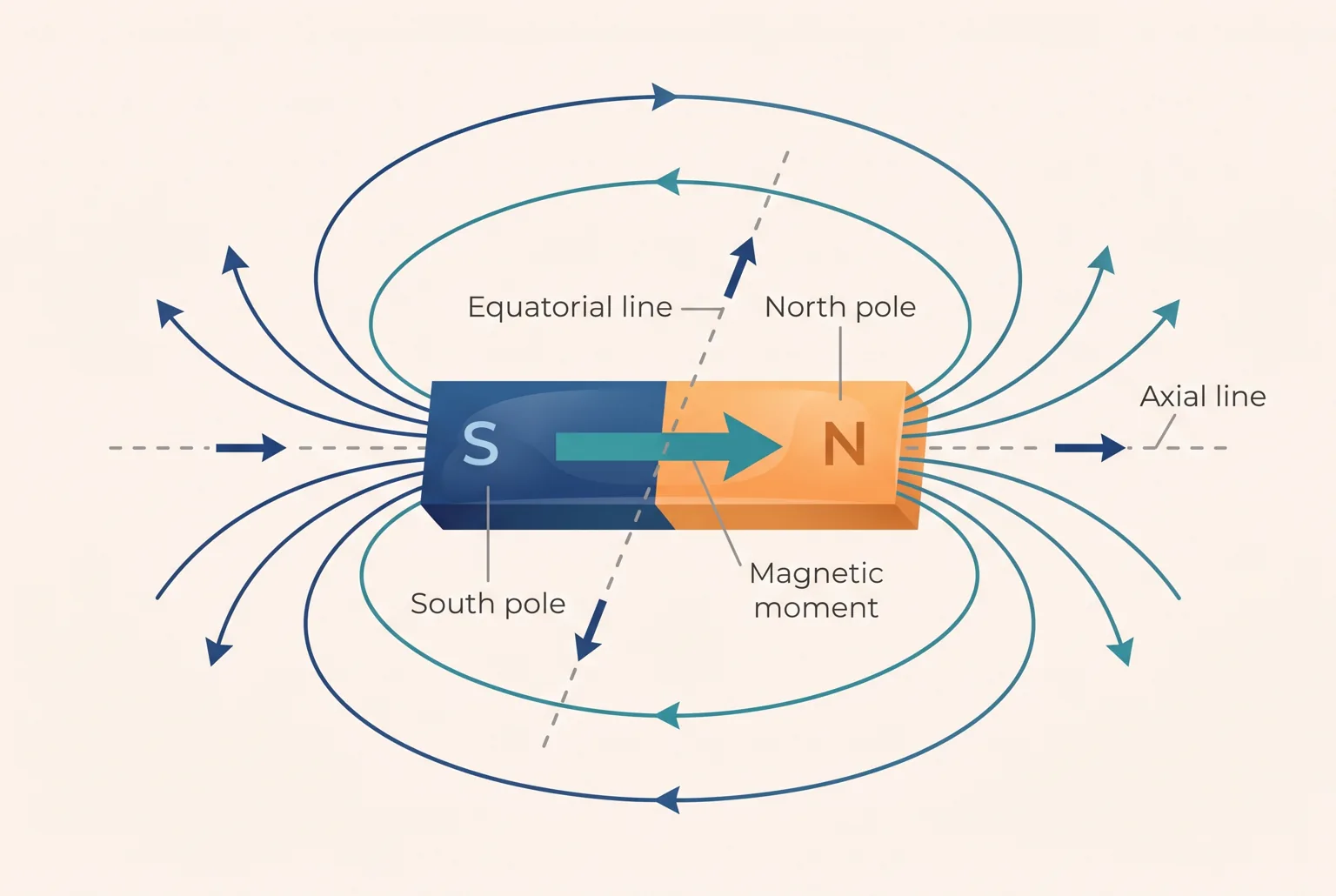
The axial line runs along the magnet; the equatorial line is its perpendicular bisector. The dipole formulas used in the file apply when the distance from the centre is large compared with the magnet’s length. Both field magnitudes vary as , with measured from the centre. Their coefficients differ, so compare axial and equatorial magnitudes at the same distance before reasoning about how a change in distance affects the field.
The direction must be handled separately from the magnitude. In this model, the axial field is parallel to the magnetic moment on either side of the magnet, while the equatorial field is antiparallel. Draw the relevant arrow before inserting values into a magnitude formula, and convert gauss to tesla when using the SI value of the permeability.
Quick self-check: can your field sketch justify the equation?
The final exercises combine the magnet’s field with Earth’s field. Before consulting the solutions, sketch each contribution at the point of interest. A null point requires equal magnitudes and opposite directions; equality of magnitudes alone does not imply cancellation. When the fields are perpendicular, their resultant must instead be found by vector addition.
Ask yourself which arrow stays fixed when the magnet turns, and which one you must redraw. Then check whether your equation matches the geometry you drew. This is a useful way to catch a sign or direction error before taking a cube root or converting the final distance.
Spotted an error? Report a correction. Practise this in the app: notes, formula sheets and mind maps.













































































































































































Loading comments…