CBSE Class 12 Physics 2024 Solved Paper: Set 55/5/2
CBSEPhysics2024 Previous Year Paper
Paper code: 55/5/2 · 2024Practise the full English version of the 2024 CBSE Class 12 Physics main examination, set 55/5/2. Use the three-hour paper for a timed attempt, then review the worked explanations to see which principles apply and where their assumptions matter.
This set is one of the year's papers. See every set from 2024, grouped by series.
What this year-wise paper contains
This is a full CBSE Class 12 Physics previous year paper, organised by examination year rather than by chapter. The 2024 main examination paper carries 70 marks and has a printed duration of 3 hours. The file retains the original English questions, options and diagrams, and its worked explanations cover the printed internal choices.
The year-wise format lets you practise recognising the relevant topic without a chapter heading to cue the method. The same paper brings together areas such as electrostatics, magnetism, electromagnetic induction, alternating current, optics, semiconductors and nuclear physics. The question-number links let you move between an attempted question and its explanation, so you can review one decision without reading ahead to the next answer.

Physics 2024 | Class 12 | Previous Year Paper | Code 55/5/2
In the StudentCurio app
A complete solved CBSE Class 12 Physics paper for 2024, set 55/5/2, with questions spanning topics including optics, electrostatics, magnetism, electromagnetic induction, AC circuits, semiconductors and nuclear physics. It helps students practise the board-paper format and review worked solutions.
Use the internal choices in two different ways
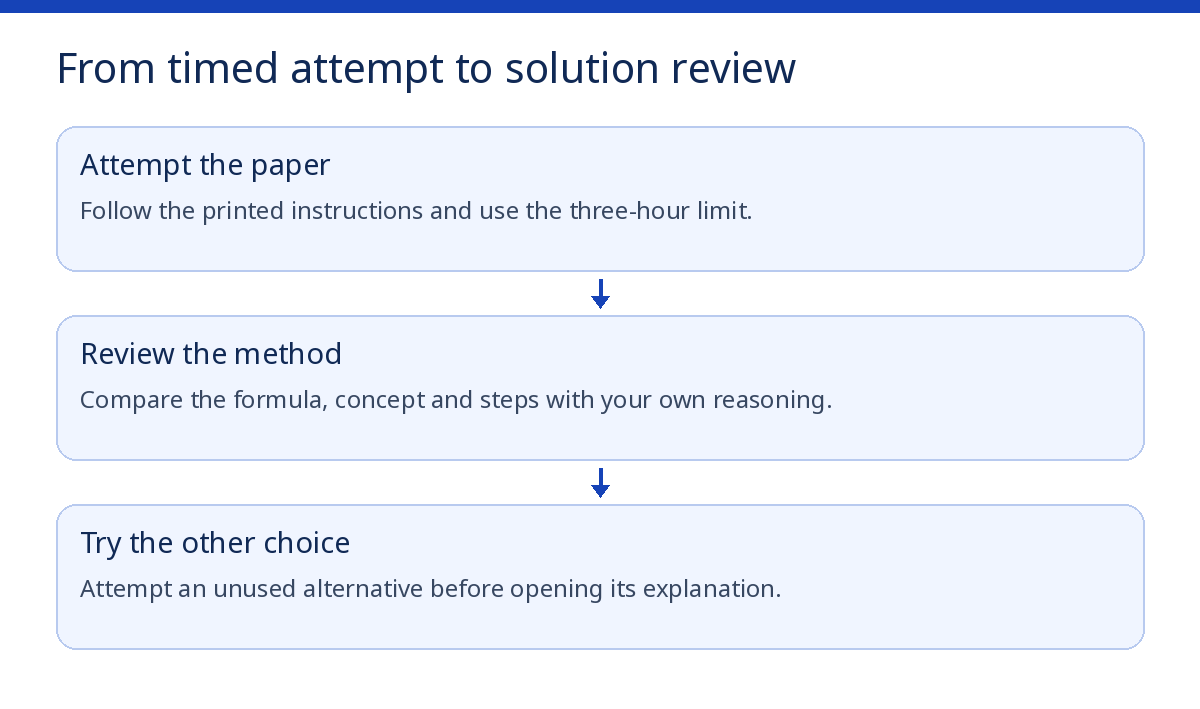
For a timed attempt, follow the printed instructions and answer only the required alternative where an internal choice is offered. Decide from the whole prompt, not just the topic name: a familiar chapter may still ask for a diagram, a justification or a derivation you are less ready to give. Save the unattempted alternative for review rather than counting it as part of the timed sitting.
Afterwards, use that alternative as a separate practice question. Internal choices can give you two ways to examine a principle. In electrostatics, for instance, different charge arrangements can call for the same vector-superposition method without having the same geometry. When comparing your reasoning with the explanations, identify which contributions you grouped together and what features of the diagram justified that grouping.
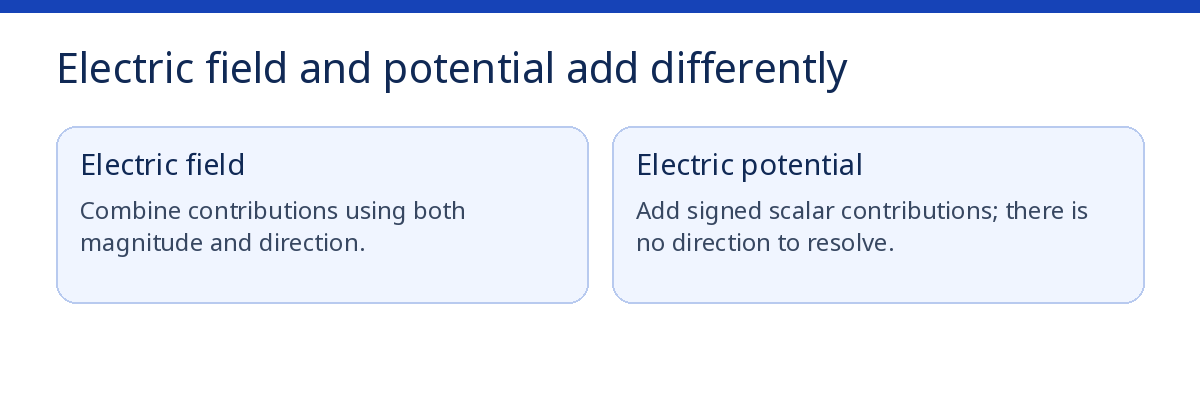
Common mix-up: electric field and potential
Electric potential adds algebraically, with the sign of each charge included. Electric field adds as a vector, with each contribution assigned a direction before the sum is taken. The distinction matters if you spot symmetry in a diagram: a cancellation in the potential calculation does not establish a cancellation in the field calculation.
When reviewing an electrostatics question, mark the observation point and ask what the geometry makes equal. Equal distances can give field contributions of equal magnitude for charges of equal magnitude, but cancellation also requires the appropriate directions. If the question asks for force rather than field, find the net field due to the source charges first, then use . The sign of the test charge matters when converting field direction to force direction.
Distinguish magnetic force, torque and work
The paper gives you a reason to distinguish several effects that are easily grouped together under magnetism. For a moving point charge, the magnetic part of the Lorentz force is perpendicular to its instantaneous velocity and therefore does no work. That statement concerns the magnetic force alone; it does not rule out work by another force. For a magnetic dipole, torque concerns orientation, whereas a net force can arise when the magnetic field varies across its position. Alignment and translation are different effects.
For a current-carrying conductor in a uniform magnetic field, the net force can be written as , with directed from the start to the end of the segment along the conventional current. For a bent segment, use that endpoint displacement, not the total length measured along the wire. Do not take the field outside the segment-by-segment sum if it varies along the wire.
When the induction and AC rules apply
In electromagnetic induction, start with the rate of change of magnetic flux, not simply the value of the magnetic field. For one fixed loop in a spatially uniform field perpendicular to its plane, the emf magnitude reduces to . The shortcut assumes the area and orientation remain fixed; if either changes, return to the flux relation. Also distinguish a request for magnitude from one that needs an induced direction.
For AC, identify the circuit element before using a phase rule. An ideal inductor in sinusoidal steady state has current lagging its voltage by a quarter-cycle. That is not a rule for the current relative to the supply voltage of every circuit containing an inductor. This guide leaves out the instrument-reading item because its interpretation depends on whether the series resistance is idealised as zero.
Quick self-check: name what stays fixed in optics
Before comparing fringe widths, ask: Am I holding the slit separation and screen distance fixed, or changing the geometry? In the usual Young’s double-slit approximation, , where is the slit-to-screen distance and is the finite slit separation. If the arrangement is immersed while its geometry stays fixed, it is the wavelength in the medium that belongs in the expression. A change in slit separation is a different comparison.
For the compound microscope, check the final-image condition before selecting a magnification expression. A relaxed eye corresponds to the final image at infinity, and the paper’s explanation uses the standard tube-length approximation for that case. Keep the magnitude of magnification distinct from its sign: the magnitude gives the factor, while a negative sign indicates inversion.
Read the worked solutions for the decision you missed
The worked explanations separate the formula used, the concept used and the steps. Review them in that order when your method differs from the printed one: check whether the relation fits the model, whether you can explain why it fits, and only then trace the algebra or substitution. For a graph-based photoelectric question, for example, identify what the threshold-frequency intercept means before comparing stopping potentials. Such a comparison applies where photoemission occurs for the metals being compared.
For assertion–reason items, judge the truth of each statement separately before deciding whether the reason explains the assertion. After checking an explanation, return to the original prompt and state the deciding condition in your own words. That tells you whether you can recognise the principle again without the formula label as a cue.
Spotted an error? Report a correction. Practise this in the app: notes, formula sheets and mind maps.













































































































































































Loading comments…