CBSE Class 12 Physics 2026 Previous Year Paper Guide
CBSEPhysics2026 Previous Year Paper
Paper code: 55/5/1 · 2026Use the full 2026 CBSE Class 12 Physics main examination paper (55/5/1) for a three-hour board practice session. Then use the worked solutions to check whether your choice of law, diagrams and calculations fit the conditions in each question.
This set is one of the year's papers. See every set from 2026, grouped by series.
Set up a three-hour practice attempt
This English-language paper carries 70 marks and contains 33 questions across five sections. Section A has sixteen one-mark multiple-choice questions, including four assertion–reason items. Section B has five two-mark very short answers, and Section C has seven three-mark short answers. Section D contains two four-mark case studies, while Section E has three five-mark long-answer questions. The PDF retains the original questions, options and diagrams and provides question-number links to the worked solutions.
There is no overall choice: attempt every question number, selecting one branch wherever an internal choice is offered. Such choices appear in some questions outside Section A. To match the printed conditions, keep the solutions closed, work without a calculator and use the constants provided in the paper where needed.

Physics 2026 | Class 12 | Previous Year Paper | Code 55/5/1
In the StudentCurio app
A complete CBSE Class 12 Physics examination paper with questions and worked solutions across topics including electricity, magnetism, optics, nuclear physics and electronic devices. Useful for board-exam practice and reviewing solution methods.
Electricity: separate material properties from circuit quantities
The electricity questions range from resistance, resistivity and electrical heating to capacitor combinations, the Wheatstone bridge and the link between conductivity and electron drift. For a uniform wire, resistance depends on length and cross-sectional area as well as resistivity. In a heating calculation, distinguish the voltage used to specify the appliance’s rating from the voltage actually applied. They describe different operating conditions, so the rated power should not automatically be used as the power at the new voltage.
The electrostatics case study connects electric potential and field to the motion of a charged particle. Potential is a scalar, while electric field and acceleration have directions. When reviewing, check which conclusions come from the arrangement of the plates and which also depend on the sign of the particle’s charge. A magnitude alone cannot establish the direction of motion or deflection.
Magnetism and AC: read the geometry and the time interval
The paper asks about magnetic fields due to currents, induction in a rotating coil, mutual inductance and magnetic forces and torque. Before using a diagram, label the current direction, the field direction and, where relevant, the normal to the coil. For magnetic flux through a flat loop in a uniform field, the angle in is measured from the normal, not from the plane. In a rotating-coil plot, the starting orientation fixes the initial phase. Check the induced emf against the rate at which flux changes, rather than making both curves follow the same shape at the same phase.
Average is not rms: An average uses signed values over the stated interval; rms takes the square root of the mean of the squared values over that interval. Check whether the question specifies a full cycle before using a familiar result. The paper also treats electromagnetic waves and displacement current: distinguish reading the spatial and time dependence of a travelling wave from tracking changing electric flux during capacitor charging.
Optics: choose the model before choosing the formula
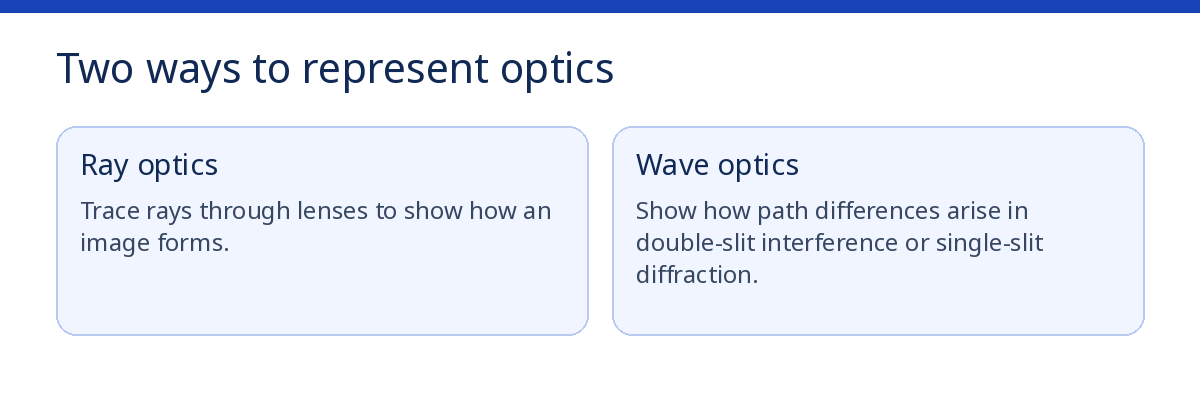
Ray optics appears through apparent depth, thin lenses in contact and the compound microscope. Wave optics appears through Young’s double-slit experiment and single-slit diffraction. The distinction changes what you should draw: a ray diagram tracks how an image forms, while a wave-optics sketch can show how path differences arise. In the double-slit case study, read the figure alongside the text and distinguish distances in the apparatus from spacings measured on the screen.
When the fringe-width relation applies: The usual double-slit expression gives the fringe spacing in the small-angle treatment, with the screen distance much larger than the slit separation . Here is the wavelength in the medium where the light propagates. Do not carry the double-slit rule over to single-slit diffraction: slit width and the separation between two slits describe different geometries.
Modern physics and electronics: label what each quantity means
The paper includes photon energy and photoemission, Bohr’s atomic model, nuclear size and nuclear reactions. In photoelectric questions, label the incoming photon energy, the metal’s work function and the maximum kinetic energy separately. Keep the units consistent before combining energies, and distinguish stopping potential, a voltage, from the energy associated with that voltage. In nuclear physics, distinguish mass number, atomic number and neutron number instead of treating them as interchangeable labels.
Electronic devices appear through diode bias, carrier concentrations in doped silicon and full-wave rectification. These questions ask for different kinds of responses: a comparison of diode behaviour, a concentration calculation, or a circuit diagram accompanied by input and output waveforms. When reviewing a diagram question, check that your written explanation accounts for the behaviour shown in the drawing.
Use the worked solutions to find the first mismatch
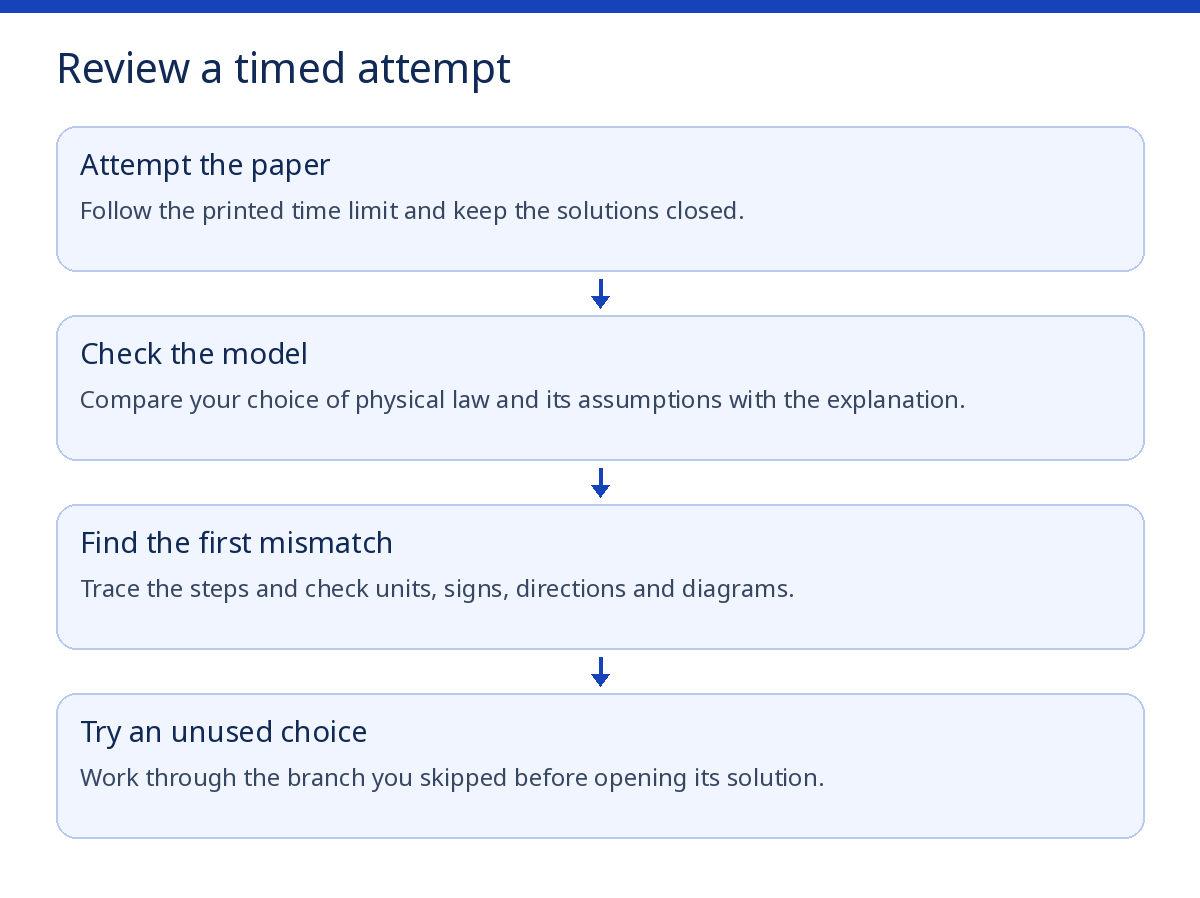
After the timed attempt, start with questions you marked as uncertain. The worked explanations separate the formula used, the concept used and the explanation in steps. First ask whether you used the same physical model and whether its assumptions match the setup. Then trace your working until it first diverges. A model error calls for revisiting the concept; a conversion, direction or sign error calls for checking the specific step where it entered.
Quick self-check before a second attempt: For an assertion–reason item, can you judge each statement independently before deciding whether the reason explains the assertion? For a derivation, can you name the condition that makes your opening equation applicable? Use an internal-choice branch you skipped as fresh practice before opening the explanation for that branch.
Spotted an error? Report a correction. Practise this in the app: notes, formula sheets and mind maps.













































































































































































Loading comments…