CBSE Class 12 Physics 2024 Solved Paper: Set 55/1/2
CBSEPhysics2024 Previous Year Paper
Paper code: 55/1/2 · 2024Practise with the full English-language CBSE Class 12 Physics main examination paper for 2024, set 55/1/2. Use the worked solutions to check not only your final answers but also how you chose a model, interpreted a diagram or justified a step.
This set is one of the year's papers. See every set from 2024, grouped by series.
How the 2024 paper is organised
This is a year-wise previous year paper, not a chapter test. The original English questions, options and diagrams are retained. The paper allows three hours, carries 70 marks and prohibits calculators. All 33 questions are compulsory, but that does not mean answering both sides of an internal choice. There is no overall choice; some questions in Sections B through E offer alternatives, while Section A does not.
- A: Questions 1–16 are worth one mark each and include assertion–reason items.
- B: Questions 17–21 are two-mark very short answers.
- C: Questions 22–28 are three-mark short answers.
- D: Questions 29–30 are four-mark case studies.
- E: Questions 31–33 are five-mark long answers.
For a timed attempt, follow the printed choice rules. Afterward, use the unattempted alternatives for further practice; the resource includes explanations for those choices too.

Physics 2024 | Class 12 | Previous Year Paper | Code 55/1/2
In the StudentCurio app
Complete solved CBSE Class 12 Physics 2024 paper (55/1/2), covering questions across topics including optics, electrostatics, electricity and magnetism, modern physics, and semiconductors. Useful for exam practice and reviewing worked solutions.
What changes from an MCQ to a long answer
Section A moves quickly between topics such as electrostatics, cells, magnetic effects of current, electromagnetic waves, the photoelectric effect and semiconductors. An option records your conclusion but not how you reached it, so jot down a reason before turning to the solution. For an assertion–reason item, decide whether each statement is true on its own before asking whether the reason explains the assertion. Two true statements do not necessarily form an explanation.
Later sections make the reasoning visible. A short answer can ask for a plot and an explanation, as in the question on intrinsic semiconductor conductivity. A long answer can combine a derivation with a numerical application or ask for a labelled diagram and a description of how a device works. Check each instruction separately: a calculation cannot stand in for a diagram or a physical explanation when both are requested.
When a relation applies: circuits and induction
In the battery questions, keep emf distinct from terminal potential difference. A real battery has internal resistance, so its terminal potential difference need not equal its emf when current flows. Draw or read the cell polarities before writing a loop equation, and use the indicated connections rather than assuming that batteries in series always assist each other.
The induction questions give you two different ways to think about changing magnetic flux: a loop changes size in a magnetic field, and the current in one coil changes the flux linked with another. In the shrinking-loop setup, the field is uniform and perpendicular to the loop’s plane, so the area is the changing quantity. In the two-coil setup, start by identifying what changes in the first coil before reasoning about the response in the second. A steady current alone does not imply a continuing induced emf in a stationary neighbouring coil.
Read the optical setup before choosing a formula
The optics questions move between refraction at an interface, image formation by a mirror, lens power, and longer alternatives on prisms or wavefronts and interference. Decide first what the question is asking you to describe. A wavelength question at an interface concerns light in a specified medium; a mirror question about image position and magnification needs a consistent sign convention for distances.
In the lens case study, the shape of the surfaces and the refractive index relative to the surrounding medium matter. Read the diagram before treating the pieces of a cut lens as optical elements: a cut along the principal axis is not the same operation as a cut perpendicular to it. The paper also states that powers add algebraically for lenses in contact. Keep that condition attached to the rule rather than extending it to lenses at an unspecified separation.
What the case studies ask you to track
Section D uses diode rectification and lens power as its two case studies. The rectifier passage introduces forward and reverse bias, then distinguishes half-wave from full-wave rectification. When reading its subparts, separate the behaviour of an individual diode from the behaviour of the output across the load. The time for which a diode conducts and the repetition of the output waveform describe different things.
The lens passage supplies relationships that the following subparts put to use in different geometries. In both cases, use the shared passage to establish the model, then return to the individual prompt to check which component, arrangement or output it refers to. This keeps a correct general rule from being applied to the wrong part of the setup.
Before you open the worked solution
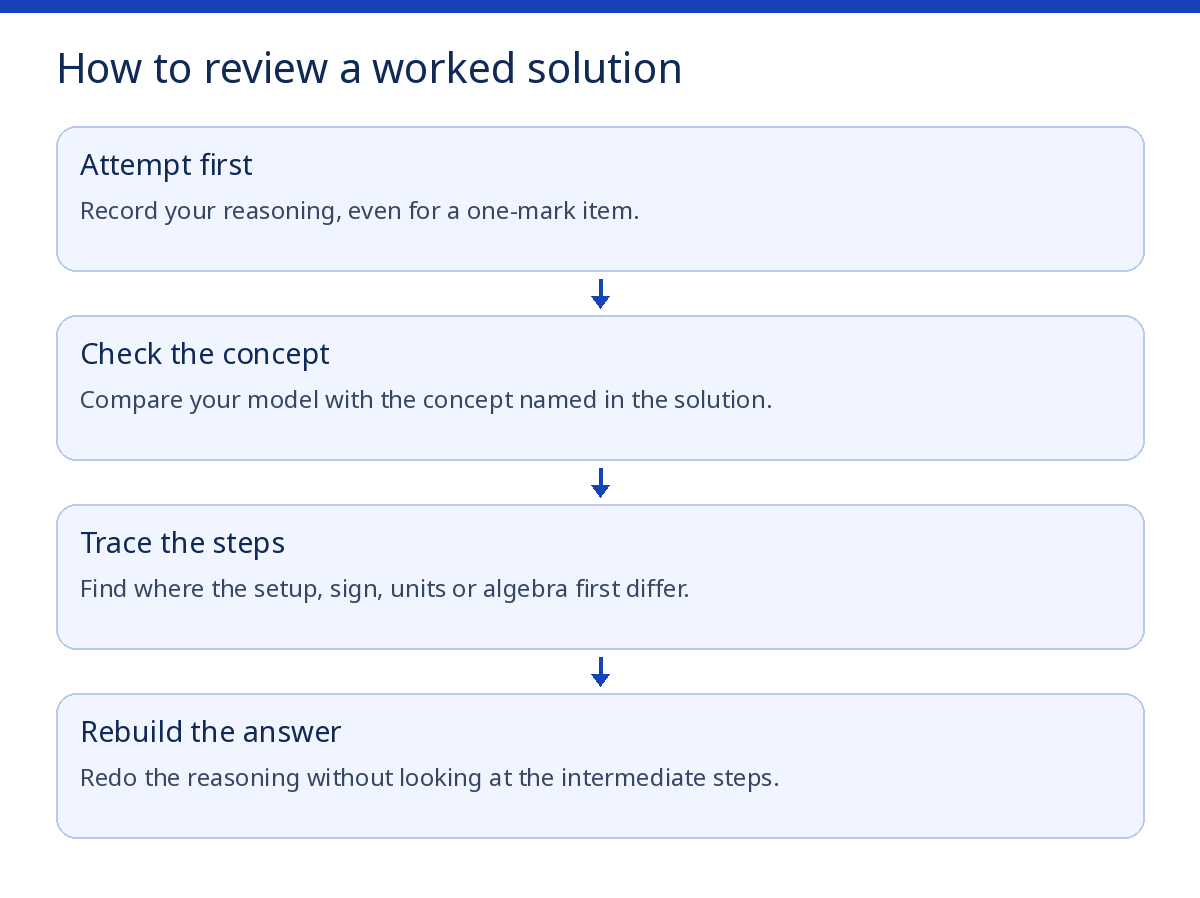
Keep your first attempt beside you. Use the question-number index to open the relevant explanation, then compare its formula used, concept used and explanation in steps with your own reasoning. Look for the first point where the two approaches diverge. If your setup agrees but the result does not, check signs, unit conversions and algebra before deciding that you misunderstood the topic.
For a derivation, try reconstructing the argument from the starting assumptions without looking at the intermediate lines. For a graph, check what belongs on each axis and whether your explanation accounts for the shape you drew. This guide omits the shrinking-loop answer options and the point-charge coordinates because they are not reliably rendered in the supplied text excerpt; consult the printed page for the original notation.
Spotted an error? Report a correction. Practise this in the app: notes, formula sheets and mind maps.













































































































































































Loading comments…