2023 CBSE Class 12 Physics Paper with Worked Solutions
CBSEPhysics2023 Previous Year Paper
Paper code: 55/2/2 · 2023Use the full English paper from the 2023 CBSE Class 12 Physics Main Examination, set 55/2/2, for a three-hour practice attempt. Then use the worked solutions to review not just your calculations, but why each method applies.
This set is one of the year's papers. See every set from 2023, grouped by series.
What this year-wise paper includes
This is a complete 70-mark board paper from one examination year, not a collection of questions arranged by chapter. It retains the original English questions, options and diagrams. The worked explanations cover the printed internal choices, so after your attempt you can study an alternative even if you did not choose it during the timed sitting.
The file has a question-number index, and solution pages link back to their corresponding questions. The explanations separate the formula used, the concept used and the steps. That structure is useful when an answer looks familiar but you cannot yet explain why the underlying rule fits the situation. The excerpts illustrate several topics; they are not a checklist of everything in the full paper.

Physics 2023 | Class 12 | Previous Year Paper | Code 55/2/2
In the StudentCurio app
Complete CBSE Class 12 Physics Main Examination paper for 2023, set 55/2/2, with worked solutions. It covers questions across the syllabus and helps students practise board-exam questions and review solution methods.
Attempt the paper before opening the solutions
For a board-style attempt, use the printed three-hour limit, follow the paper's instructions and make your internal choices as you go. Keep the worked explanations closed. This gives you a record of what you can select, set up and finish independently, before a solution makes the next step seem obvious.
When time is up, distinguish questions you did not reach from questions you started but could not complete. The first group can point to a pacing problem; the second gives you a place to inspect your reasoning. If you chose an option without a clear reason, mark it for review even if it matches the solution. The review should tell you what to practise, not just what you got right.
Optics: distinguish a boundary rule from an approximation
The optics explanations give you two different kinds of reasoning to compare. At a stationary interface, the frequency is preserved in reflection and refraction, but the wave speed can differ between media. Use to see why a change in speed at fixed frequency changes the wavelength. A quantity that stays fixed at the boundary does not make every other wave quantity fixed.
In the Young's double-slit treatment, uniform fringe spacing comes from a model: monochromatic light, fixed geometry and the paraxial approximation, where the angles are small. Here, relates the fringe spacing to the wavelength, the slit-to-screen distance and the slit separation. When reviewing the explanation, notice that the equal spacing follows from the form of the fringe positions within that approximation; it is not an unrestricted claim about every interference pattern.
When the circuit and semiconductor formulas apply
In the circuit explanations, check what voltage each symbol represents. In , is the potential difference across the resistor. An ideal source maintains its terminal voltage, but for a cell delivering current with internal resistance, the terminal voltage is less than the emf by the internal drop . Label these quantities before substituting so that a correct power formula is not used with the wrong voltage.
The semiconductor explanations distinguish a carrier process from an equilibrium relation. In a p–n junction, mobile electrons and holes diffuse and recombine near the junction, leaving uncovered fixed ions in the depletion region. The ions are not dopant atoms that have migrated to the junction. In a carrier-density calculation, applies at thermal equilibrium; use consistent concentration units and the intrinsic carrier concentration for the same temperature.
Common mistakes: extending a field rule too far
The electrostatics discussion illustrates why the type of field matters. For an electrostatic field, the work around a closed path is zero because the starting and ending potentials coincide. Do not extend that statement to an electric field induced by a changing magnetic field, which can be nonconservative.
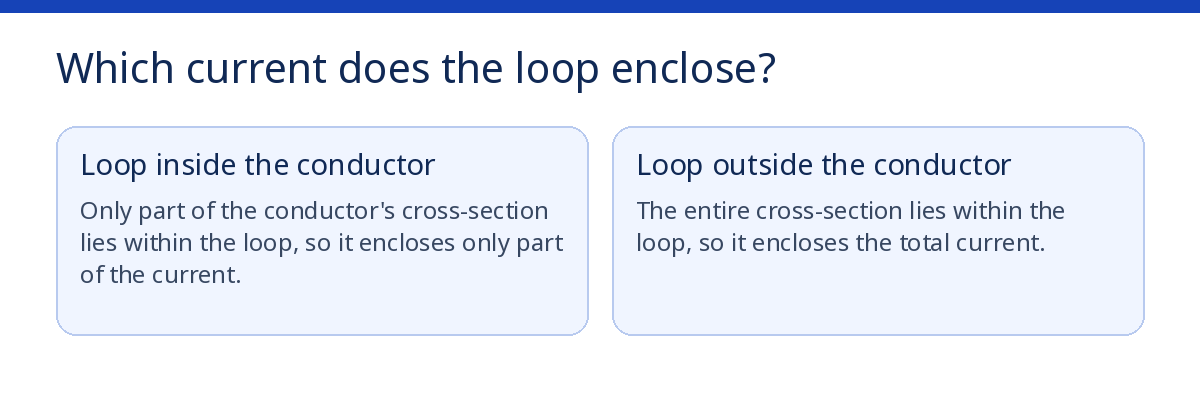
The magnetic-field explanation makes a different distinction: the current in Ampère's law is the current enclosed by the chosen loop. For a long cylindrical conductor with uniform current density, a circular loop centred on the axis and lying inside the conductor encloses only part of the total current. A loop outside encloses all of it. Check the position of the loop and the current distribution before choosing an inside or outside field expression.
Emission and the photoelectric effect: track the energy
The atomic-transition and photoelectric explanations both connect photon energy to wavelength, but they use the connection in different directions. In atomic emission, the drop between energy levels determines the energy of the emitted photon. For the photoelectric effect, you start with the incoming photon energy and compare it with the material's work function. Any energy left after overcoming the work function gives the maximum kinetic energy of an emitted electron; below the threshold there is no photoemission.
Before subtracting, express the two energies in the same units. If you calculate the photon energy in joules from and the work function is supplied in electronvolts, convert one quantity first. A unit mismatch changes the numerical result even if the energy argument is correct.
Quick self-check before a second attempt
For a question you missed, go back to its diagram or wording and ask: What feature of the setup tells me which rule to use? Compare your explanation with the concept block before reading the steps. Then identify the first point at which your reasoning diverged. That might be the assumed field type, the voltage you labelled, or the units you used, rather than the final arithmetic.
Close the solution and write a fresh setup. If an internal alternative is available, try it independently before consulting its explanation. The aim is to reproduce the reasoning from the question, not to remember the printed sequence of steps.
Spotted an error? Report a correction. Practise this in the app: notes, formula sheets and mind maps.













































































































































































Loading comments…