CBSE Class 12 Physics Supplementary Paper 2024
CBSEPhysics2024 Previous Year Paper
Paper code: 55/S/1 · 2024Practise with the full English-language 2024 CBSE Class 12 Physics supplementary paper, set 55/S/1. Use it for a three-hour board-paper attempt, then compare your reasoning with the worked explanations.
This set is one of the year's papers. See every set from 2024, grouped by series.
Know the paper before you start
This year-wise file contains the complete 2024 supplementary paper, labelled Supplementary / Compartment on the cover. It retains the original English questions, options and diagrams and pairs the paper with worked explanations. The printed instructions allow three hours for 70 marks, with no calculator. A list of physical constants is supplied for use where needed.
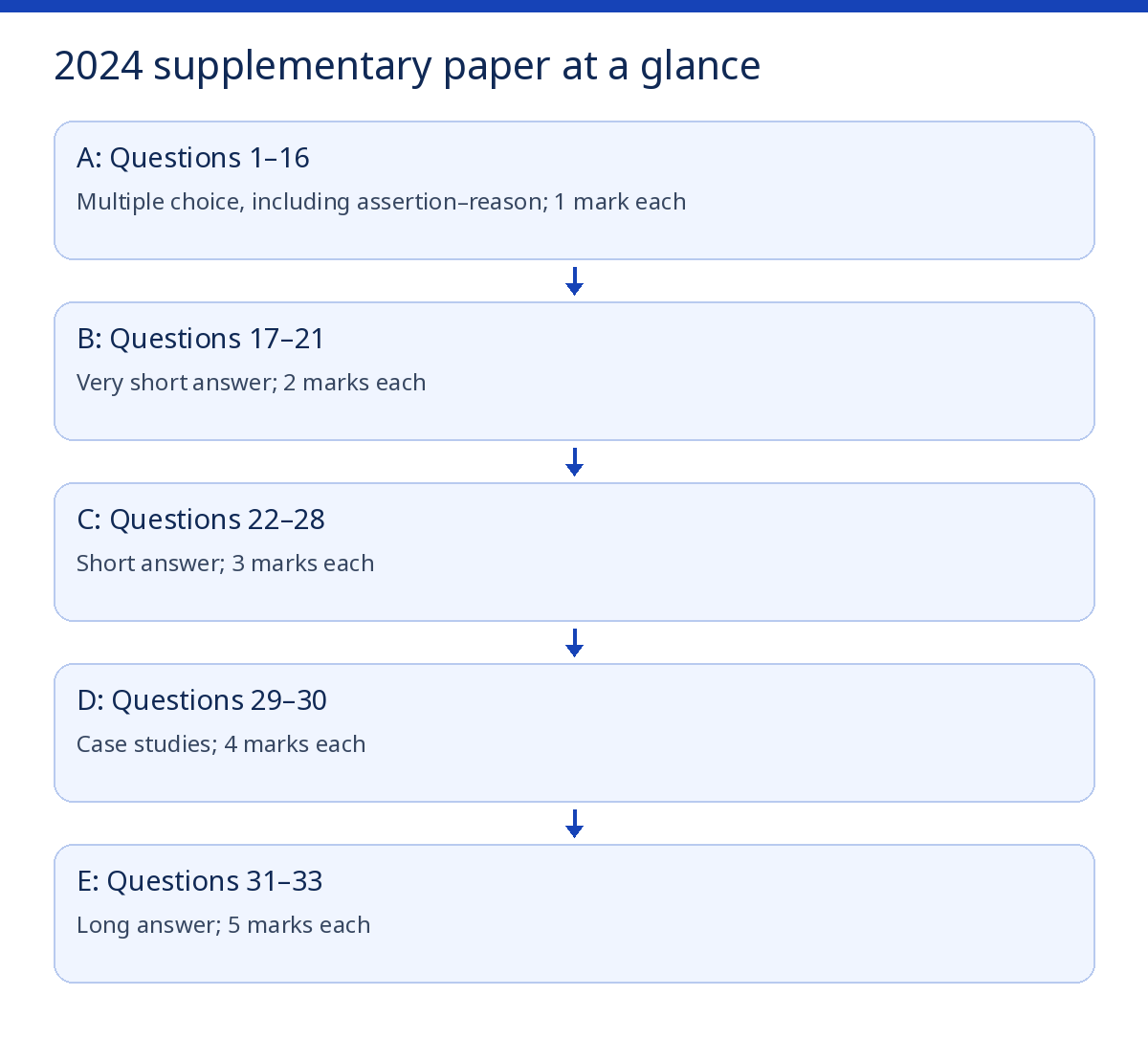
The paper has 33 questions in five sections. Section A contains 16 one-mark multiple-choice questions, including assertion–reason items. Sections B and C contain two-mark and three-mark questions respectively. Section D has two four-mark case studies, and Section E has three five-mark questions. There is no overall choice: all questions are compulsory, subject to the internal choices printed in some questions outside Section A. During a timed attempt, answer only the branch required; after the attempt, use the alternative branch for extra practice.

Physics Supplementary 2024 | Class 12 | Previous Year Paper | Code 55/S/1
In the StudentCurio app
The complete 2024 CBSE Class 12 Physics supplementary paper includes questions and worked solutions across topics such as electricity, magnetism, optics, semiconductors, atomic physics and nuclear physics. It helps students practise the board-paper format and review solution methods.
Electricity and magnetism: identify the setup first
The electricity questions move between point charges, capacitors, cells with internal resistance and current in a wire of changing cross-section. These setups call for different starting points. For a cell supplying current, distinguish its emf from the terminal potential difference across the external circuit. For a capacitor, read the connection conditions before choosing an energy relation: a battery connection and an isolated capacitor do not impose the same constraint.
The magnetism and induction questions include forces near current-carrying wires, a loop inside a solenoid, galvanometer conversion, an AC generator and a series circuit at resonance. A useful way to classify these tasks is to ask whether you need a force, an induced emf or a circuit response. The first depends on the relevant vector directions, the second on changing magnetic flux, and the third on the elements connected in the circuit.
Optics: decide whether to draw rays or track phase
The paper brings together refraction, total internal reflection, telescope magnification, interference and diffraction. In geometrical optics, a sketch makes it easier to keep the interfaces, normals and directions straight. For a critical-angle problem, first identify which medium the light is travelling through and which it is approaching: total internal reflection is possible only for light incident from the higher-index medium toward the lower-index medium, at an angle greater than the critical angle.
The Young’s double-slit question calls for wave reasoning instead. Keep the path difference distinct from the phase difference, and check what the question states about the intensities of the interfering waves. Huygens’ principle is another wave-based tool in the paper, but the task there is to show refraction with a wavefront diagram rather than calculate interference intensity.
Modern physics: separate the quantities being tested
Modern physics appears in several forms: photoelectric graphs, matter waves, photon energy and emission rate, Bohr’s hydrogen model, and nuclear binding energy. The photoelectric question is particularly useful for practising controlled comparisons. Before drawing a curve, label both axes and note which quantity is varied and which are held fixed. Changing the collector potential is not the same task as changing the incident intensity.
In the longer questions, pay attention to what the requested result measures. Energy per photon is not energy emitted per second, and binding energy per nucleon is not the total binding energy of a nucleus. These distinctions help you identify the quantity your reasoning must produce before substituting any data.
A useful connection: diode bias and rectifier output
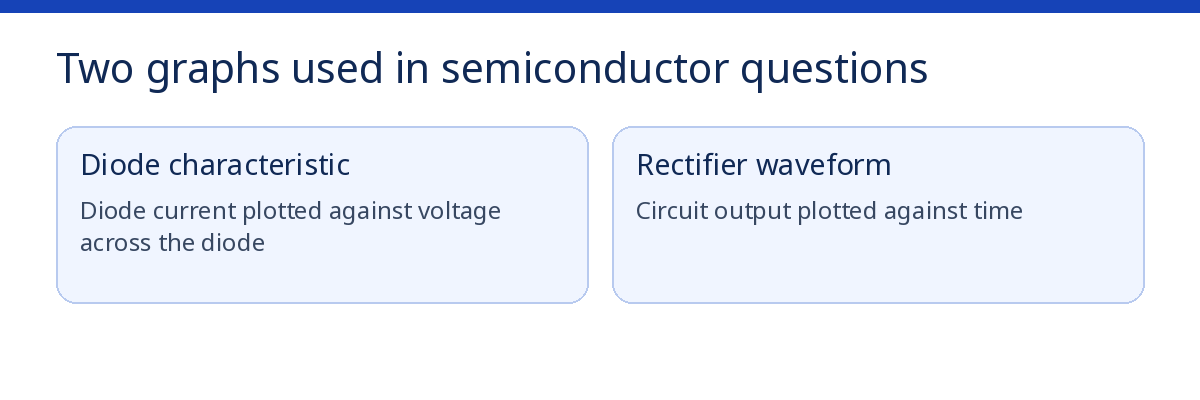
A short-answer question asks you to interpret the bias of a silicon junction and sketch its current–voltage characteristic. The rectification case study takes the same device into a circuit driven by an alternating input. Use the two tasks together: first identify the p-side and n-side and compare their potentials, then track the bias conditions as the input changes.
Keep the current–voltage characteristic separate from the output waveform. The characteristic relates the current through the diode to the voltage across it. The waveform shows how the circuit output varies with time. In a rectifier diagram with more than one diode, follow each available conducting path before interpreting the output; the input polarity alone does not tell you which branch conducts without the diode orientations.
Quick self-check before opening the worked solutions
After the timed attempt, choose a few answers you were unsure about and ask whether you can name the principle, identify the condition that makes it applicable, and explain your first step. For assertion–reason items, judge each statement separately before deciding whether the reason explains the assertion. For longer responses, check that a requested diagram, derivation or justification is present, not just a final value.
The worked pages separate the formula used, concept used and explanation in steps. Compare them with your attempt in that order, looking for the first difference in reasoning rather than just checking the result. The guide does not use Q4’s transformer result or Q9’s spherical-refraction result as references: the former uses operating data not established by the bulb rating, and the latter depends on an unstated refractive index. The microwave-oven subpart is also omitted from the concept review.
Spotted an error? Report a correction. Practise this in the app: notes, formula sheets and mind maps.













































































































































































Loading comments…