2025 CBSE Class 12 Physics Supplementary Paper 55/S/2
CBSEPhysics2025 Previous Year Paper
Paper code: 55/S/2 · 2025Practise the full 2025 CBSE Class 12 Physics supplementary paper in English, then use the linked worked solutions to check where your reasoning held up and where it broke down. The paper combines multiple-choice questions, short written responses, case studies and longer derivations.
This set is one of the year's papers. See every set from 2025, grouped by series.
Know the paper and its internal choices
This year-wise resource contains the 2025 supplementary paper, set 55/S/2, with the original English questions, options and diagrams. The paper allows 3 hours for 70 marks, and calculators are not permitted. It supplies a table of physical constants for use where needed, so keep that page available during a timed attempt rather than relying on a separate formula sheet.
The paper has 33 compulsory questions in five sections. Section A has 16 one-mark questions, ending with four assertion–reason items. Section B has five two-mark very short answers, and Section C has seven three-mark short answers. Section D has two four-mark case studies, and Section E has three five-mark long answers. There is no overall choice. Where an internal choice is printed, attempt one alternative during a mock; Section A has no internal choices.

Physics Supplementary | Class 12 | Previous Year Paper | 2025 | Code 55/S/2
In the StudentCurio app
Complete 2025 CBSE Class 12 Physics supplementary examination paper 55/S/2 with worked solutions, covering questions across the Physics syllabus. It helps students practise exam-style problems and review their solutions.
Follow concepts across question formats
Use the full paper to see how a familiar principle changes when the required response changes. Electrostatics appears in brief questions on potential energy and flux, a short answer on Coulomb’s law in vector form, and longer work on capacitors or the electric fields of point charges. Selecting an option and constructing a vector argument draw on related knowledge, but only the latter makes you show how you established the direction and combined the contributions.
The paper also covers current electricity, magnetism, induction, alternating current, optics, electromagnetic waves, atomic and nuclear physics, and semiconductors. Look across sections when diagnosing a mistake. If you recognise a principle in a multiple-choice item but cannot explain how to use it in a written response, practise building the argument rather than simply rereading the definition.
Common mix-ups in brief answers
In the assertion–reason items, judge each statement independently before deciding whether the reason explains the assertion. Read the codes printed in this paper rather than relying on a memorised list from another test. Pay particular attention to changes in conditions: a statement about light of one frequency must be judged under that condition, not under a different illumination setup mentioned elsewhere in the item.
In numerical answers, identify the quantity requested before substituting. In AC work, peak and rms are not interchangeable; for a sinusoidal current, the peak value is times the rms value. In nuclear physics, binding energy per nucleon is not the binding energy of the whole nucleus. If comparing total binding energies, account for the mass number of each nucleus.
Read the case studies as two different models
Section D pairs a semiconductor and p–n junction passage with a compound microscope passage. In the semiconductor case, separate the properties of the bulk material from what happens at the junction. The distinction between intrinsic and doped material concerns charge carriers; depletion width and barrier height concern the junction and depend on its bias. Drawing that distinction helps you pick out the relevant part of the passage without treating every sentence as a cue for every subpart.
For the microscope, sketch the objective, the intermediate image and the eyepiece in sequence before choosing a magnification expression. The intermediate image formed by the objective is the object for the eyepiece. Check whether the question specifies a final image at the near point or at infinity: the eyepiece expression depends on that condition.
Build long answers around the requested evidence
Section E asks for more than final expressions. The optics alternatives include a prism derivation at minimum deviation and a wavefront construction for refraction at a plane interface. The AC alternatives call for phasor reasoning in a series LCR circuit or phase and graph reasoning for inductors. Start by identifying what the prompt asks you to draw, derive, state or justify; a correct formula does not replace a requested diagram or explanation.
Make the setup explicit before the algebra. In optics, label the relevant rays or wavefronts and measure incidence and refraction angles from the normal. In electrostatics, distinguish a capacitor that is still connected to a battery from one whose battery has been disconnected before it is connected to another capacitor. The connection determines whether the battery can maintain the potential difference or whether you need to track charge redistribution.
Use the worked solutions after an independent attempt
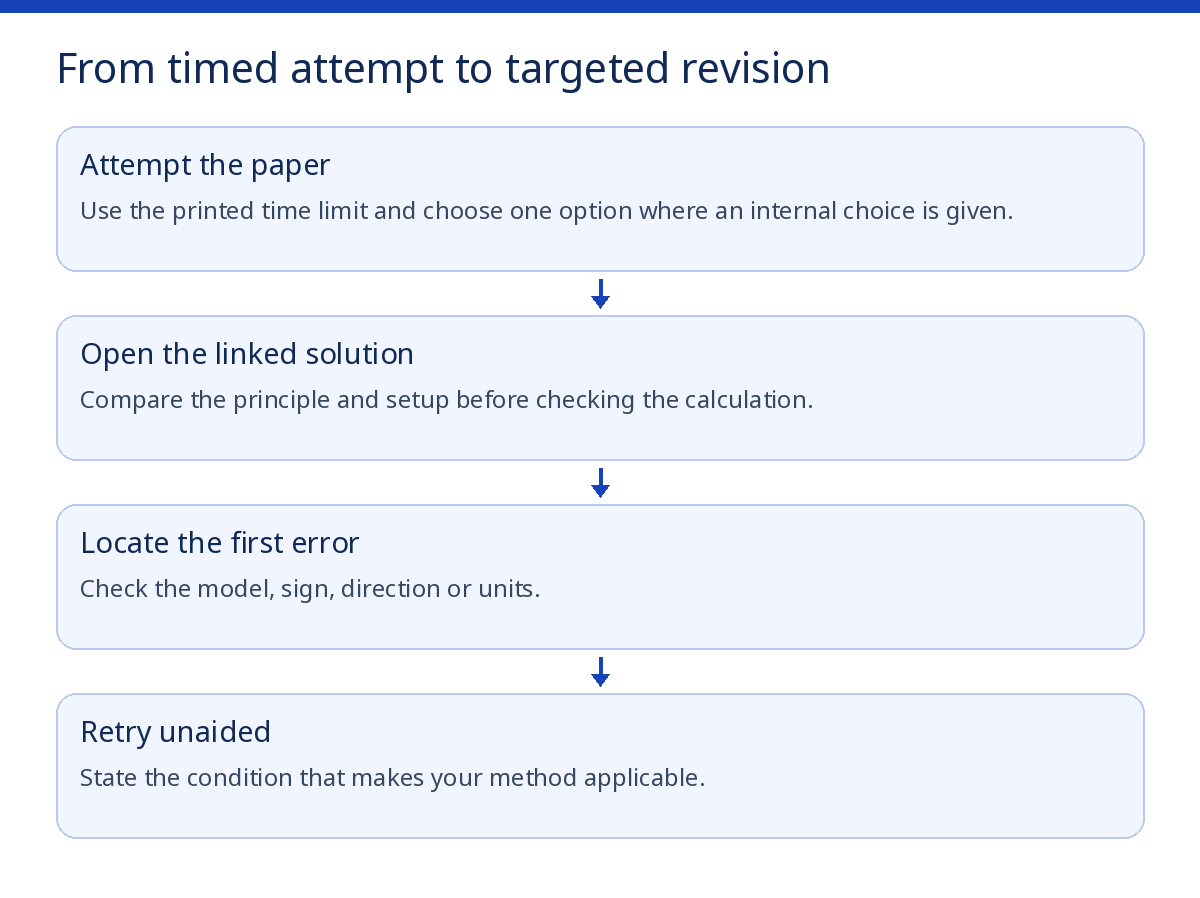
The PDF links question numbers to explanations organised by formula used, concept used and explanation in steps. After the timed attempt, place your working beside the linked explanation and find the first step where they diverge. A wrong result may start with a poor choice of model, a sign or direction error, or a unit conversion. Identifying that first difference gives you a more useful revision target than copying the finished method.
The resource includes explanations for the printed internal choices, so return to the alternative you left unattempted during the mock. Try it before opening its explanation. Then redo one question you missed with the solution closed, checking whether you can now state the controlling condition and carry it through to the requested result.
Spotted an error? Report a correction. Practise this in the app: notes, formula sheets and mind maps.













































































































































































Loading comments…