CBSE Class 12 Physics Supplementary Paper 2022
CBSEPhysics2022 Previous Year Paper
Paper code: 55/6/3 · 2022Use this full, year-wise CBSE Class 12 Physics supplementary paper to practise under the original two-hour limit, then review your reasoning with the worked solutions. The 2022 paper, code 55/6/3, includes wave and ray optics, atomic and nuclear physics, electromagnetic waves, and semiconductors.
This set is one of the year's papers. See every set from 2022, grouped by series.
Paper format: 35 marks across three sections
The English-language file identifies the exam as Supplementary / Compartment. Section A has Questions 1–3, worth two marks each. Section B has Questions 4–11, worth three marks each. Section C is Question 12, a five-mark case study on lenses with five one-mark parts.
All 12 questions are compulsory, but that does not mean answering both alternatives in an internal choice. Where the paper prints an OR, attempt only one alternative in your timed sitting. The original instructions permit log tables if needed but prohibit calculators. The worked solutions cover both printed alternatives, so you can return to the unused one for practice without counting it as part of your timed attempt.

Physics Supplementary 2022 | Class 12 | Previous Year Paper | Code 55/6/3
In the StudentCurio app
A 2022 CBSE Class 12 Physics supplementary examination paper with worked solutions, covering topics across the syllabus, including optics, atomic physics and semiconductors. It helps students practise board-exam questions and review solution methods.
Wave optics: compare the patterns and their causes
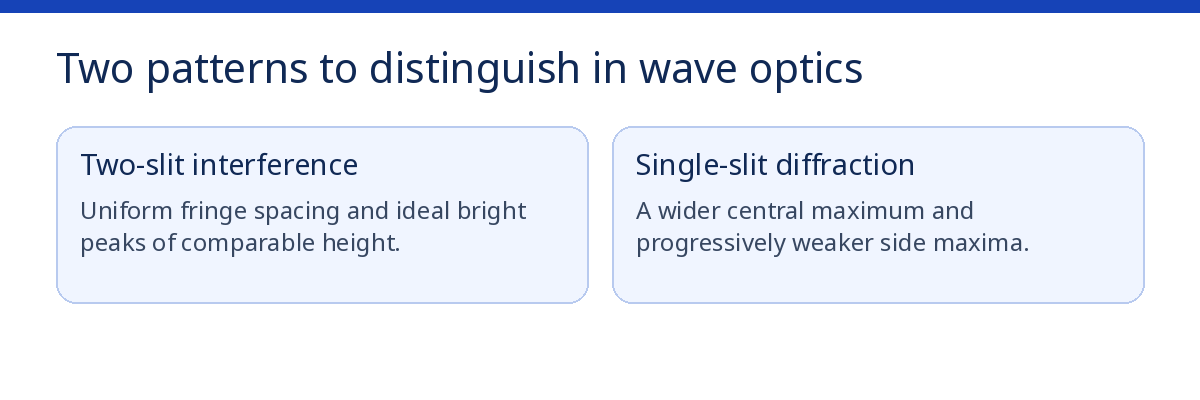
The paper tests wave optics through Young’s double-slit setup, single-slit diffraction and a wavefront construction for refraction. For an interference calculation, separate amplitude from intensity: waves superpose through their amplitudes, while intensity is proportional to the square of the resultant amplitude. A ratio of source intensities is therefore not directly a ratio of amplitudes. Also distinguish the ideal two-slit fringe pattern from the broader central maximum and weaker side maxima of single-slit diffraction.
In the refraction alternative, the diagram is part of the argument. In a Huygens construction, compare the distances travelled in the same time in the two media. As you review the solution, trace how the new wavefront is constructed before checking the relation between the angles. This makes it easier to spot whether an error began in the sketch or in the algebra.
Before using a ray-optics formula, name the setup
Ray optics appears both in Section B and in the lens case study. The compound-microscope alternative specifies a final image at the least distance of distinct vision; a magnification expression for a final image at infinity is not interchangeable with it. The spherical-refraction alternative instead concerns one curved boundary between two media. Its derivation uses paraxial rays and signed Cartesian distances, rather than treating the boundary as a complete lens.
For the thin-lens power relation , use the signed focal length in metres to obtain power in dioptres. The case study also tests what changes when the surrounding medium changes, so distinguish the lens material’s refractive index from its index relative to the medium. For separated lenses, mark the first image on a ray sketch before deciding how it acts as the object for the second lens.
Keep particle, photon and nuclear energy distinct
The modern-physics questions move between matter waves, photoemission, hydrogen energy levels and nuclear mass differences. Begin by identifying the quantity that governs the model. A de Broglie wavelength depends on particle momentum. A photoelectric threshold instead compares the energy of an incident photon with the work function of the surface. The threshold wavelength is an upper limit for emission in the ordinary single-photon model, not a minimum wavelength.
For hydrogen spectra, relate the photon energy to the difference between two levels, not to the energy of either level alone. When reviewing the standing-wave explanation of Bohr quantisation, look for the condition that the matter wave reproduce its phase after one orbit. In the nuclear calculation, keep the mass bookkeeping separate from the energy conversion: the sign of the initial-minus-final rest-mass difference determines whether energy is released or required.
Semiconductors: read the diagram at the right scale
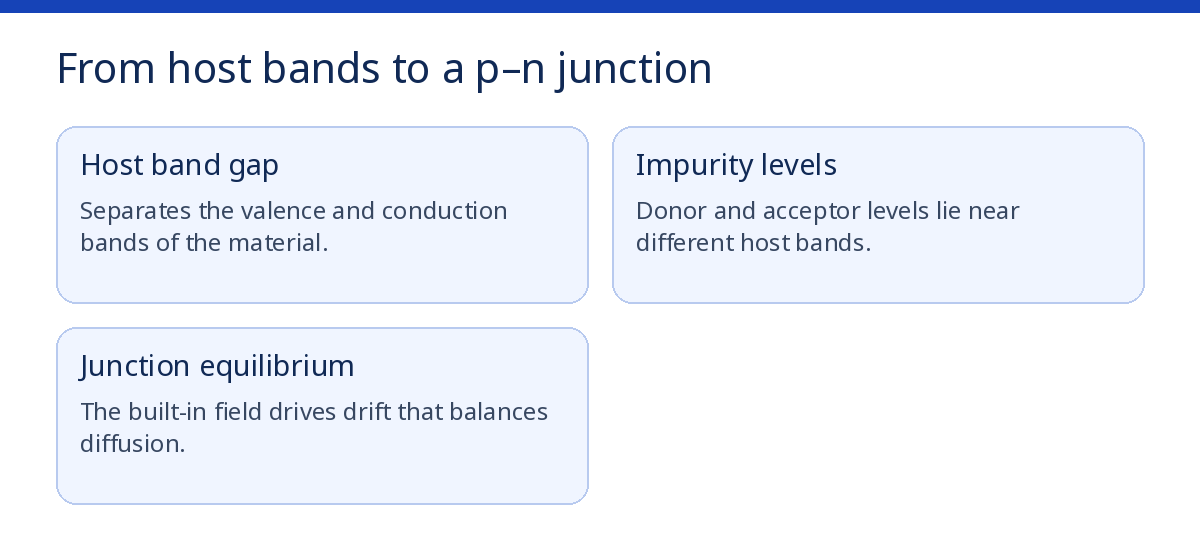
The semiconductor questions link three distinct ideas: the band gap of the host material, the impurity levels introduced by doping, and carrier motion across a junction. Similar lattice geometry does not guarantee similar electrical behaviour. In the carbon comparison, the intended structure is diamond, not graphite; the useful comparison with silicon is between their band gaps.
On a doped-semiconductor diagram, label the valence and conduction bands before placing the impurity level. The smaller energy separation between an impurity level and its nearby band is not the full host band gap. For a p–n junction, switch from reading energy levels to explaining what happens across the interface: separate mobile electrons and holes from the fixed ions left in the depletion region. At equilibrium, distinguish the drift driven by the built-in field from diffusion driven by the carrier concentration gradient.
Review the first step that went wrong
After the timed attempt, use the solution headings—Formula Used, Concept Used and Explanation in Steps—to find the first place your reasoning diverged. A wrong diagram calls for a different correction from a sign error or a missing condition. For an internal choice you skipped, try its setup independently before reading the worked method.
Use the printed PDF rather than the extracted text when checking signs, exponents and units. The extracted constants list and some numerical prompts and lens options do not reliably preserve mathematical notation, so those details are omitted here. The guide also does not treat the radio-frequency demonstration wording as a universal limit: the worked explanation distinguishes a Hertz-type electrical demonstration from other ways of detecting electromagnetic waves.
Spotted an error? Report a correction. Practise this in the app: notes, formula sheets and mind maps.













































































































































































Loading comments…