Atoms: Class 12 NCERT Notes on Rutherford, Bohr and Hydrogen Spectra
CBSEPhysicsAtomic Physics
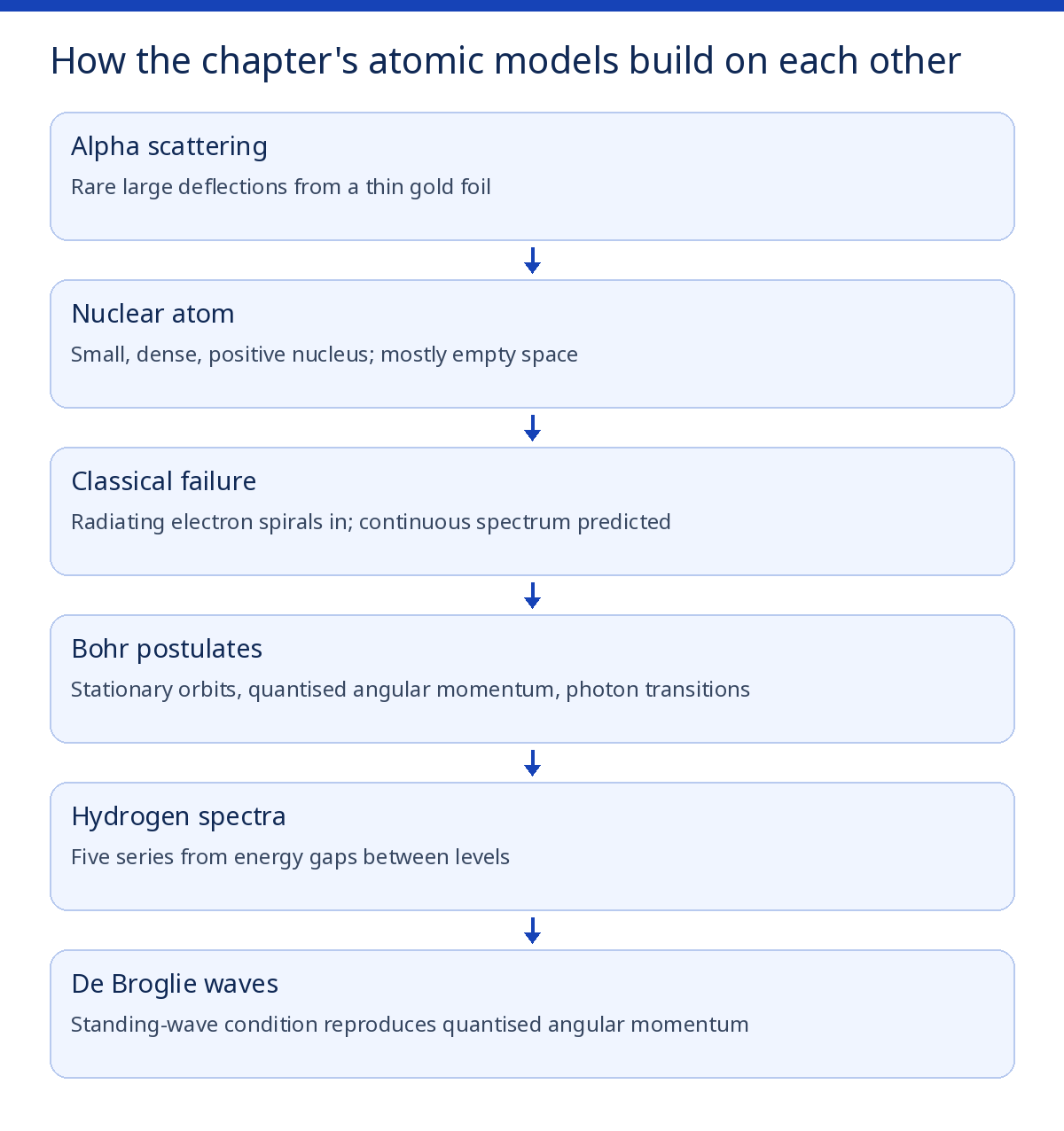
This guide to NCERT Class 12 Physics Chapter 12, Atoms, follows the notes from Geiger-Marsden alpha scattering to Rutherford's nuclear model and its classical failures. It then explains Bohr's postulates, hydrogen energy levels and ionisation, the five spectral series, de Broglie's standing-wave argument and the limits of the Bohr model.
What alpha-particle scattering revealed about the atom
At Rutherford's suggestion, Geiger and Marsden fired a 5.5 MeV alpha-particle beam from a bismuth-214 source at a gold foil m thick. A lead collimator narrowed the beam. A rotating zinc sulphide screen and microscope counted flashes, called scintillations, at different angles.
Most particles passed through with little deflection. About 0.14% scattered beyond , and about one in 8000 scattered beyond . For equal detector solid angles and a fixed beam and target, the counts follow the Rutherford law, . To compare counts at two angles, take the ratio of the terms. The notes' first worked example uses this method.
The rare large deflections imply a nucleus that holds all the positive charge and almost all the mass. Its size is of order to m, against about m for the whole atom, so most of the atom is empty space.

Atomic Physics | Class 12 | NCERT Notes
In the StudentCurio app
These notes cover Rutherford’s alpha-particle scattering experiment and atomic model, Bohr’s postulates and energy levels, and hydrogen spectra, with related concepts such as de Broglie’s explanation. They help Class 12 students revise atomic models and energy transitions.
Distance of closest approach and the impact parameter
An alpha particle is a helium nucleus of charge . At separation from a nucleus of charge , it feels a radially outward repulsion , where N m C. The gold nucleus is much heavier than the alpha particle, so it is treated as fixed.
In a head-on encounter the particle stops momentarily at distance . Take the potential energy as zero far away. All of the initial kinetic energy then becomes potential energy, giving . This is purely an energy-conservation step, and the notes' example uses for gold.
The impact parameter is the perpendicular distance from the nucleus to the incoming line of motion. For Coulomb scattering, . A large gives a small deflection. At , the particle retraces its path, so .
Why Rutherford's orbiting electron cannot be stable
In hydrogen, the electrostatic attraction supplies the centripetal force: . Taking the potential energy as zero at infinite separation gives three relations:
- kinetic energy
- potential energy
- total energy
A negative means the electron is bound, and must be supplied to separate it from the proton. A positive total energy would mean an unbound electron.
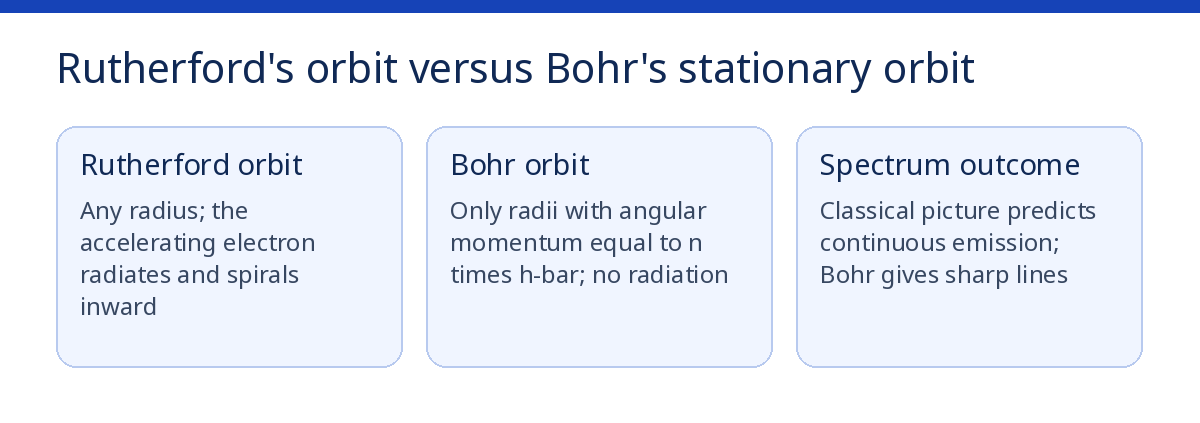
The notes identify two drawbacks of this model. First, circular motion involves acceleration, and classical electrodynamics predicts that an accelerating electron radiates energy and spirals into the nucleus. Second, as the orbit shrank, its frequency would change continuously and give a continuous spectrum. Excited hydrogen actually emits sharp lines at particular frequencies.
Bohr's three postulates and the quantised orbits
Bohr kept the Coulomb attraction but added new rules. They apply to hydrogen and to one-electron ions such as He and Li.
- Stationary states: in certain orbits the electron has a definite energy and does not radiate.
- Quantised angular momentum: , where and
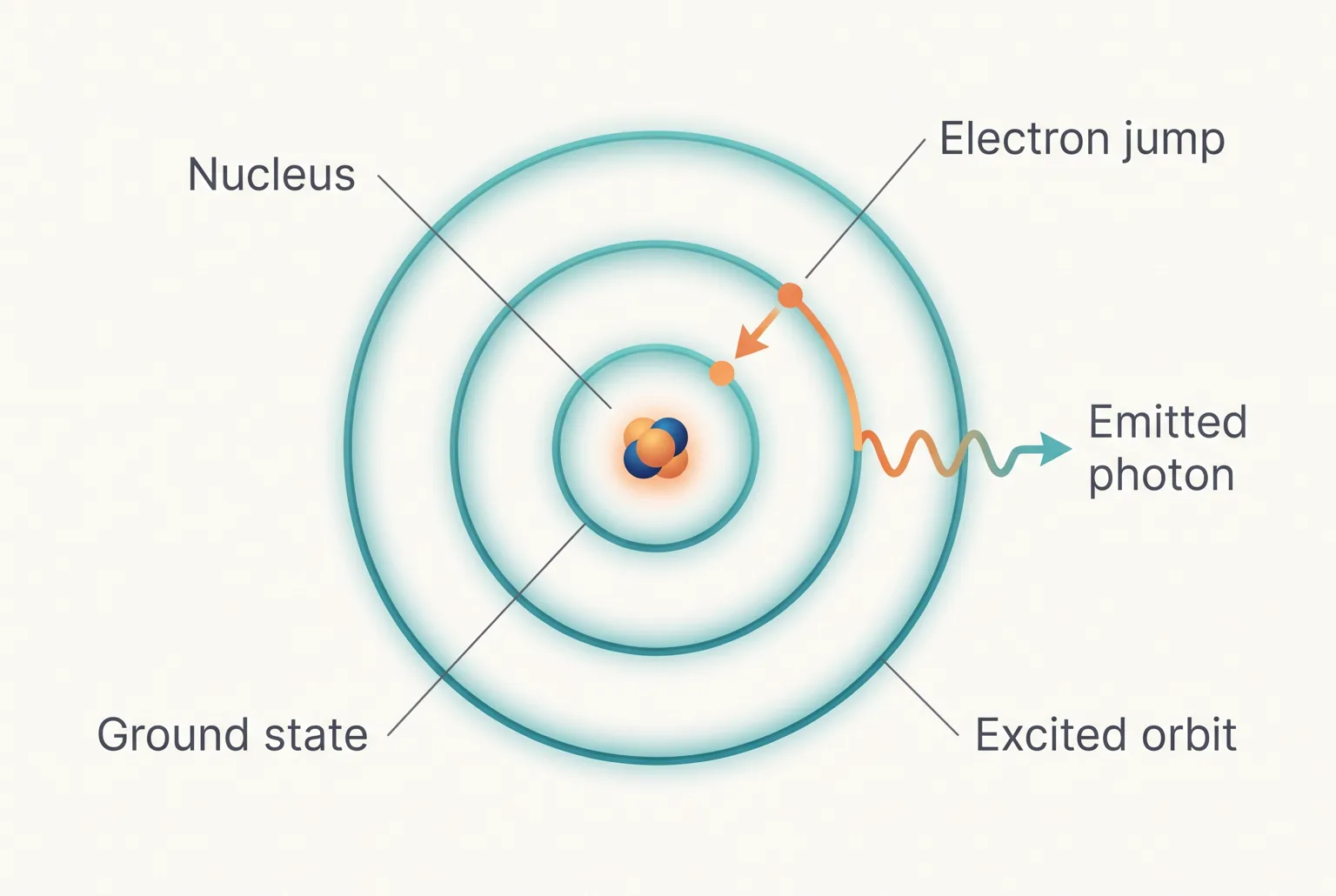
- Transitions: a photon of energy is emitted in a downward jump, and the same gap is absorbed in an upward jump.
Substituting into the force equation gives . Here m (0.529 Å) is the Bohr radius, so the allowed radii are in the ratio 1 : 4 : 9 : 16. The speed is , so . For hydrogen, m s, about . The orbital frequency varies as . The emitted photon frequency, however, is set by the energy gap, not by the orbital frequency.
Energy levels, signs and ionisation energy
The circular-orbit relations still hold for each stationary orbit: and . With the allowed radii, eV. Using the Rydberg constant m, this is .
For hydrogen the levels are , , , and eV for to 5. They approach zero from below as increases. The state is the ground state, and most hydrogen atoms at room temperature are in it. Collisions or photon absorption can excite an atom.
The minimum energy needed to free an electron from level is , which is a positive quantity. The ground-state ionisation energy of hydrogen is therefore +13.6 eV.
Reading the five hydrogen spectral series
Excited hydrogen gas gives an emission spectrum of bright lines. Light from a continuous source passing through cooler hydrogen gives dark absorption lines at the same allowed wavelengths. Many excited states radiate within about s. An electron may drop directly to a lower level or cascade through intermediate levels.
For emission with , the wavenumber is . The first line of a series comes from and has the longest wavelength. As , the lines crowd towards the short-wavelength limit .
- Lyman (): ultraviolet
- Balmer (): visible lines with a near-UV limit
- Paschen, Brackett, Pfund (): infrared
The Balmer lines are H at 656.3 nm (red), H at 486.1 nm, H at 434.1 nm and H at 410.2 nm. They converge towards a limit near 364.6 nm.
De Broglie's standing waves and where Bohr's model stops
De Broglie gave the electron a wavelength . A wave on a closed orbit matches its phase only if a whole number of wavelengths fits around it, so . Substituting the wavelength gives , which is exactly Bohr's second postulate. Combining this with shows that the hydrogen electron's de Broglie wavelength is proportional to . The notes' final worked example uses this result.
Bohr's model predicts the main wavelengths of one-electron atoms and ions, but it has clear limits. It ignores electron-electron interactions and does not explain fine splitting or the relative strengths of spectral lines. It also assumes circular paths. Quantum mechanics replaces orbits with orbitals, described by a wavefunction from Schrödinger's equation. The quantity gives the probability density for finding the electron at a position.
Revising atoms: energy signs, level counting and series limits
The ideas most worth revising are:
- the scattering law and what it implies about the nucleus
- the energy relations and
- the scalings and
- the series formula with its first lines and limits
Common mistakes the notes correct:
- Ionisation energy carries the wrong sign. Bound-state energies are negative, but the energy needed to ionise from level is , a positive input.
- Excited states are miscounted. The second excited state is , and the third excited state is .
- Photon frequency is confused with orbital frequency. The photon's frequency comes from the energy gap between two levels.
- Series end on the wrong level. Each series ends on a fixed , and its first line has the longest wavelength.
Quick self-check: Why does a large impact parameter produce only a small deflection? Why must appear in for He?
Frequently asked questions
Do these notes apply Bohr's model to atoms other than hydrogen?
Only to hydrogen-like ions with a single electron, such as He+ and Li2+, using nuclear charge +Ze. The notes state that the model omits electron-electron interactions in atoms with several electrons.
Which NCERT chapter do these notes follow?
They reference NCERT Class 12 Physics, Part II, Chapter 12, Atoms. They include a chapter summary and seven worked examples.
Spotted an error? Report a correction. Practise this in the app: notes, formula sheets and mind maps.













































































































































































Loading comments…