CBSE Class 12 Physics 2022 Term 2 Paper with Solutions
CBSEPhysics2022 Previous Year Paper
Paper code: 55/4/1 · 2022Practise the complete CBSE Class 12 Physics 2022 Term 2 paper (55/4/1) as a two-hour, 35-mark test. Then use the worked solutions to check the reasoning behind your diagrams, calculations and explanations.
This set is one of the year's papers. See every set from 2022, grouped by series.
What this 2022 paper contains
This year-wise PDF contains the English version of the CBSE Class 12 Physics main examination for Term 2, followed by worked solutions. It preserves the original questions, options and diagrams, and the solutions cover the printed internal choices. It is a complete paper for that term, not a chapter-wise collection or a statement of the current exam pattern.
The paper has 12 compulsory questions in three sections. Section A has three questions worth two marks each. Section B has eight worth three marks each. Section C is a five-mark case study. There is no overall choice: where a question offers an internal choice, attempt only one alternative in a timed sitting. The printed instructions allow log tables if needed but do not allow a calculator.

Physics 2022 | Class 12 | Previous Year Paper | Code 55/4/1
In the StudentCurio app
A CBSE Class 12 Physics Term 2 examination paper with worked solutions, covering topics including semiconductor devices, atomic and nuclear physics, ray and wave optics, and interference. Useful for practising exam-style questions and reviewing solution methods.
Semiconductors: connect the model to the device
The semiconductor questions move from the energy-band picture of a solid to the operation of junction devices. When reviewing a band diagram, distinguish an energy gap from a spatial separation: the vertical axis represents energy, and the forbidden gap is an interval with no allowed electron states in the ideal band picture. In a junction diagram, by contrast, the depletion region occupies a physical width.
The device questions also distinguish doping from biasing. Doping changes the type and concentration of charge carriers available in the material. An applied bias changes the junction barrier and affects how carriers move across it. As you review the questions on light emission and detection, check that your explanation follows the direction of energy transfer. A device that produces light and one that responds to light are not doing the same job, even though both involve charge carriers in a semiconductor.
Atomic, nuclear and quantum physics: choose the right model
The paper uses wavelength in two different settings. In hydrogen spectroscopy, it describes light emitted in a transition between energy levels. In the matter-wave alternative, it is a de Broglie wavelength associated with a particle's momentum. When comparing particles accelerated through the same potential difference, do not assume they gain the same kinetic energy: the gain also depends on the magnitude of their charge.
The nuclear and scattering questions test different uses of energy accounting. In the fusion calculation, distinguish the energy per reaction from the total energy available, and check how many nuclei each reaction consumes. Converting released energy into a running time at a given power also requires an assumption about conversion into useful energy. In the closest-approach problem, the head-on condition matters: the incoming particle momentarily stops at the turning point, which lets you relate its initial kinetic energy to the change in electrostatic potential energy.
Optics: decide whether to draw rays or wavefronts
The optics questions use several kinds of diagrams. In the telescope and microscope alternatives, a ray diagram should distinguish the intermediate image from the final one. The specified viewing condition matters: an image at infinity is not the same adjustment as a final virtual image at the near point. In the prism question, read the symmetry and geometry from the original figure before choosing a relation for the angles.
For interference, track the path difference between coherent waves arriving at the same point on the screen. Complete cancellation at a dark fringe requires equal amplitudes as well as opposition in phase. When reviewing a fringe-width derivation, locate the step where the small-angle approximation enters and check that the spacing is measured between successive fringes of the same kind. For the Huygens construction, distinguish the wavefront from the direction of propagation and compare the distances travelled in the two media over the same time.
Before using a formula: check signs and assumptions
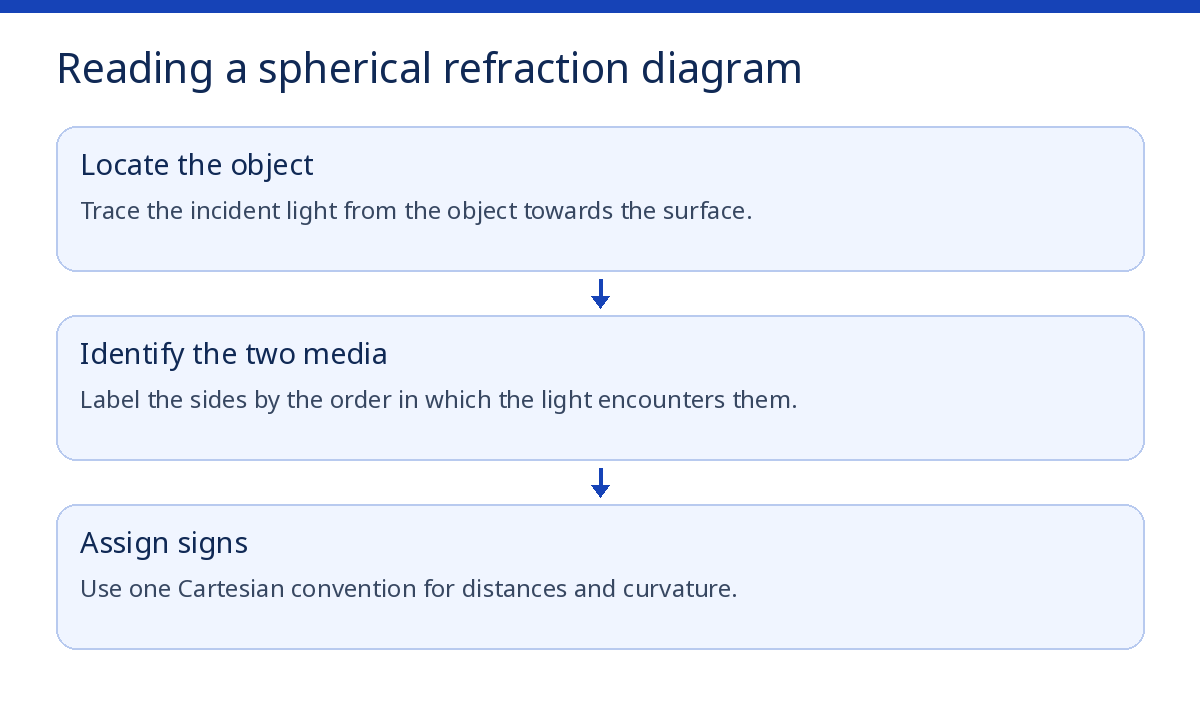
The Section C case study brings together refraction at a spherical surface, image formation and lens power. Start by tracing the light from the object: the incident and outgoing media are determined by its direction, not by which index is written first. Apply one Cartesian sign convention consistently to object distance, image distance and radius of curvature. For the combination of thin lenses, note that the power-addition rule used here is for lenses in contact. Where the case depends on a diagram or a printed sign, consult the original PDF rather than the extracted options.
In the photoelectric question, separate maximum kinetic energy from the number of emitted electrons. First check whether each frequency reaches the emission threshold. Equal incident intensity alone does not establish equal electron counts: photon arrival rate and the efficiency of emission can differ. This guide therefore does not adopt the worked page's simplified count comparison as a general result.
After the timed attempt: check the step that failed
Attempt the paper before opening the solutions, and leave the unused alternatives for a second round. When reviewing, use the solution pages' three labels—Formula Used, Concept Used and Explanation in Steps—to locate the first point where your reasoning diverged. A correct formula will not rescue a calculation based on the wrong image condition, and a correct numerical value does not replace a reason when one is requested.
For a quick self-check, take one response you would change and explain what feature of the question governs the method: the direction of light, the kind of energy transfer or the stated approximation. Then redraw or redo just that step without consulting the worked page.
Spotted an error? Report a correction. Practise this in the app: notes, formula sheets and mind maps.













































































































































































Loading comments…