Electric Charges and Fields: Class 12 NCERT Solutions
CBSEPhysicsElectric Charges and Fields
This CBSE Class 12 Physics solutions file works through NCERT Chapter 1 exercises on electric charge, Coulomb’s law, electric fields, dipoles and Gauss’s law. Use it to check not just your calculations, but also the signs, directions and symmetry arguments that justify each step.
Charge: What changes and what stays the same
The exercises on rubbing materials distinguish quantisation from conservation. Quantisation describes the possible values of a body’s net charge: , where is the positive magnitude of the elementary charge and can be any integer, including zero. Conservation describes what happens during transfer: one body loses electrons and the other gains them, so the total charge of the pair does not change. A body can therefore become positively charged without gaining positive particles.
The solutions also explain why treating charge as continuous can be useful. When a macroscopic charge is large compared with the elementary charge, adding or removing one electron makes a negligible relative difference. This approximation does not mean that quantisation stops applying. When an exercise asks how many electrons moved, the elementary charge matters again.

Electric Charges and Fields | Class 12 | NCERT Solutions
In the StudentCurio app
Worked NCERT solutions cover charge and Coulomb-force problems, electric fields and dipoles, and applications of electric flux and Gauss’s law to spherical, line and plane charge distributions. These solutions help Class 12 students practise electrostatics questions step by step.
Coulomb’s law: Separate magnitude from direction
For point charges in vacuum, Coulomb’s law gives the force magnitude as . The small-sphere exercises in air use the free-space value of as an approximation. In the copper-sphere problem, the radii are explicitly negligible compared with the separation, so the solutions use the distance between the centres. Convert that distance to metres and the charges to coulombs before substituting in SI units.
The absolute value gives a nonnegative magnitude; it does not tell you which way the force points. Like charges repel, while unlike charges attract, along the line joining them. When several charges contribute, the square arrangement shows why a sketch is useful: compare the directions as well as the magnitudes of the individual forces before deciding whether they cancel. Equal distances alone do not establish cancellation.
Common mistake: Giving a negative charge the field’s direction
The electric field at a point is not the same quantity as the force on a charge placed there. Work out the field due to the source charges first: it points away from a positive point charge and towards a negative one. Add those contributions as vectors. Only then use . A positive test charge experiences a force along the net field; a negative one experiences a force in the opposite direction.
In the midpoint exercise, draw a separate arrow for each source’s contribution before looking at the worked solution. The same attention to direction helps with field-line questions. A field line’s tangent follows the local field wherever it is nonzero. Two lines cannot cross there, because their crossing would imply two different field directions at one point.
Dipoles: Zero net charge does not mean zero torque
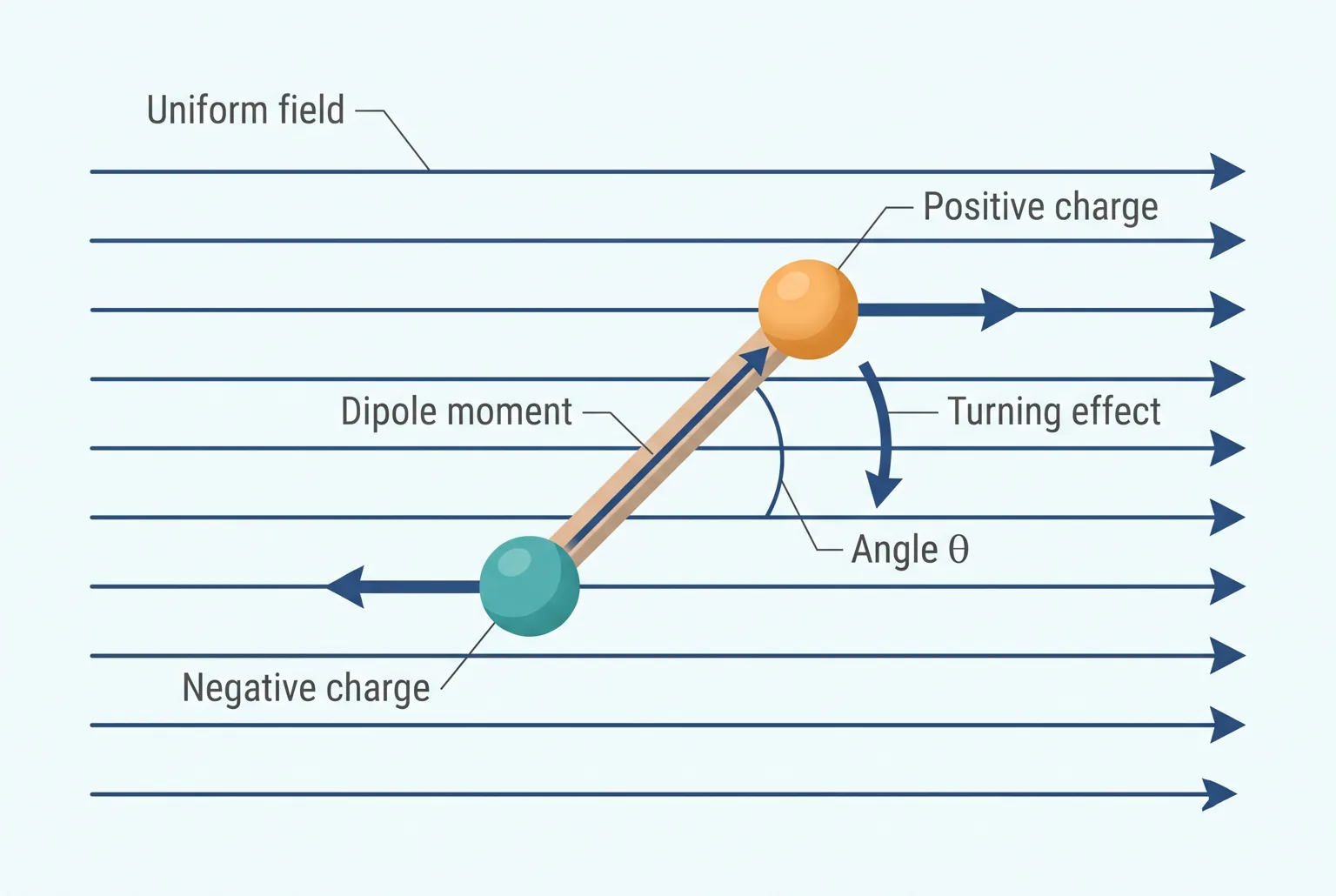
An electric dipole consists of equal and opposite charges separated by a distance. Its net charge and dipole moment describe different things. The charges sum to zero, but their separation gives the dipole a moment of magnitude , where is the full distance between the charges. The moment points from the negative charge to the positive charge. In the coordinate exercise, determine that direction from the positions of the charges rather than from the order in which they are listed.
The torque exercise then places a dipole in a uniform electric field. The torque magnitude is , with measured between the dipole moment and the field. The angle matters: a dipole can experience a turning effect even though the forces on its two charges cancel as a net force in a uniform field.
Electric flux: Choose the normal before the angle
For a flat surface in a uniform field, electric flux is , where is the angle between the field and the chosen surface normal, not the angle between the field and the plane. Reversing the normal reverses the sign of the flux. A field parallel to the surface gives zero flux through it, even if the field itself is nonzero.
Compare the square and cube exercises. For the square, which is an open surface, the solution specifies a normal before calculating signed flux. For the closed cube, each face has an outward normal. As you read that solution, track the signs on opposite faces before adding their contributions. This makes clear how a field can pass through a closed surface without producing any net outward flux.
Gauss’s law: Enclosed charge fixes flux; symmetry helps find fields
Gauss’s law relates the net outward flux through a closed surface to the net charge enclosed: . Changing the surface’s size without changing the enclosed charge leaves the total flux unchanged. The field strength at the surface, however, can change. Likewise, dividing the total flux equally among the faces of a cube requires symmetry, as when a point charge sits at the centre; the law alone does not give the flux through each face.
The spherical and line-charge exercises show why the geometry matters when finding a field. Outside the uniformly charged sphere, field magnitude falls with the square of the distance from the centre. For an ideal infinite uniform line charge, it falls with the perpendicular distance itself. Use the field expression that matches the distribution, rather than applying the point-charge formula to every source.
Quick self-check before opening a worked solution
Use the exercise index to find a problem, then write down the physical decision you need to make before the arithmetic. For a charged-sphere problem, what makes the point-charge approximation reasonable? For a flux problem, is the question about one face or the entire closed surface? Which direction defines positive flux?
When comparing your attempt with the worked steps, look for the first place your reasoning differs, not just a different final value. In the particle-track exercise, for instance, ask what must be comparable about the particles’ motion before you can use their deflections to rank the magnitudes of their charge-to-mass ratios. Identifying that assumption is as important as interpreting the tracks.
Spotted an error? Report a correction. Practise this in the app: notes, formula sheets and mind maps.













































































































































































Loading comments…