CBSE Class 12 Physics 2025 Previous Year Paper: Set 55/5/2
CBSEPhysics2025 Previous Year Paper
Paper code: 55/5/2 · 2025Use the full English-language CBSE Class 12 Physics 2025 main examination paper for a three-hour, 70-mark practice attempt. Then use the worked explanations to check not just your answers, but how you chose a formula, read a diagram or justified a step.
This set is one of the year's papers. See every set from 2025, grouped by series.
Know the five-section format before you start
This year-wise resource contains the full 2025 paper for set 55/5/2, with the original English questions, options and diagrams retained. Section A has 16 one-mark questions, including four assertion–reason items. Section B has five two-mark very short answers, and Section C has seven three-mark short answers. Section D has two four-mark case studies, while Section E has three five-mark long answers.
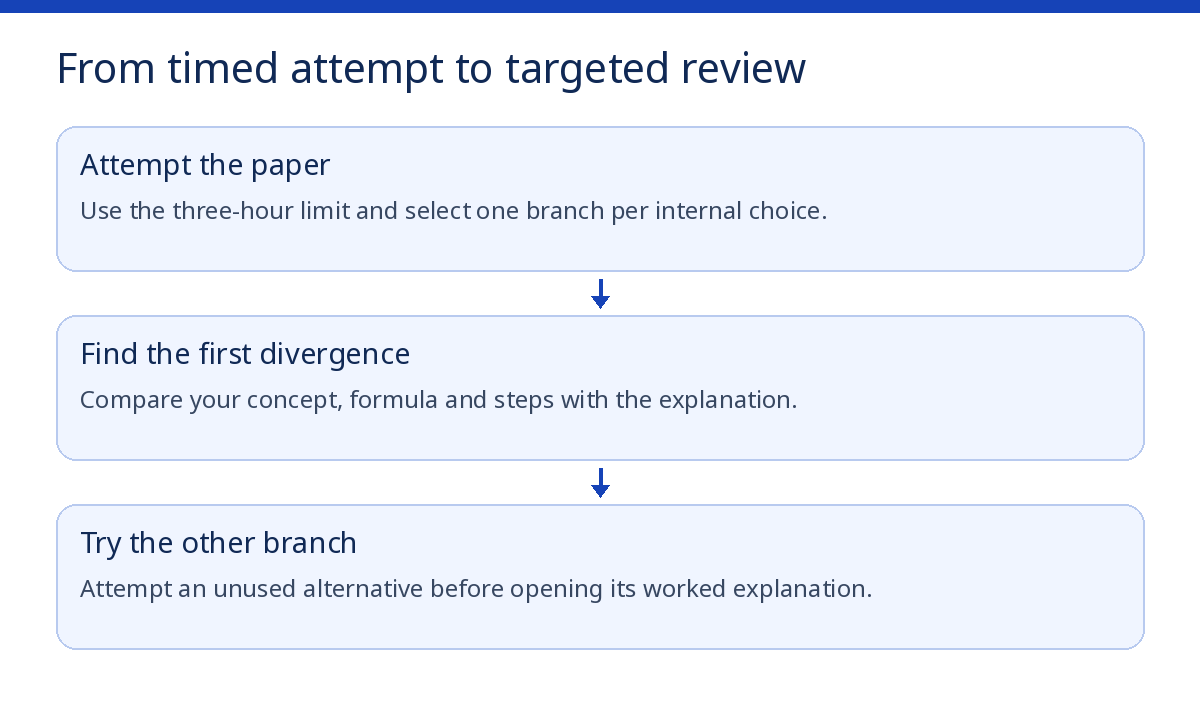
There is no overall choice: all 33 questions are compulsory, with internal alternatives in selected questions outside Section A. For a timed attempt, choose only one branch wherever an internal choice is offered and work without a calculator, as the paper requires. Save the unattempted alternatives for a second round; they give you more practice without changing the conditions of your first attempt.

Physics 2025 | Class 12 | Previous Year Paper | Code 55/5/2
In the StudentCurio app
Complete CBSE Class 12 Physics 2025 question paper with worked solutions, spanning topics including optics, electrostatics, current electricity, magnetism, electromagnetic induction, nuclear physics and semiconductors. Useful for board-exam practice and reviewing solution methods across chapters.
Common mistakes: Reducing a circuit before reading it
The paper approaches circuits through capacitor and resistor networks, a switched circuit, and a multi-battery problem that includes internal resistance. Before reducing a network, trace the conducting paths in the printed figure. Components drawn side by side are not necessarily in parallel: they must share the same two nodes. Similarly, a branch interrupted by an open switch cannot carry steady current through that gap. Redrawing the circuit by nodes can reveal a connection you missed in the original layout.
In the capacitor plate-separation question, the phrase the battery is disconnected determines what you hold fixed. For an isolated capacitor with negligible leakage, the charge is fixed, not the voltage. In review, check whether your reasoning respects that condition before comparing your treatment of potential difference, electric field or work.
Optics: Choose the model before the formula
The optics questions move between interference, a wavefront argument for reflection, refraction at a curved surface and image formation in optical instruments. These are different tasks. For interference, keep the addition of wave amplitudes separate from the relation between intensity and the square of the resultant amplitude. For refraction at a spherical surface, identify the direction of incident light and apply one sign convention consistently to the object distance, image distance and radius of curvature.
The long-answer alternatives also make the final image condition explicit: the refracting-telescope problem specifies an image at infinity, while the compound-microscope diagram calls for an image at the near point. When reviewing your ray diagrams, check that the rays leaving the eyepiece represent the stated condition, not just a familiar instrument layout.
Case studies: Identify what varies and what is fixed
Section D brings together two different kinds of reasoning. The photoelectric-effect case uses photon energy, work function, photocurrent and cut-off potential. The galvanometer case connects coil deflection to the balance between magnetic torque and the spring’s restoring torque, then considers how added resistance changes the instrument’s use.
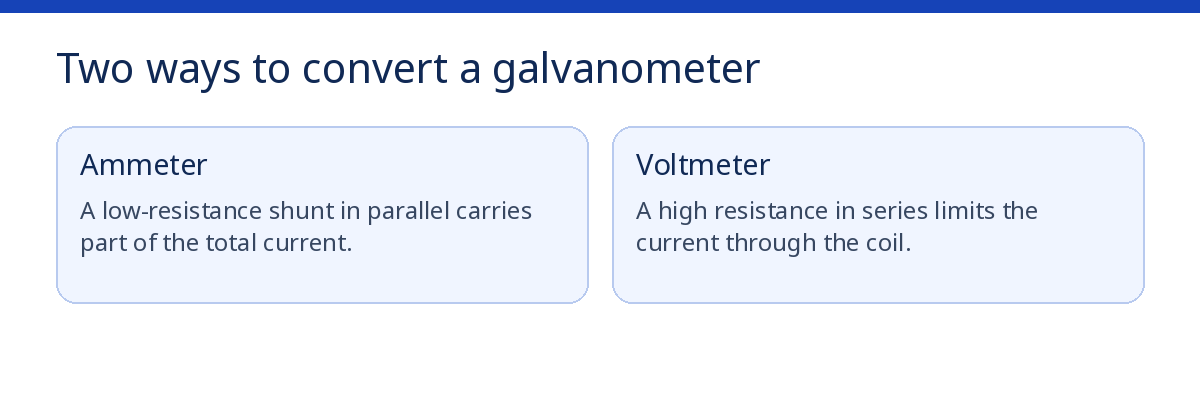
For the photoelectric questions, label both graph axes before interpreting the trend. Frequency and intensity are different inputs, and current and cut-off potential describe different aspects of the response. For the galvanometer questions, distinguish the current through the coil at full-scale deflection from the full-scale current of an ammeter made from it. A low-resistance shunt goes in parallel for ammeter conversion; a high resistance goes in series for voltmeter conversion. Sketching the connection helps you see which current or voltage belongs to which part of the instrument.
A useful connection: Rate of change versus stored energy
The electromagnetic induction alternatives distinguish self-inductance, where changing current induces an emf in the same coil, from mutual inductance, where a current change in one coil induces an emf in another. The paper also moves between a definition, a derivation and graph interpretation. When revising, explain in words what is changing and where the emf is induced before writing a relation.
For a coil of constant self-inductance, the induced emf depends on how fast the current changes, whereas the stored magnetic energy depends on the current itself. A steady nonzero current can therefore correspond to stored energy without a self-induced emf. This distinction is worth checking before any graph work: an axis labelled current is not interchangeable with one labelled rate of change of current.
Quick self-check: Keep related terms distinct
The nuclear physics questions connect mass defect with binding energy and ask why a nucleus can remain bound despite electrostatic repulsion between protons. Before moving on, can you explain the difference between the total binding energy of a nucleus and its binding energy per nucleon? The first refers to the nucleus as a whole; the second is an average per constituent nucleon.
For semiconductors, keep three descriptions separate: energy bands at absolute zero, thermal formation of electron–hole pairs at room temperature, and the use of a rectifier circuit. When you return to the rectification question, can you explain the difference between half-wave and full-wave operation by tracing the conducting path over each half-cycle? That check is more informative than recalling the circuit shape alone.
Use the worked explanations for a second pass
The file lets you navigate by question number and separates each worked explanation into the formula, the concept and the steps. Use those parts to locate the first point where your reasoning diverged: did you miss a condition, choose the wrong relation or make an algebraic slip? For assertion–reason items, check each statement independently before deciding whether the reason explains the assertion. The file also includes worked explanations for the printed internal choices, so you can try the other branch before consulting it.
This guide omits the charged-particle trajectory worked example because the displayed substitution and result do not agree. It also leaves out the nuclear-scattering assertion–reason item because the extracted wording and exponent are unclear.
Spotted an error? Report a correction. Practise this in the app: notes, formula sheets and mind maps.













































































































































































Loading comments…