Electrostatic Potential and Capacitance: Class 12 CBSE Practice Guide
CBSEPhysicsElectrostatic Potential and Capacitance
This guide to the Class 12 CBSE chapter Electrostatic Potential and Capacitance explains the ideas its practice questions test: potential as work per unit charge, the link $E = -\mathrm{d}V/\mathrm{d}l$, equipotential surfaces, dipole potential and charged shells. It also explains how the assessment's four topic sets and mixed chapter practice are organised, and in what order to attempt them.
Potential as work per unit charge, added as scalars
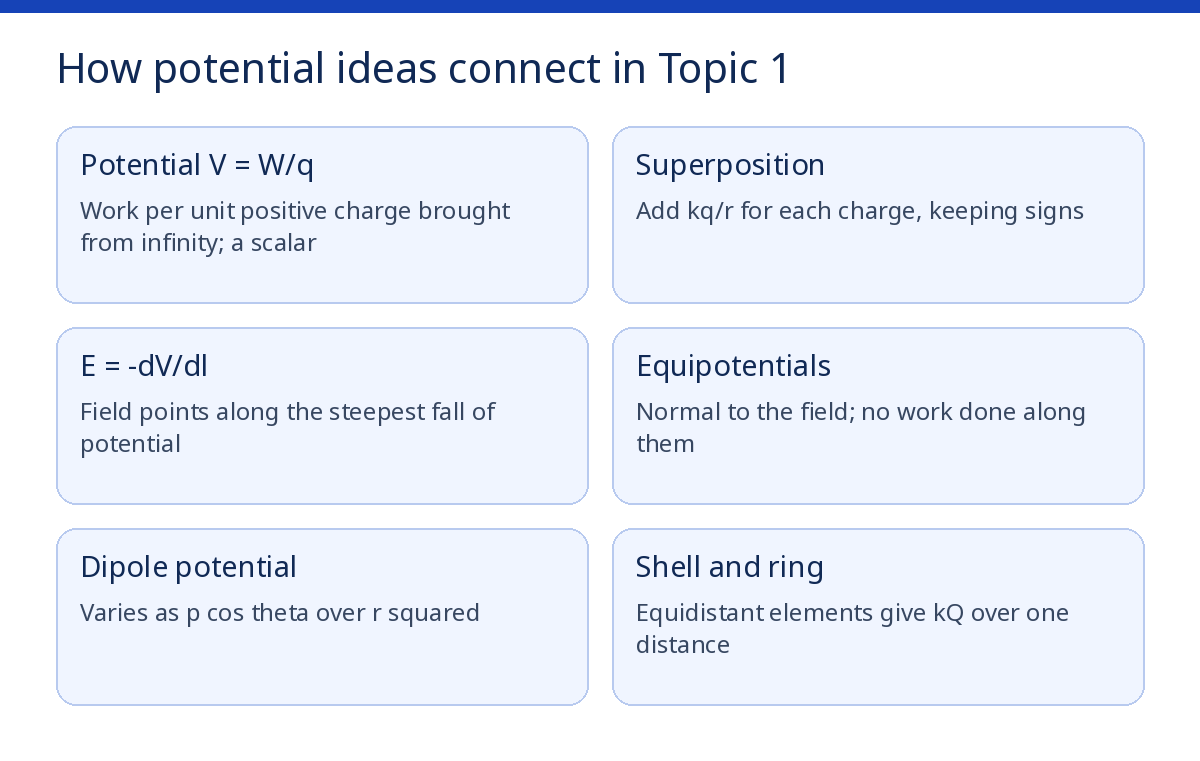
The assessment defines electrostatic potential at a point as the work done by an external force in bringing a unit positive test charge from infinity to that point, without acceleration: . Its SI unit is the volt, where . It is a scalar.
For a point charge, the solutions build by integrating the external force from infinity to . The worked arithmetic uses in SI units. is positive for and negative for , and it falls as .
Because potential is a scalar, the potential of a system of charges is the algebraic sum , with signs included. No vector resolution is needed. This idea runs through the triangle, square and two-charge questions in Topic 1.
It also explains a recurring task: finding where on the line joining two unlike charges. A strong answer checks each region separately, between the charges and beyond each one. It then rules out the region where the larger charge is always nearer.

Electrostatic Potential and Capacitance | Class 12 | CBSE Assessment
In the StudentCurio app
201 original Class 12 Physics questions on electrostatic potential and capacitance, arranged by NCERT topic, with step-by-step worked solutions. Four topic sections (potential and equipotential surfaces; potential energy; conductors, dielectrics and capacitance; capacitor combinations and stored energy) plus mixed chapter practice, each with MCQs, assertion-reason, 2-, 3- and 5-mark questions and case-based questions.
Reading the field from the potential: E = −dV/dl
Several questions turn on the relation , where is measured along the normal between two close equipotentials. The derivation in the source compares the work done by the external force with the change .
The normal is the shortest path between two equipotentials. The fall in potential per unit length is therefore greatest along it, so the field points in the direction of steepest decrease of potential.
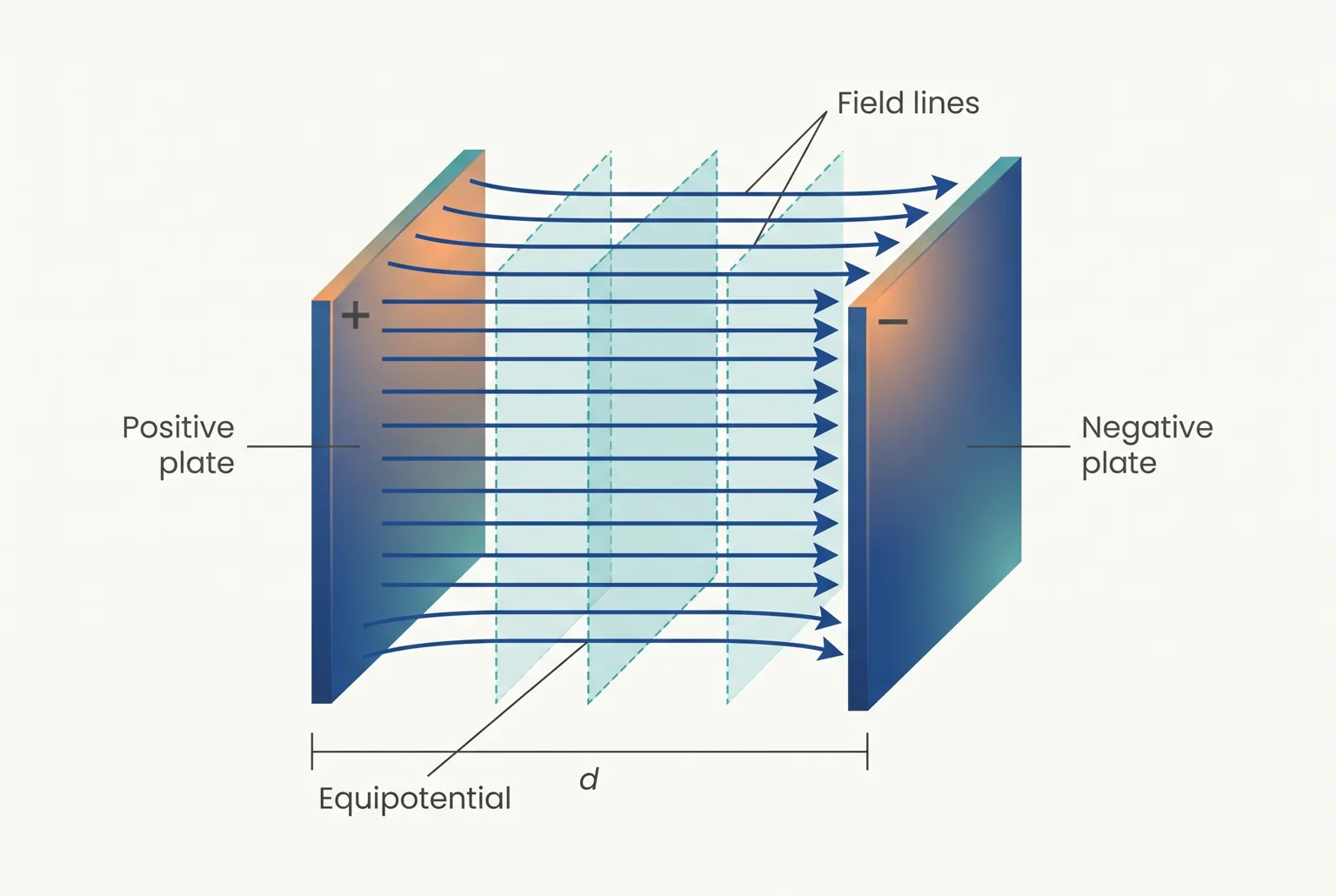
When is given as a function of coordinates, each field component is the negative partial derivative, for example . The magnitude then comes from combining the components. Between parallel plates, as on the cover figure, the field magnitude is , and it is nearly uniform away from the plate edges.
The unit of potential gradient, , reduces to , the unit of electric field. Notice also that depends on how changes, not on its value. So potential and field need not be zero at the same point.
Equipotential surfaces and the work done on them
An equipotential surface has the same potential at every point. Along such a surface , so the work is zero. The field is normal to the surface at every point, never parallel to it.
Two equipotentials cannot intersect. At the crossing point the potential would have two values, and the field would have two normal directions.
The shape of the surfaces depends on the field:
- In a uniform field, they are planes perpendicular to the field. Equal steps of give equal spacing.
- For an isolated point charge, they are concentric spheres. Because , equal potential steps do not give equal radial gaps. Work out which way the spacing changes.
- Where equipotentials drawn at equal steps of crowd together, the field is stronger.
In a uniform field, only the displacement along the field changes the potential. Motion perpendicular to the field stays on one equipotential.
Why dipole potential falls faster than a point charge's
For a short dipole with , the source derives , where .
On the axis ( or ), . On the equatorial line (), both charges are at the same distance , so their contributions cancel and .
Two differences from a point charge matter:
- A dipole's potential varies as , not .
- It depends on the angle , while a point charge's potential is spherically symmetric.
The source attributes the faster fall-off to the two opposite charges nearly cancelling at large . Keep that cause separate from the angle dependence. Assertion–reason items reward exactly this kind of distinction between a true statement and a correct explanation.
Shells and rings: when every charge element is equidistant
By Gauss's law, the field inside a uniformly charged thin spherical shell is zero. No work is needed to move a test charge inside, so the potential there is constant and equal to the surface value . Outside, the shell behaves as if its charge were concentrated at the centre.
The long-answer shell question asks for sketches of both and against . Expect to show a flat inside the shell but zero there.
A thin ring uses the same shortcut. At the centre, every element is at distance . At an axial point, every element is at the same distance . Each case reduces to divided by one common distance.
Common mistakes with signs and direction
- Work by the field versus by an external agent. The solutions use . When a positive charge moves to higher potential, the field does negative work.
- Negative charges. A negative charge such as an electron is pulled towards higher potential. The force on it is opposite to .
- Field direction. points from higher to lower potential. Between plates, it runs from the higher-potential plate to the lower one.
- Dropping signs in sums. Add potentials algebraically, with the sign of each charge included.
How the topic sets lead into mixed practice
The assessment has 201 original questions with step-by-step worked solutions, arranged by NCERT topic:
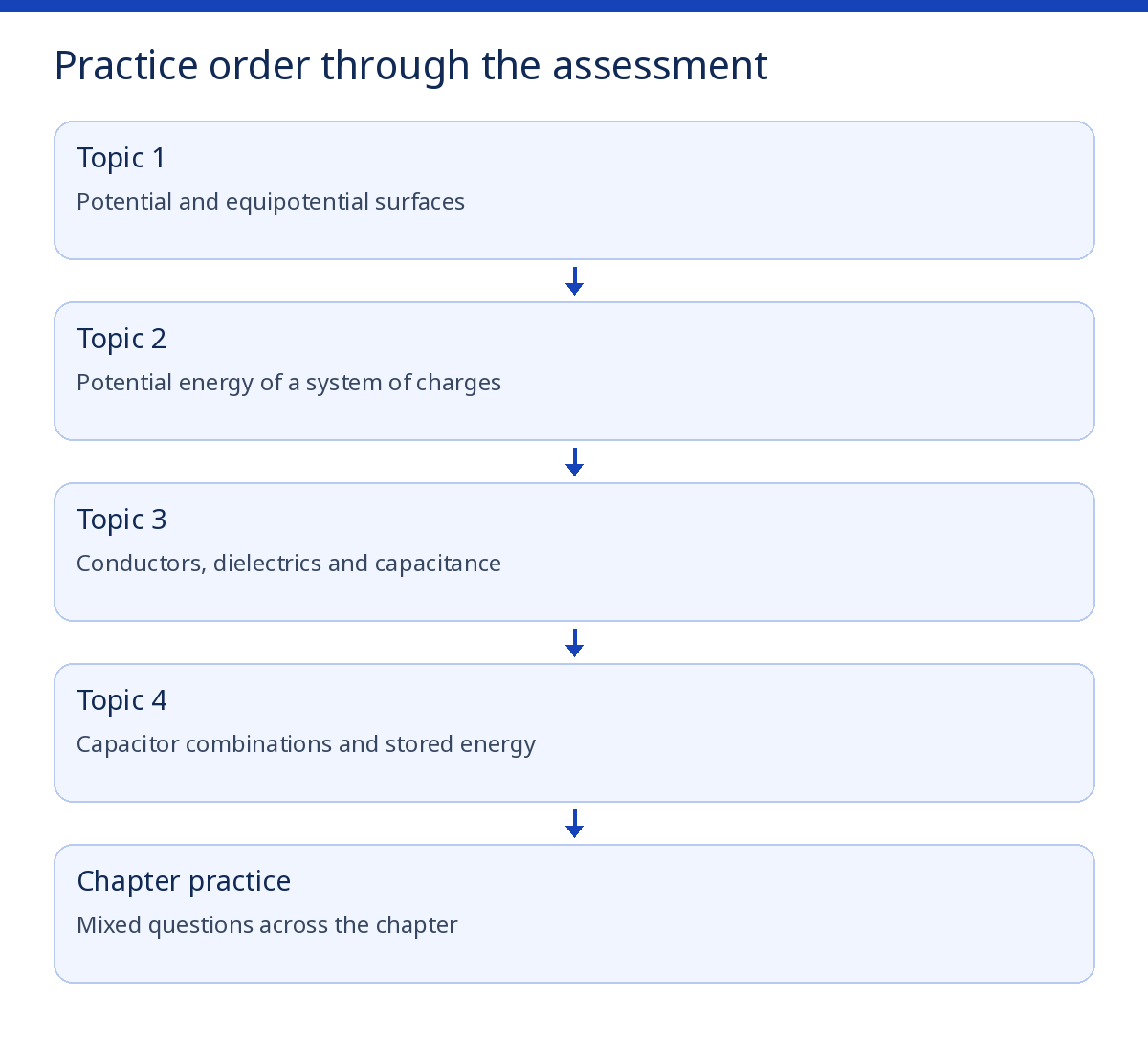
- Topic 1: Electrostatic Potential and Equipotential Surfaces (41 questions, NCERT 2.1–2.6)
- Topic 2: Potential Energy of a System of Charges (34)
- Topic 3: Conductors, Dielectrics and Capacitance (39)
- Topic 4: Combination of Capacitors and Energy Stored (38)
- Chapter practice: mixed questions (49)
Each part contains MCQs and assertion–reason items, very short answer (2 marks), short answer (3 marks), case-based (4 marks) and long answer (5 marks) questions. Each case-based question is followed by four 1-mark MCQs. Every question links to its solution and back.
Work through the topics in order before the mixed set, because Topic 1's ideas about potential and field underpin the later topics. In each solution, check that your answer shows the steps the solution sets out: the formula stated, SI conversions, and the direction or sign of the result. Attempt questions before opening solutions.
Quick self-check on potential and field
- Can you explain, using , how a point can have zero potential but a non-zero field?
- For a point charge, do equal steps of potential produce equipotential spheres that get closer together or farther apart moving outward? Why?
- Why does only the component of displacement along a uniform field change the potential?
Frequently asked questions
Which NCERT sections does Topic 1 cover?
Topic 1 covers NCERT 2.1 to 2.6: the introduction, electrostatic potential, potential due to a point charge, an electric dipole and a system of charges, and equipotential surfaces, including the relation between field and potential.
What question formats appear in each topic?
Each topic and the chapter practice include MCQs and assertion–reason items, 2-mark very short answers, 3-mark short answers, 4-mark case-based questions and 5-mark long answers, followed by worked solutions.
Spotted an error? Report a correction. Practise this in the app: notes, formula sheets and mind maps.













































































































































































Loading comments…