CBSE Class 12 Physics 2023 Solved Paper: Set 55/4/3
CBSEPhysics2023 Previous Year Paper
Paper code: 55/4/3 · 2023Practise the full English-language CBSE Class 12 Physics main examination paper from 2023, set 55/4/3. Use the worked explanations to check not only your final answers but also how you interpreted graphs, chose a physical model and justified each step.
This set is one of the year's papers. See every set from 2023, grouped by series.
What you get in this year-wise paper
This file pairs the original English questions, options and diagrams with worked explanations organised by question number. The explanations distinguish the formula used, the concept used and the steps connecting them. The cover provides links to individual questions, and the worked pages link back to the corresponding question. The resource also includes explanations for the printed internal alternatives, so you can review the branch you did not attempt after a timed sitting.
Because this is one full paper from a particular year and set, its value is in practising how to switch between topics and response formats in a single sitting. Use it to see how this board paper combines conceptual choices, graph interpretation, diagrams and calculations, not as a checklist of everything that could appear in another paper.

Physics 2023 | Class 12 | Previous Year Paper | Code 55/4/3
In the StudentCurio app
Complete solved CBSE Class 12 Physics paper, set 55/4/3, with worked answers covering topics including optics, electrostatics, current electricity, magnetism, electromagnetic induction, semiconductors and nuclear physics. Useful for practising a previous board examination and reviewing solution methods.
How the 70 marks are organised
The printed instructions allow three hours, prohibit calculators and list 35 questions across five sections. Section A contains 18 one-mark objective questions, including assertion–reason items at the end. Section B has seven two-mark very short answers; Section C has five three-mark short answers; Section D has three five-mark long answers. Section E contains two four-mark case-based questions.
There is no overall choice. All question numbers must be attempted, but where an internal choice is printed, select the required branch rather than treating both alternatives as compulsory. For a timed attempt, record the branch you chose and leave the other for review. In the assertion–reason items, make three separate checks: whether the assertion is true, whether the reason is true and whether the reason actually explains the assertion. Then consult the codes printed on this paper.
Optics: know what your diagram represents
The paper uses both wave optics and ray optics. The wave-optics questions draw on interference and single-slit diffraction. When reviewing them, distinguish the spacing of interference fringes from the width of a diffraction maximum. A double-slit pattern can have closely spaced interference fringes within a broader diffraction envelope, so the two widths describe different features of the pattern.
The ray-optics material includes an astronomical refracting telescope, a two-lens combination, an optical fibre and a prism. For a lens combination, track the image formed by the first lens before assigning the object distance for the second; use the second lens as the reference for that distance. In the lens case study, separate the effects of surface curvature from those of refractive index. The refractive index of the surrounding medium matters as well as that of the lens material.
Common mix-ups in circuit and field questions
The cell question asks for terminal voltage plotted against two different variables: external resistance and current. Before sketching either graph, label the horizontal axis and identify what stays fixed. For a cell delivering current with fixed emf and internal resistance, terminal voltage is linear in current. That does not make it linear in external resistance, because changing the resistance also changes the current.
In the alternating-current questions, distinguish a change in magnitude from a reversal of direction. Also distinguish adding voltage magnitudes from combining voltages with a phase difference: across a resistor and a capacitor in series, the component voltages are out of phase. In induction, use the change in magnetic flux to decide the direction of the induced effect. Lenz’s law concerns opposition to the change in flux, not opposition to the original magnetic field in every situation.
Read energy and semiconductor questions by quantity
The photoelectric questions make it useful to distinguish the incident photon energy, the work function and the maximum kinetic energy of the emitted electrons. The work function is the minimum energy needed to remove an electron from the surface; the stopping potential measures maximum kinetic energy per unit charge. An energy in electronvolts and a potential in volts are not the same physical quantity.
In the nuclear section, a potential-energy graph provides a way to reason about force: the force along the separation coordinate is given by the negative slope, not by whether the potential energy is positive or negative. In semiconductors, distinguish mobile carrier concentration from net charge. Donor doping can increase the number of mobile electrons without leaving the crystal negatively charged, because ionised donors carry balancing positive charge.
Quick self-check before opening a worked answer
For a graph or diagram question, ask whether you can say in words what the axes, rays or current arrows represent. For a calculation, name the physical quantity you want and the conditions that make your chosen relation applicable. In the electrostatics case study, for example, the paper moves between field, potential and dipole energy. Identifying which quantity a subpart asks for helps you avoid carrying a relation over simply because it appeared in the previous part.
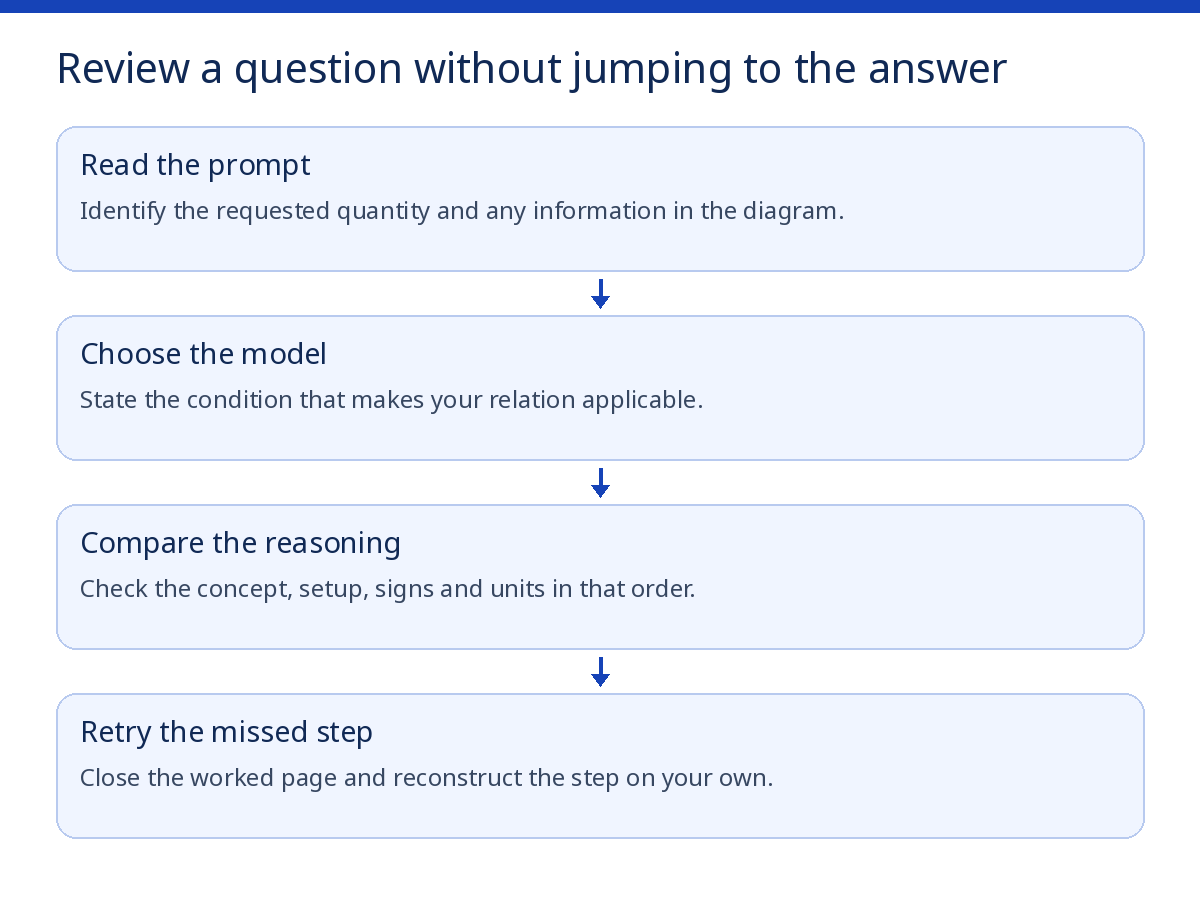
Set aside the worked pages for your first attempt. On review, find the earliest point where your reasoning diverged: reading the figure, selecting the model, handling a sign or completing the arithmetic. Then retry that step without the worked page open. For an internal alternative, attempt it separately to see whether the same weakness carries over to a different question format.
Items not used as worked examples
This guide does not rely on the answer choice for the nuclear-force wording in Q3, the charge-sign assumption in Q4, the mirror wording and option lettering in Q9, or the unrealistic mass-defect value in Q15. Those isolated issues do not prevent you from using the rest of the paper. If an extracted line appears to have lost a sign, symbol or unit, refer to the printed question and its diagram rather than treating the extracted text as authoritative.
Spotted an error? Report a correction. Practise this in the app: notes, formula sheets and mind maps.













































































































































































Loading comments…