CBSE Class 12 Physics 2026 Previous Year Paper With Solutions
CBSEPhysics2026 Previous Year Paper
Paper code: 55/4/1 · 2026Practise with the full English-language CBSE Class 12 Physics 2026 main examination paper (55/4/1). This year-wise file pairs the original questions and diagrams with worked explanations you can use to review your reasoning after an attempt.
This set is one of the year's papers. See every set from 2026, grouped by series.
Know the format before you start
This paper gives you 3 hours for 70 marks, with no calculator. Its 33 questions are divided into five sections. Section A has sixteen one-mark multiple-choice questions, including four assertion–reason items. Section B has five two-mark very short answers, and Section C has seven three-mark short answers. Section D has two four-mark case studies, while Section E has three five-mark long answers.
All numbered questions are compulsory: there is no overall choice. Where an internal choice is printed, attempt one alternative in a timed sitting. Section A has no internal choices. Keep the supplied list of constants available during the attempt, and use the original PDF diagrams when a question depends on the orientation of a field, a ray or a circuit branch.

Physics 2026 | Class 12 | Previous Year Paper | Code 55/4/1
In the StudentCurio app
A complete CBSE Class 12 Physics paper for 2026 with worked solutions, covering topics across electricity, magnetism, optics, modern physics and semiconductors. It helps students practise board-exam questions and review solution methods.
Electricity and magnetism: track what changes
The paper moves between electrostatics, current electricity, magnetic forces and electromagnetic induction. An electric dipole task asks about work between two orientations in a uniform field. A circuit task calls for Kirchhoff’s rules, while a magnetic-force task requires you to distinguish the net field at a conductor from the force on that conductor. These are different jobs: identify the quantity being asked for before choosing a relation.
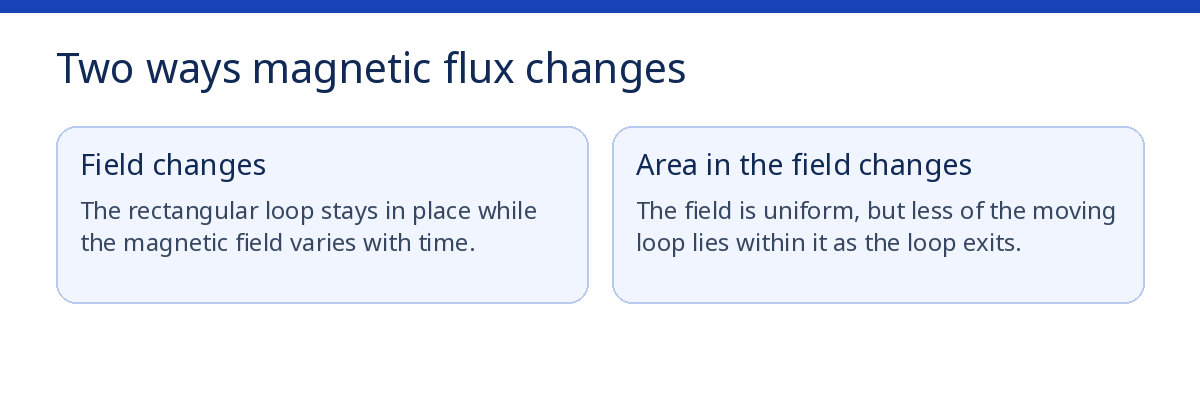
The induction questions are useful to compare because flux can change for different reasons. One setup has a time-varying magnetic field; another has a loop leaving a region of uniform field, changing the area of the loop within that region. In the graph question, read the flux and emf plots together: the magnitude of the induced emf is tied to the rate of change of flux, not to how large the flux is at that instant.
Common mix-up: average, peak and effective AC values
The AC questions give you a reason to label a quantity before substituting it. The coefficient of a sine term is its peak value. A signed average over a complete cycle accounts for both positive and negative halves; the root-mean-square value instead describes the effective value for heating in a resistor. For a sinusoid, the conversion is . Do not use that conversion for an arbitrary waveform.
The longer AC question offers a series LCR circuit or a transformer. In the circuit branch, distinguish impedance, which governs the current amplitude for a given voltage amplitude, from power factor, which accounts for the phase difference when finding average power. In the transformer branch, notice when the question explicitly assumes an ideal transformer before relating input and output quantities.
Optics: choose the representation the question needs
The optics questions ask for more than one kind of diagram. A prism task needs a ray path with angles read relative to the relevant surface normal. A Huygens construction, by contrast, needs wavefronts and secondary wavelets to show how the next wavefront forms. The single-slit diffraction option changes the representation again: it asks for an intensity pattern against angular position and separately asks about the linear width on the screen.
In the telescope case study, begin by identifying which lens acts first and which image becomes the object for the next lens. Mark the adjustment condition wherever it is specified. This gives you a way to check whether a statement about lens separation belongs to the stated setup rather than to every arrangement of the same two lenses.
Modern physics and semiconductors: read the assumptions
The photoelectric items distinguish whether emission can occur from how much kinetic energy an emitted electron can have. The first comparison is between photon energy and the material’s work function. A later task connects photoelectric emission to the de Broglie wavelength and explicitly makes the work function negligible; that simplification does not carry over to the questions that give work-function data.
The alpha-scattering task asks for both a graph and conclusions drawn from it. Keep those parts separate so you can check that each inference follows from the pattern you drew. Semiconductor questions also use distinct representations: carrier concentrations in a doping problem and a circuit with input and output waveforms for a full-wave rectifier. A concentration calculation does not practise the same skill as explaining why the rectifier conducts through different paths over successive half-cycles.
After the attempt: find the first step to revise
The file’s question-number links let you move to the worked explanations, and the solutions cover the printed internal choices. Use the Formula used, Concept used and Explanation in steps labels to pinpoint where your reasoning first diverged. A wrong result can come from choosing the wrong principle, using a valid principle under the wrong conditions, or making an error in signs, units or arithmetic. Note which occurred before reworking the question without looking.
For a second pass, try the internal alternatives you left blank. Check sketches against the printed axes and diagrams, and assess assertion–reason items by testing each statement separately before asking whether the reason explains the assertion. This guide leaves out the answer choices for the resistance-measurement error item because their wording does not clearly specify the kind of error being compared.
Spotted an error? Report a correction. Practise this in the app: notes, formula sheets and mind maps.













































































































































































Loading comments…