CBSE Class 12 Physics 2026 Paper with Worked Solutions
CBSEPhysics2026 Previous Year Paper
Paper code: 55/2/1 · 2026Practise with the full English CBSE Class 12 Physics 2026 main examination paper, code 55/2/1. Use the worked solutions after your attempt to check how you chose a principle, interpreted a diagram or set up a derivation.
This set is one of the year's papers. See every set from 2026, grouped by series.
Know the format before you start
This year-wise resource contains one complete board paper, not a chapter-wise question bank. The exam allows three hours for 70 marks and does not permit a calculator. The printed instructions supply physical constants for use where needed. Keep that page available during a timed attempt so you can use the stated values without opening the solutions.
The paper has 33 questions in five sections. Section A contains 16 one-mark multiple-choice questions, including four assertion–reason items. Sections B and C contain five two-mark very short answers and seven three-mark short answers, respectively. Section D has two four-mark case studies, and Section E has three five-mark long answers. There is no overall choice: all questions are compulsory, with internal alternatives in selected questions outside Section A. Attempt one branch where a choice is offered; save the other for review.

Physics 2026 | Class 12 | Previous Year Paper | Code 55/2/1
In the StudentCurio app
Complete CBSE Class 12 Physics paper (code 55/2/1) with worked solutions, covering questions across topics including electromagnetism, optics, atomic and nuclear physics, and semiconductors. Helps students practise board-exam questions and review solution methods.
What the paper asks you to do with the physics
Electrostatics and current electricity appear in several forms. An equipotential sketch asks you to translate a field into a spatial picture, while a Kirchhoff problem asks you to interpret connections in a circuit. The nuclear physics questions distinguish ways of grouping nuclides from reasoning about nuclear size. The atomic physics questions use the Bohr model to ask about both orbit radii and energy levels: before comparing neighbouring states, identify which quantity the question is asking you to compare.
The magnetism and induction questions also vary the task. A field-direction item uses a specified coordinate setup, while a mutual inductance derivation depends on the placement and orientation of a loop inside a solenoid. In both formats, the geometry is part of the reasoning. Mark the relevant axis, direction or area before referring to an equation.
Common mistakes: using a rule before checking its conditions
Do not treat equal kinetic energy and acceleration through the same potential difference as interchangeable starting points in a de Broglie comparison. Wavelength depends on momentum. If particles start from rest and gain energy by acceleration through a potential difference, the energy gain depends on the magnitude of the charge as well as the voltage. Decide which quantity is actually held fixed before comparing wavelengths.
In capacitor questions, distinguish a capacitor that remains connected to a battery from one that is disconnected and isolated. An ideal battery fixes the potential difference; an isolated capacitor retains its charge. These are different constraints when the capacitance changes. In assertion–reason items, make a similar distinction between two separate checks: whether each statement is true, and whether the reason explains the assertion. Two true statements need not form an explanation.
Read each case study as a model
Section D gives you two setups: a p–n junction and a convex lens moved between a fixed object and screen. In the junction passage, separate the role of concentration differences in diffusion from the role of the junction field in drift. The comparison between an unbiased junction and a biased one matters because a statement about the balance of the two currents does not automatically carry over when a voltage is applied.
For the lens case, sketch the fixed object and screen first. Then mark the two positions of the lens described in the setup. Keep the total object–screen separation distinct from the distance between the lens positions and from the object and image distances measured at either position. Labelling these separately gives you a way to check what each quantity means before you interpret a formula or compare image sizes.
Quick self-check: does the diagram support the explanation?
The long answers ask for different representations, including an interference intensity graph, a telescope ray diagram and a series LCR phasor diagram. In an intensity graph, the horizontal coordinate describes position on the screen. In a phasor diagram, the angles show phase relationships, not physical angles between wires or components. For the refracting telescope, the stated final image position sets a condition that the ray diagram must represent.
Before opening a worked solution, ask yourself: Could I use my diagram to explain why I wrote my next equation? Check whether you have labelled the quantities named in the question and shown the condition that governs the setup. If you can recall the final formula but cannot connect it to the diagram, revisit that link during review.
Use the worked solutions to diagnose your first wrong step
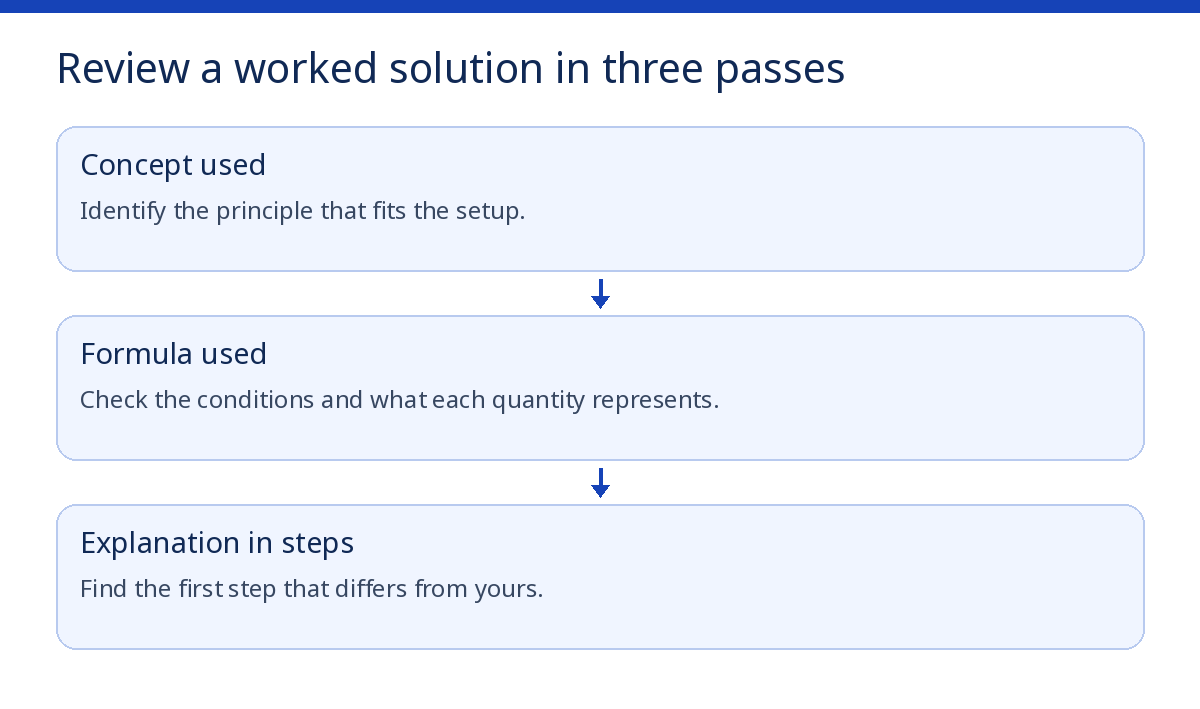
Finish your first attempt before using the question-number links on the cover. The worked explanations separate the formula used, concept used and explanation in steps. Compare those layers in order. If you picked the wrong principle, reread the condition in the question. If the principle was appropriate, look for the first difference in your setup, such as a sign convention, a graph axis or a unit conversion. This is more useful than checking only whether your final result matches.
After reviewing your first attempt, try the internal alternative you left unattempted. The resource includes explanations for the printed choices, so you can review those separately without changing how you sat the paper.
Review note: This guide leaves out the first version of Q30(iv) and part (iii) of the Q33 generator alternative because their printed wording is ambiguous. It does not reproduce assessment answers.
Spotted an error? Report a correction. Practise this in the app: notes, formula sheets and mind maps.













































































































































































Loading comments…