CBSE Class 12 Atoms: From Rutherford to Bohr
CBSEPhysicsAtomic Physics
This guide to the NCERT Class 12 Physics chapter **Atoms** connects two kinds of evidence: how alpha particles scatter and why hydrogen emits light at discrete wavelengths. It explains what each atomic model accounts for, where it falls short, and how to read the chapter’s diagrams and equations together.
What does an atomic model need to explain?
The chapter begins with a distinction: knowing that an atom is electrically neutral does not tell you how its charges are arranged. The presence of negatively charged electrons implies that a neutral atom also contains positive charge. Thomson’s model spread that positive charge throughout the atom, with electrons embedded in it. Rutherford’s model instead concentrated the positive charge and most of the mass in a small central nucleus, with electrons some distance away.
Read these models as different explanations, not just different pictures. Scattering tests how charge and mass are distributed within the atom. Spectroscopy raises another question: why does an excited atom emit only certain wavelengths? The nuclear model was successful at explaining the scattering evidence, but it did not answer the question posed by the spectrum.

Atomic Physics | Class 12 | NCERT Textbook
In the StudentCurio app
This textbook chapter covers Rutherford’s alpha-particle scattering, atomic models, Bohr’s energy levels and hydrogen spectra, and de Broglie waves. It helps Class 12 students understand atomic structure and the origin of spectral lines.
How rare deflections revealed the nucleus
In the Geiger–Marsden experiment described by NCERT, a narrow beam of alpha particles struck a thin gold foil. A movable detector registered light flashes when scattered particles hit its screen. The experimenters could therefore compare how many particles emerged at different angles. In Figure 12.3, distinguish the dots, which represent observations, from the solid curve, which is the prediction based on a small, dense, positively charged nucleus.
Most alpha particles passed through the foil with little or no deflection, consistent with atoms being largely empty space. A small fraction turned through large angles. That rare result was especially informative: to turn a positively charged alpha particle back, the atom had to exert strong repulsion. A close encounter with a compact region of positive charge could account for this. The two observations belong together: most particles pass through because the nucleus occupies so little of the atom, but a close pass can change a particle’s direction sharply.
Do not confuse impact parameter with closest approach
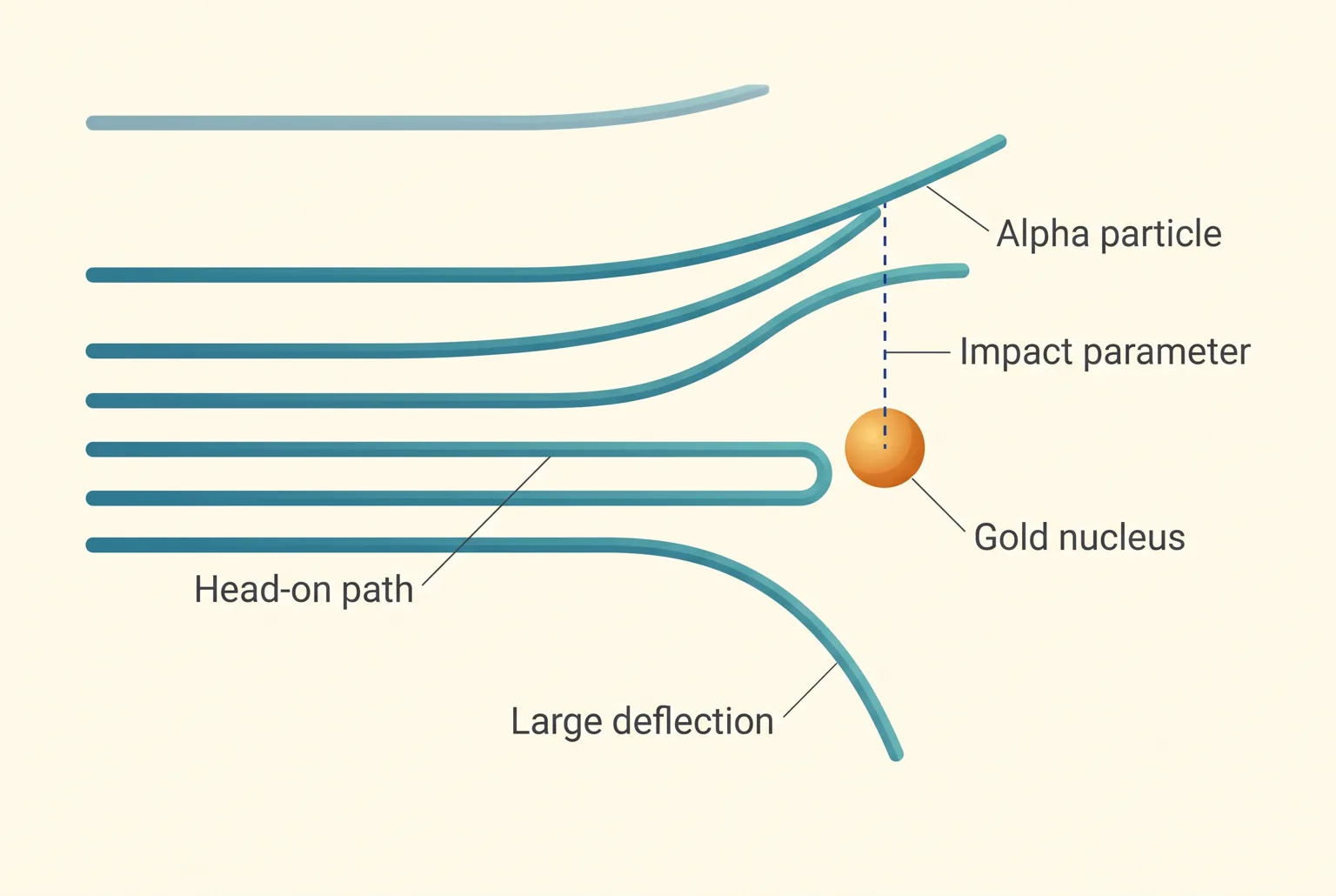
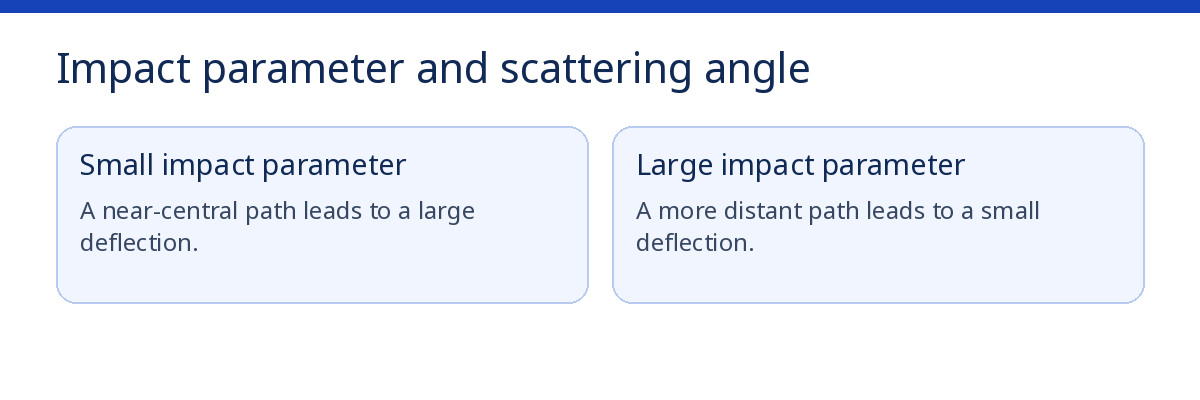
Use Figure 12.4 to locate the impact parameter before following the curved trajectory. It is the perpendicular distance from the centre of the nucleus to the straight line along which the alpha particle is initially moving. For particles with nearly the same incoming kinetic energy, a smaller impact parameter gives a larger deflection. In the head-on case, the impact parameter is zero, but the particle still turns around at a finite distance from the nucleus.
That turning distance is the distance of closest approach in a head-on encounter. In the chapter’s approximation of a stationary gold nucleus, the alpha particle momentarily stops and its initial kinetic energy has become electrostatic potential energy. This argument does not apply unchanged to an off-centre encounter, where the particle is still moving at its closest point. Nor does the turning distance measure the nuclear radius directly: electrostatic repulsion can reverse the particle without contact.
What spectral lines tell you that scattering cannot
An excited atomic gas at low pressure emits light at certain wavelengths rather than across a continuous range. In an emission line spectrum, these wavelengths appear as bright lines against a dark background. When white light passes through a gas, the wavelengths removed from the transmitted light appear as dark lines in an absorption spectrum. The characteristic wavelengths make the spectrum useful for identifying the gas.
The classical orbit picture could not account for this discreteness. An electron moving in a circle accelerates even if its speed is constant. Classical electromagnetic theory predicts that an accelerating charge radiates, so the orbiting electron should lose energy and spiral inward. As its orbital frequency changed, the predicted radiation frequency would change continuously. This would explain neither the stability of the atom nor its observed pattern of distinct lines.
Read Bohr’s energy levels from the sign as well as the number
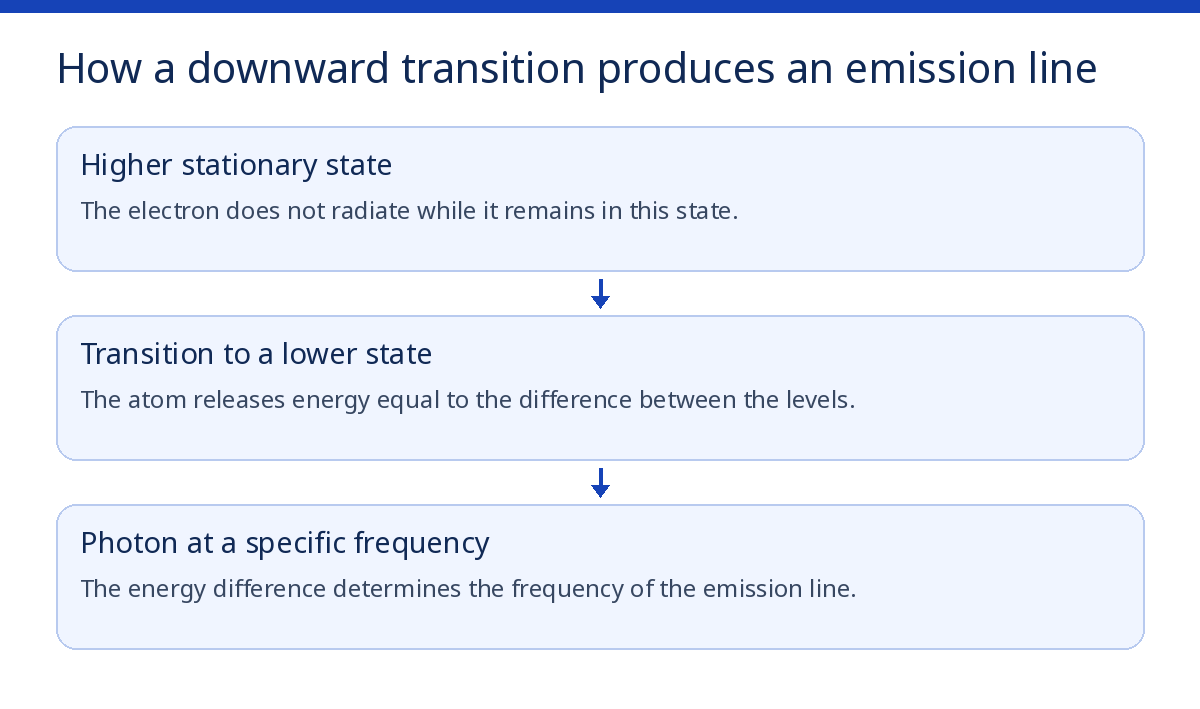
Bohr retained the nucleus but postulated that the electron could occupy only certain stationary states, each with a definite energy. The electron does not radiate while it remains in one of these states. In the model, the allowed orbital angular momenta satisfy , where is Planck’s constant and is a positive integer. This restricts which orbits are allowed; it is not a rule for calculating the energy of an emitted photon.
For hydrogen, the allowed energies are . Zero energy here corresponds to a separated electron and proton at infinite distance. A negative value therefore indicates a bound electron, not negative kinetic energy. As increases, the energy rises towards zero: a level that is less negative is higher in energy and requires less additional energy to reach the ionisation limit.
Quick self-check: is it a level or an energy gap?
For emission, the electron moves from a higher-energy state to a lower-energy state. The photon carries the difference, , with . Although both bound-state energies are negative, the photon energy is positive. Ask yourself whether an expression describes the energy of hydrogen in one state or the energy transferred between two states. Different allowed gaps give different photon frequencies, which is the link between Bohr’s model and the discrete lines of hydrogen.
As you read the file, compare the scattering trajectories in Figure 12.4 with the hydrogen emission lines in Figure 12.5. For each figure, state what is observed and what the model explains. The resource overview also lists de Broglie waves, but that discussion lies beyond the supplied excerpt. The numerical calculation in Example 12.4 is omitted because the printed prose and display disagree on the speed exponent.
Spotted an error? Report a correction. Practise this in the app: notes, formula sheets and mind maps.













































































































































































Loading comments…