CBSE Class 12 Physics 2026 Previous Year Paper and Solutions
CBSEPhysics2026 Previous Year Paper
Paper code: 55/4/3 · 2026Use the full CBSE Class 12 Physics 2026 main examination paper (55/4/3) for a three-hour practice attempt. Then use the worked solutions to check whether you chose the right principle, applied it under the right conditions and answered every part of the question.
This set is one of the year's papers. See every set from 2026, grouped by series.
Set up a three-hour attempt
This English-language paper is organised by year rather than by chapter. It carries 70 marks and contains 33 questions across five sections. Section A has sixteen one-mark questions, including assertion–reason items. Section B has five two-mark very short answers, and Section C has seven three-mark short answers. Section D contains two four-mark case studies, while Section E has three five-mark long answers.
There is no overall choice: attempt every question number, choosing one alternative wherever an internal choice is printed. These choices occur in some questions in Sections B to E, not in Section A. The paper supplies physical constants and does not allow calculators. Use the printed values during your attempt, and write down any unit conversions so you can check them afterwards.

Physics 2026 | Class 12 | Previous Year Paper | Code 55/4/3
In the StudentCurio app
A complete CBSE Class 12 Physics paper for 2026, with questions and worked solutions covering topics across the syllabus. Helps students practise board-exam questions and review solution methods.
Notice what each question asks you to show
The shorter items move across topics such as photoelectric emission, electromagnetic waves in a medium, alternating voltage and semiconductor behaviour. The written questions ask you to do different things: reason about the equilibrium positions of a dipole, explain a full-wave rectifier with a circuit diagram and waveforms, or derive the balance condition of a Wheatstone bridge. A correct numerical result does not replace a diagram or derivation where one is requested.
Some questions combine ideas that use similar language. In the question linking photoelectric emission and de Broglie waves, the incident radiation has a wavelength, and the emitted electron has a wavelength associated with its momentum. Label the two quantities separately and note that the question asks you to treat the work function as negligible. That is an assumption for this task, not a general rule for photoemission.
The long-answer alternatives include a series LCR circuit or a transformer, and prism optics or wavefront construction. Read all the subparts before choosing a branch: knowing the opening definition does not tell you whether you can complete the later calculation or diagram.
Common mistakes: confusing similar quantities
In the alternating-current questions, keep peak, cycle average and root-mean-square (rms) values distinct. An ordinary average retains the signs of the instantaneous values. An rms value comes from averaging their squares and then taking the square root. Before calculating, identify which quantity is being asked for and check whether the interval is a complete cycle. A sinusoid-specific shortcut is not a general rule for every waveform.
In current electricity, distinguish calculating a ratio from testing a law. The ratio , where , gives the resistance at that operating point. One pair of readings does not establish ohmic behaviour: for an ohmic conductor, voltage is proportional to current when temperature and other physical conditions are held fixed. Use that distinction in the resistance case study, where interpreting how readings vary demands more than evaluating a single ratio.
A useful connection: follow the setup through the diagram
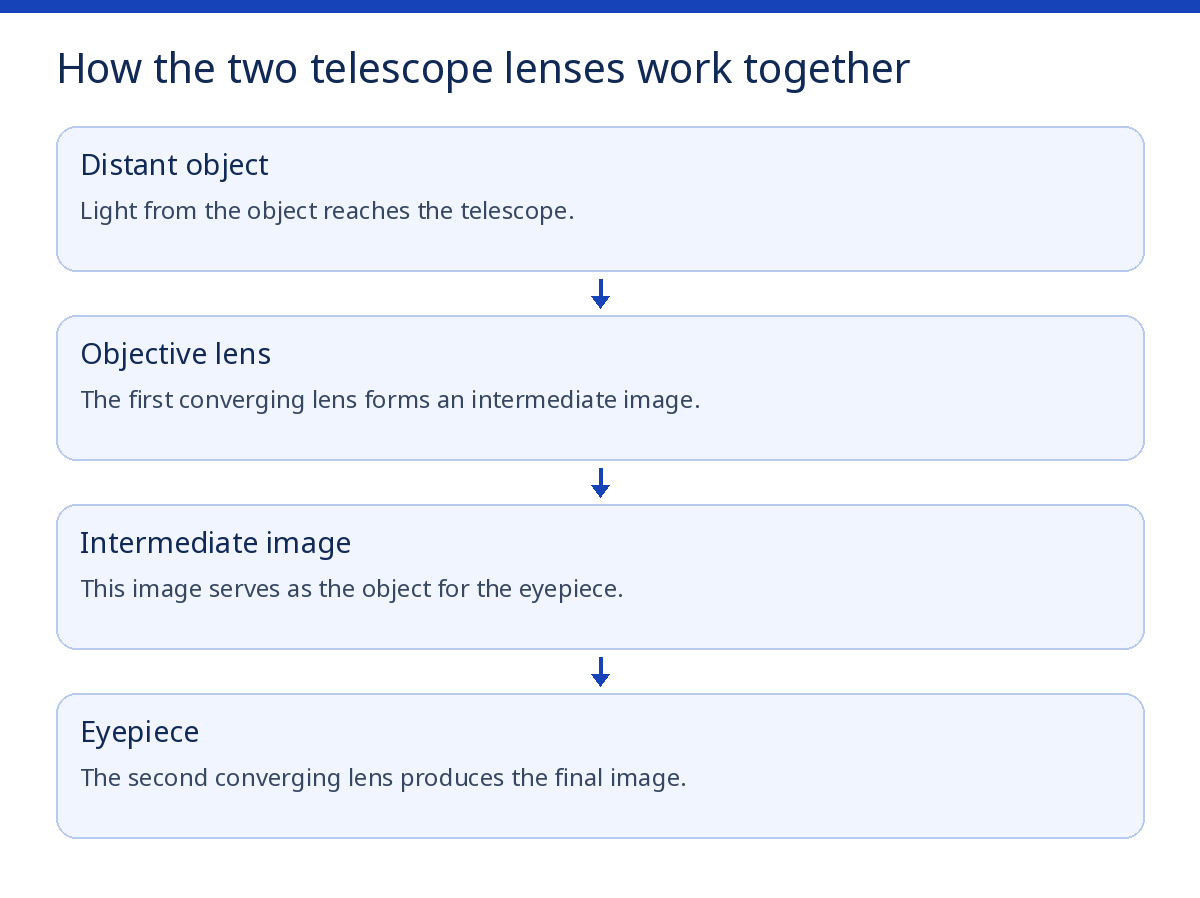
The case studies use a shared setup across several subparts. In the telescope passage, the objective forms an intermediate image that serves as the object for the eyepiece. Follow that sequence before thinking about the final image, and note when a subpart specifies normal adjustment rather than assuming it throughout. In the resistance case study, locate the meters and trace the rheostat connections in the printed circuit before reasoning about changes in readings. The effect of moving the contact depends on which part of the rheostat is connected, not simply on whether the contact moves left or right.
Apply the same habit to the prism question. Identify the face the ray meets and draw the normal there before marking the angle of incidence. At the next interface, measure the new angle from the normal to that face, not from the first normal or from the face itself.
Use the worked solutions to find the first wrong step
The file links question numbers to worked explanations and provides links back to the questions. The explanations separate the formula used, concept used and steps. The cover says they include all printed internal choices. For a timed attempt, stay in the question pages until you finish; during review, use the links to find the explanation for the branch you actually attempted.
When your result differs, find the first step where your reasoning diverges from the explanation. Choosing the wrong principle calls for a different review from choosing the right principle but misreading a unit, sign or diagram label. For a written response, check the requested elements too: a rectifier explanation needs to connect the operation of the circuit to both the input and output waveforms.
This guide leaves out the worked comparison in Question 5 because the extracted option layout is unclear, and the meter-error options in Question 30(ii) because the type of error is not specified.
Quick self-check before a second attempt
For an assertion–reason item, judge each statement independently before deciding whether the reason explains the assertion. Two statements can concern the same phenomenon without one accounting for the other. For a numerical item, name the quantity you need and state the conditions for the relationship before substituting values.
Then try one internal choice you skipped in the timed attempt, without opening its worked solution. Compare what the two branches asked you to produce. If the calculation was manageable but the alternative left you unable to construct or explain a diagram, practise that representation next rather than repeating the calculation you already know.
Spotted an error? Report a correction. Practise this in the app: notes, formula sheets and mind maps.













































































































































































Loading comments…