Dual Nature of Matter and Radiation: NCERT Class 12 Physics
CBSEPhysicsDual Nature of Matter and Radiation
This CBSE Class 12 NCERT chapter uses the photoelectric effect to show why light’s wave model is not enough to explain every observation. Use the textbook’s graphs, examples and exercises to connect electron emission with Einstein’s equation before moving on to de Broglie’s matter-wave hypothesis.
Why free electrons still need energy to escape
The chapter begins with evidence for the wave nature of light and with experiments that established the electron as a constituent of matter. These two threads meet in the photoelectric effect: when suitable light falls on a metal surface, electrons can escape. The initial distinction is that an electron can be free to move within a metal, contributing to conduction, without being free to leave its surface.
The work function, , is the minimum energy needed for an electron to escape from the metal surface. It depends on the metal and the condition of its surface. The textbook distinguishes three ways to supply that energy: heating in thermionic emission, applying a sufficiently strong electric field in field emission, and illuminating the surface with light of suitable frequency in photoelectric emission. The electrons that escape in the last case are called photoelectrons.

Dual Nature of Matter and Radiation | Class 12 | NCERT Textbook
In the StudentCurio app
This textbook chapter covers photoelectric emission and Einstein’s photoelectric equation, the photon model of light, and de Broglie’s hypothesis and matter-wave relation, with examples and end-of-chapter exercises. It helps Class 12 students understand wave–particle duality and practise related problems.
How the experiment separates emission from collection
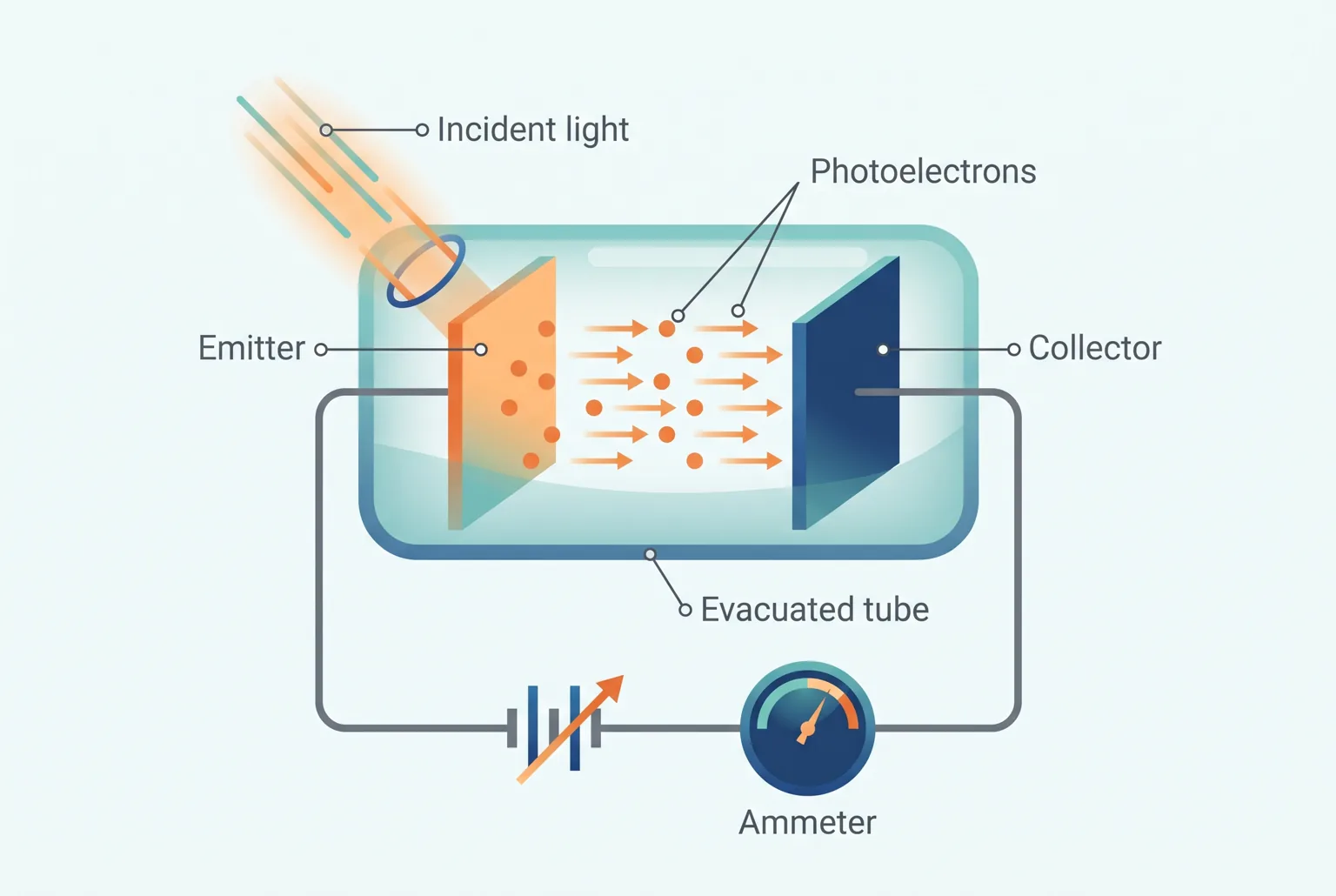
In the textbook’s evacuated-tube setup, light illuminates the photosensitive emitter, while a second plate collects electrons that reach it. The measured photocurrent therefore depends on collection as well as emission. With the light frequency and intensity fixed, making the collector more positive attracts more of the emitted electrons until all of them are collected. The current then levels off at the saturation current. A further increase in accelerating potential does not raise the current.
Reversing the polarity makes the collector negative relative to the emitter. The resulting retarding field prevents less energetic electrons from reaching the collector first. As the collector becomes more negative, the photocurrent falls to zero. At this point even the most energetic photoelectrons fail to reach the collector. Zero current here is not evidence that light has stopped ejecting electrons: it means the circuit no longer registers any arriving at the collector.
Common mistake: treating brightness and frequency alike
Read the intensity and frequency graphs as separate experiments. For a given emitter and fixed frequency above threshold, increasing the intensity raises the saturation current but leaves the stopping potential unchanged. More electrons are emitted per second, but the maximum kinetic energy does not increase. On the current–potential graph, this means comparing the height of the plateaus separately from the points where current reaches zero.
Changing the frequency changes the energy result. For the same surface, a higher frequency above threshold gives a higher maximum kinetic energy, so a larger retarding voltage magnitude is needed to stop the electrons. Below the threshold frequency, there is no photoelectric emission, however intense the incident light. That threshold depends on the emitter, so a frequency that produces photoelectrons from one material need not produce them from another.
What Einstein’s photon model explains
The chapter does not discard the wave model: interference, diffraction and polarisation are explained by the wave picture. It asks instead whether continuous energy absorption can account for photoelectric emission. That picture would lead one to expect brighter light to give individual electrons more energy and sufficiently intense light to cause emission even below the observed threshold. It also struggles to explain why suitably high-frequency light causes emission without an apparent delay even when the beam is very dim.
Einstein’s model assigns energy to each photon, where is Planck’s constant and is the light frequency. In the chapter’s explanation, an electron absorbs one photon. Increasing intensity at a fixed frequency delivers more photons per unit area per second rather than increasing the energy of each photon. This distinction explains why the rate of emission can rise without a corresponding rise in the maximum electron energy.
When the photoelectric equations apply
For light above threshold, Einstein’s equation gives . The work function is the minimum escape cost, so the difference gives the maximum kinetic energy, not the energy of every emitted electron. Electrons that need more energy to escape emerge with less kinetic energy. The threshold is . A negative result from substituting a frequency below threshold does not describe a negative kinetic energy; it signals that emission is not possible under this model.
The experiment gives a second expression, , where is the positive magnitude of the electron charge and is the magnitude of the stopping potential. The collector is at a negative potential relative to the emitter at cutoff, but the energy in this expression is positive. Keep the energy units consistent: an electron volt is a unit of energy, not voltage, and .
A useful connection: from photons to matter waves
The chapter’s final change of perspective is from radiation to matter. The photoelectric effect calls for a particle description of light’s energy transfer, even though light displays wave behaviour. De Broglie’s hypothesis makes the complementary connection by associating a wavelength with a material particle’s momentum. Keep the roles of the two ideas distinct: the photoelectric equation is an energy balance for electron emission, while the matter-wave relation concerns the wavelength associated with a particle.
When reading the textbook examples, identify what each quantity describes before choosing a relation: the incident light, the emitting surface or the electron. In the end-of-chapter exercises, carry that distinction into your reasoning. Before calculating, check whether emission is possible and whether the question concerns a current, an electron energy or a wavelength. Those are different observables, even when they appear in the same chapter.
Spotted an error? Report a correction. Practise this in the app: notes, formula sheets and mind maps.













































































































































































Loading comments…