CBSE Class 12 Physics 2023 Supplementary Paper Guide
CBSEPhysics2023 Previous Year Paper
Paper code: 55/C/2 · 2023Use the full 2023 CBSE Class 12 Physics supplementary paper (55/C/2) for a three-hour board-format practice attempt. Then use the linked worked solutions to check your method, from reading a circuit diagram to stating the assumptions behind a derivation.
This set is one of the year's papers. See every set from 2023, grouped by series.
Read the paper rules before starting
This year-wise file contains the English version of the 2023 CBSE Class 12 Physics supplementary paper, labelled Supplementary / Compartment. It carries 70 marks, allows three hours and does not permit calculators. The file retains the original English questions, options and diagrams. Its question-number links help you find the worked explanations after an attempt.
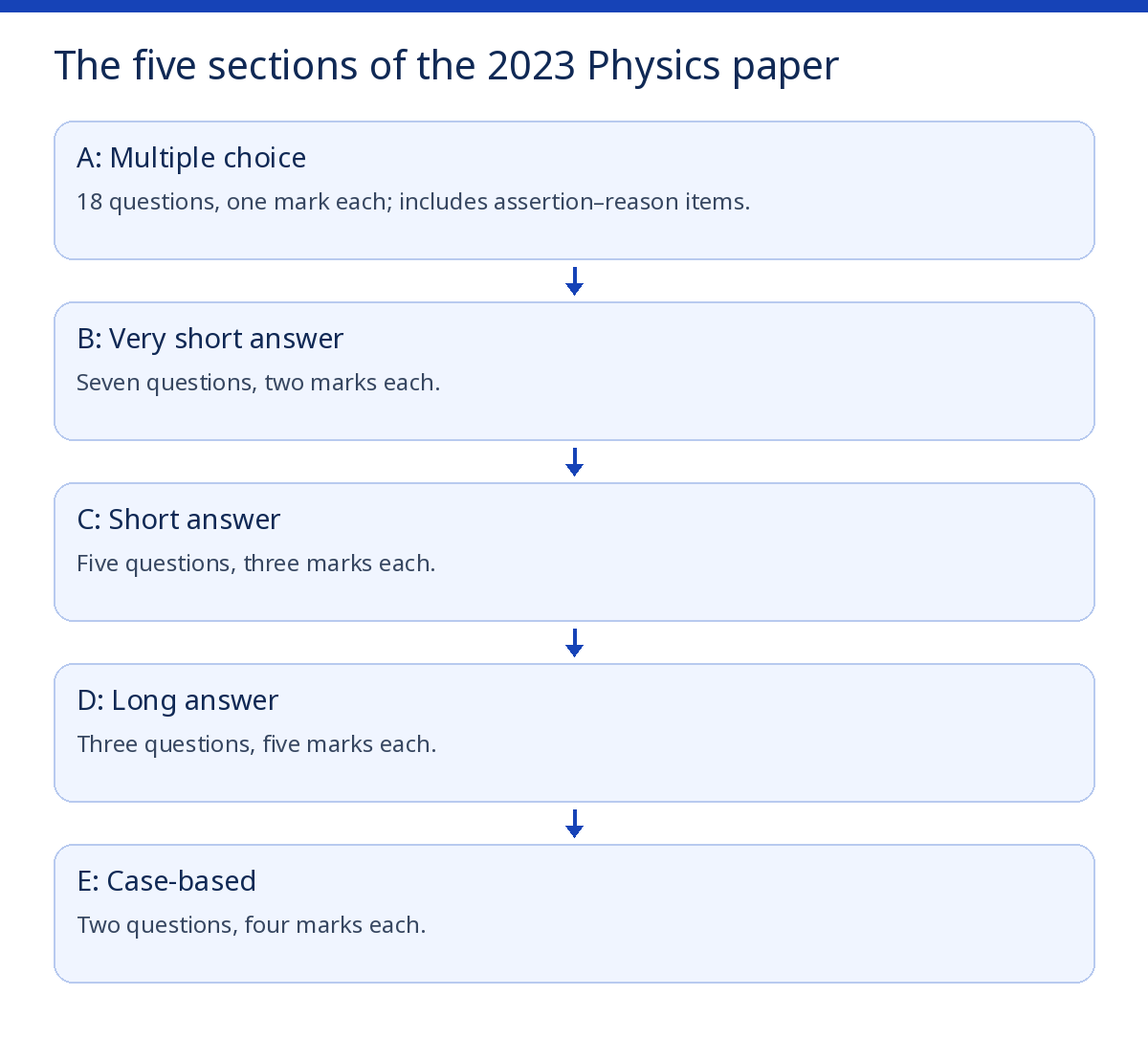
The paper has 35 compulsory questions across five sections. Section A has 18 one-mark multiple-choice questions, including assertion–reason items. Section B has seven two-mark very short answers; Section C has five three-mark short answers; Section D has three five-mark long answers; and Section E has two four-mark case-based questions. No overall choice means you cannot omit a numbered question in favour of another. Where an internal choice is printed, attempt one alternative on the timed run and save the other for review.

Physics Supplementary 2023 | Class 12 | Previous Year Paper | Code 55/C/2
In the StudentCurio app
The complete 2023 CBSE Class 12 Physics supplementary paper includes questions and worked solutions across the syllabus, including capacitor concepts. It helps students practise the board-paper format and review solution methods.
Notice how the paper changes the task
The paper covers more than capacitor calculations. It includes electrostatics, current electricity, magnetism, electromagnetic induction and alternating current, as well as optics, the photoelectric effect, atoms, nuclei and semiconductor devices. Because this is a full paper rather than a chapter worksheet, the task can change from interpreting a physical relationship to reading a graph or constructing a labelled diagram.
Adjust what you write to the instruction. In an assertion–reason item, judge each statement before deciding whether the reason explains the assertion. In a short answer that asks for justification, name the law or physical relationship that connects the setup to your conclusion. For a long answer that asks for a diagram and a derivation, make the labels in the figure match the quantities used in the algebra. This makes it easier to check where a sign or distance entered your reasoning.
Good to remember: identify what stays fixed
Capacitors appear in distinct roles. In the alternating-current questions, a capacitor is a circuit element whose reactance depends on both capacitance and frequency. For an ideal capacitor in sinusoidal steady state, for . In a series circuit with resistance, capacitive reactance is not the same as the total impedance. When a question varies one quantity at a time, note what it holds fixed before using the circuit relationship.
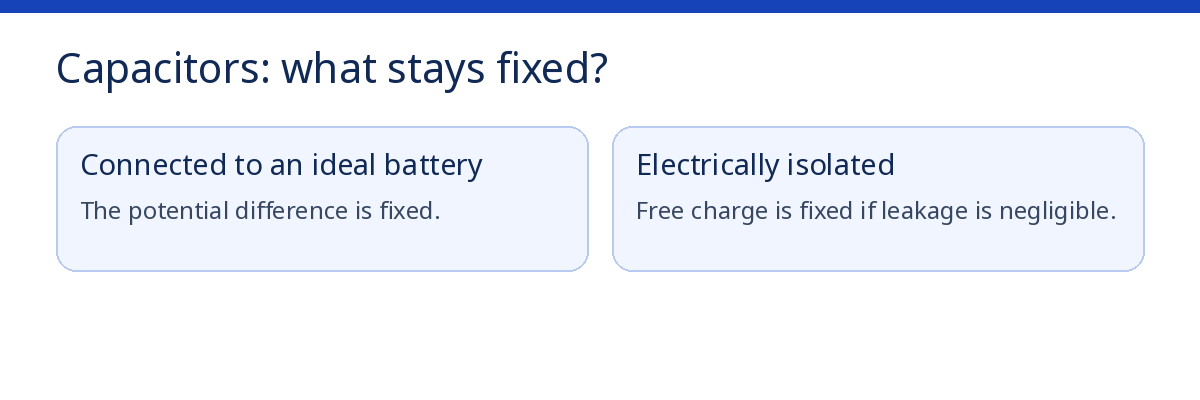
The capacitor case study instead brings together plate geometry, a dielectric, equivalent capacitance and stored energy. In questions about a charged capacitor, distinguish a connection to an ideal battery, which fixes the potential difference, from electrical isolation, which fixes the free charge if leakage is negligible. State the constraint before choosing an energy expression: the same stored energy can be written in terms of charge or potential difference, but those quantities need not both stay fixed.
Quick self-check: name the optical setup first
The optics questions distinguish ray optics from wave optics. Mirror, lens and prism tasks call for rays, angles and image geometry. The double-slit and single-slit tasks instead require you to reason about interference or diffraction. Before using a fringe relation, ask which arrangement the question describes and whether the marked position is a bright fringe, a dark fringe or the edge of a central maximum. Those labels determine how to interpret a distance on the screen.
The prism case study also separates an exact geometric condition from an approximation. Minimum deviation corresponds to a symmetric ray path through the prism, with equal angles of incidence and emergence. A small-angle expression has an additional restriction: it uses a small-angle approximation. When reviewing your response, check that you have not treated minimum deviation alone as permission to use the approximation.
Use the worked solutions to locate the first error
Keep the solutions closed during your timed attempt. Afterwards, use the question links to compare your work with the explanations, which are organised under Formula used, Concept used and Explanation in steps. Find the first point where your reasoning diverged. Choosing the wrong law calls for a different fix from choosing the right law but reversing a sign, misreading a diagram or leaving out a justification.
The explanations also cover the printed internal alternatives. Try the unused branch before opening its solution. For example, switching branches in the long-answer optics question lets you practise a different diagram and derivation rather than simply repeat a calculation. On a second pass, write the missing reasoning from memory and then check whether it addresses the original instruction.
Check the PDF when notation matters
Use the PDF page rather than the extracted text when a question depends on a circuit connection, graph label, exponent or unit prefix. This matters when identifying which component a voltmeter is across or when copying a physical constant. Keep the question diagram beside your work so that a conclusion refers to the component or point actually labelled in the paper.
This guide leaves out the capacitor case study's numerical values because the extracted unit prefix is unclear. It also leaves out the worked answer to the Rutherford impact-parameter item, where the zero-angle case needs to be distinguished from a finite trajectory. Neither omission prevents you from using the independently supported topics and paper structure for practice.
Spotted an error? Report a correction. Practise this in the app: notes, formula sheets and mind maps.













































































































































































Loading comments…