CBSE Class 12 Physics 2024 Previous Year Paper: Set 55/2/3
CBSEPhysics2024 Previous Year Paper
Paper code: 55/2/3 · 2024Use the full English-language 2024 CBSE Class 12 Physics main examination, set 55/2/3, for a timed attempt. Then use the worked solutions to check whether your reasoning, assumptions and diagrams support your answers.
This set is one of the year's papers. See every set from 2024, grouped by series.
Set up a timed attempt using the printed rules
This year-wise previous year paper keeps questions from across the syllabus in exam order rather than sorting them by chapter. Allow three hours for the 70-mark paper and work without a calculator. All 33 questions are compulsory, but there is no overall choice. Where the paper prints an internal choice, attempt one of the alternatives, not both.
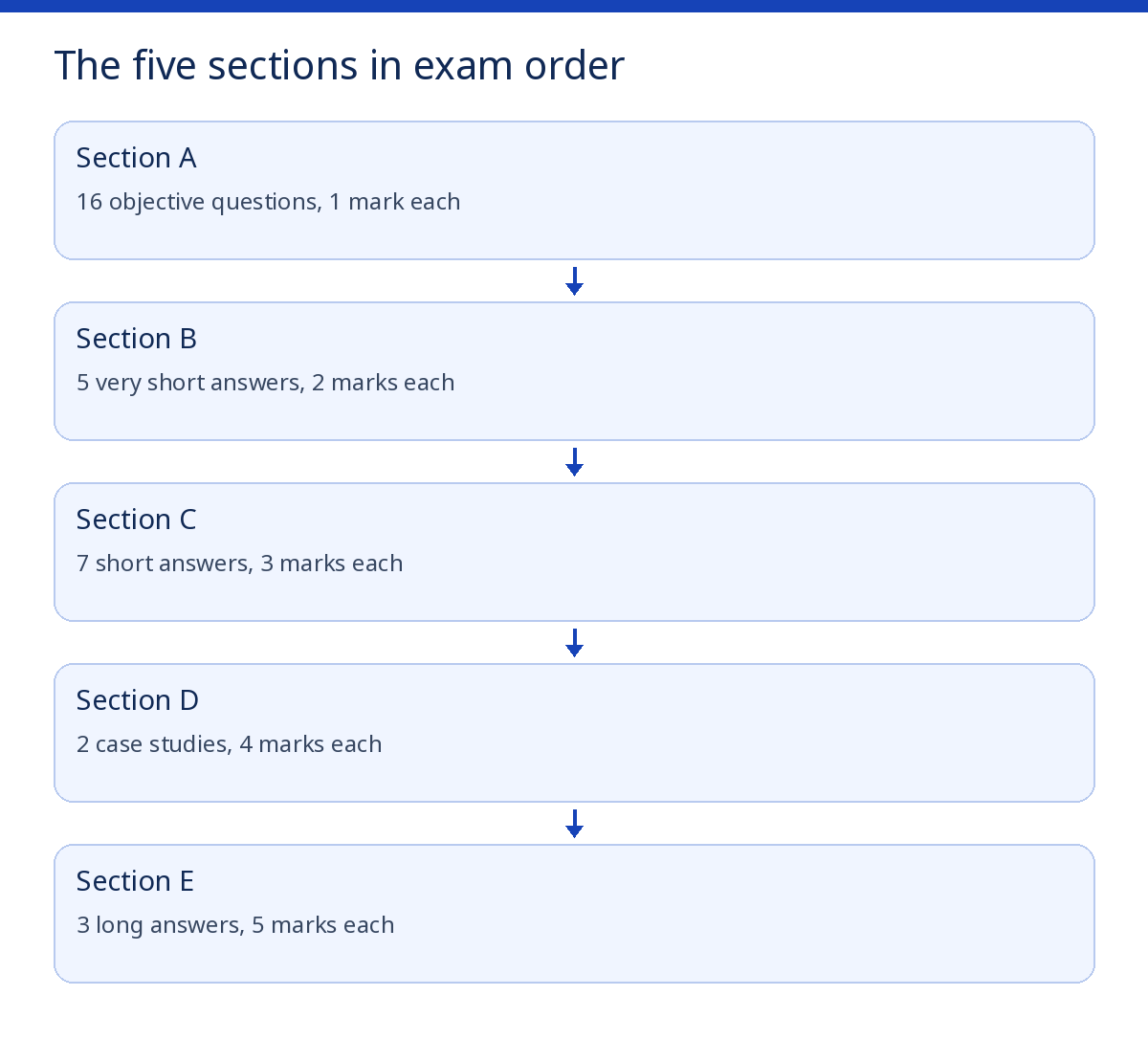
Section A has 16 one-mark multiple-choice questions, including four assertion–reason items. Section B has five two-mark very short answers, and Section C has seven three-mark short answers. Section D has two four-mark case studies, and Section E has three five-mark long answers. There are no internal choices in Section A. Read the printed instructions before starting the clock so that decisions about what to attempt do not interrupt your practice.

Physics 2024 | Class 12 | Previous Year Paper | Code 55/2/3
In the StudentCurio app
Complete 2024 CBSE Class 12 Physics examination paper, set 55/2/3, with worked solutions. It covers questions across the syllabus and helps students practise the exam and review answer methods.
Section A: Identify the quantity before reading the options
The objective section moves between charge interactions, electromagnetic induction, alternating current, atomic transitions and semiconductors. Before looking for a matching option, identify what the question compares: a signed quantity or a magnitude, a phase or an instantaneous value, a quantity that changes or one that stays fixed. In a graph question, name the quantity on each axis before interpreting the slope. That gives you a check on your reasoning that does not depend on the available options.
For assertion–reason items, judge each statement independently before deciding whether the reason explains the assertion. Two true statements can concern the same topic without one accounting for the other. Use the response codes printed on this paper rather than assuming they follow the same order as another set.
Sections B and C: Match your response to the task
The lens question places the same lens in a different medium, the transformer question asks separately about output voltage and instantaneous voltage, and the rectifier question calls for a circuit diagram as well as input and output waveforms. Use the question’s verbs to decide what to put on the page. A derivation must show how the result follows; a requested waveform needs labelled axes and must show how the signal varies with time. For the branch-current problem, report directions as well as magnitudes.
When shape alone is not enough: A convex lens does not necessarily converge light in every surrounding medium. Its behaviour depends on the refractive index of the lens relative to that of the medium. In the transformer problem, keep a different distinction in view: a peak value, an rms value and a time-dependent voltage expression are not interchangeable. Label which quantity a calculation gives.
Section D: Check the physical condition in each case study
One case study concerns refraction and the critical angle; the other distinguishes a cell’s emf from its terminal potential difference. Use the passage to establish the physical situation, then check what changes in each subpart. A ray diagram may give an angle relative to a surface, but the angle of incidence is measured from the normal. A critical angle exists for light travelling from a higher to a lower refractive index. At that angle of incidence, the refracted ray runs along the boundary; it is not the reflected ray that defines the condition.
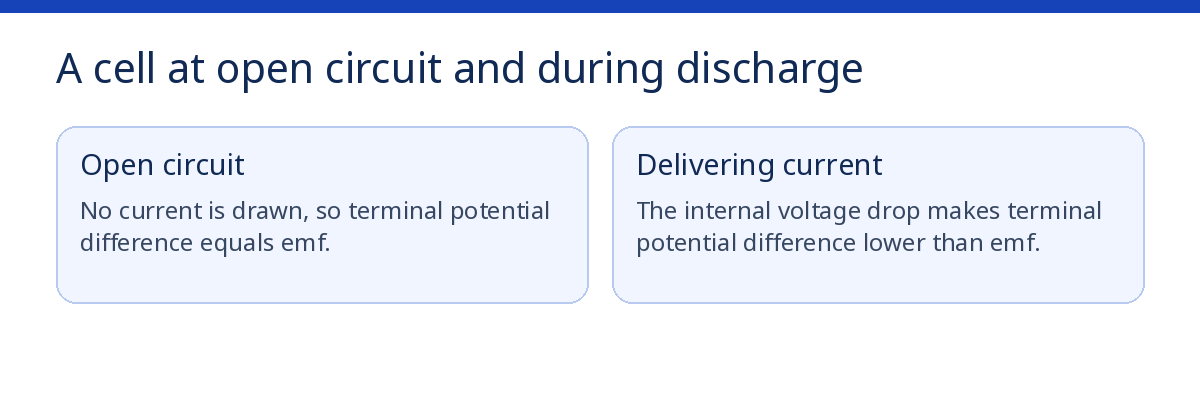
Before using a cell equation: Establish whether the cell is open-circuit or delivering current. With no current drawn, the terminal potential difference equals the emf. When the cell delivers current, its internal resistance causes a voltage drop, so the terminal potential difference is lower than the emf.
Section E: Write down the assumptions behind the method
The long-answer questions combine derivations, diagrams and calculations. The optics alternatives involve wave patterns or optical instruments; electrostatics includes a dipole and a charged plane sheet; and the magnetic topics include charged-particle motion and galvanometer sensitivity. Check every subpart of the alternative you choose. A correct numerical result does not replace a requested derivation or labelled diagram.
The far-field dipole expression assumes that the observation distance is much greater than the dipole’s size. The infinite-sheet field derivation relies on the symmetry of a uniformly charged infinite plane, not an arbitrary finite surface. For optical instruments, identify the specified final image position before selecting a magnifying-power expression. When comparing interference and diffraction, make each comparison about the same feature of both patterns rather than listing unrelated observations.
Use the worked solutions to find the first error
Keep the solutions closed during the timed attempt. Afterwards, use the question-number navigation to compare your work with the resource’s formula used, concept used and explanation in steps. Look for the first point where your reasoning diverges: did you select an unsuitable model, lose a sign or unit, or omit part of a diagram? If your result differs, check the setup before repeating the arithmetic. If it matches but you cannot justify a step, redo that step without looking. The explanations cover the printed internal choices, so you can also practise an alternative you skipped.
Check symbols and units on the rendered question pages rather than relying on extracted text. This guide omits the charge-ratio answer-option comparison because the worked explanation distinguishes the signed ratio from the listed magnitude. It also leaves out numerical options with unclear extracted notation, including the magnetic-flux units.
Spotted an error? Report a correction. Practise this in the app: notes, formula sheets and mind maps.













































































































































































Loading comments…