Wave Optics: Class 12 CBSE Practice Questions and Key Ideas
CBSEPhysicsWave Optics
This guide covers Class 12 Physics Chapter 10, Wave Optics. It explains wavefronts, Huygens' principle, refraction of plane waves and Doppler shift, then shows how a 154-question CBSE practice assessment organises these ideas into board-style sets with step-by-step worked solutions.
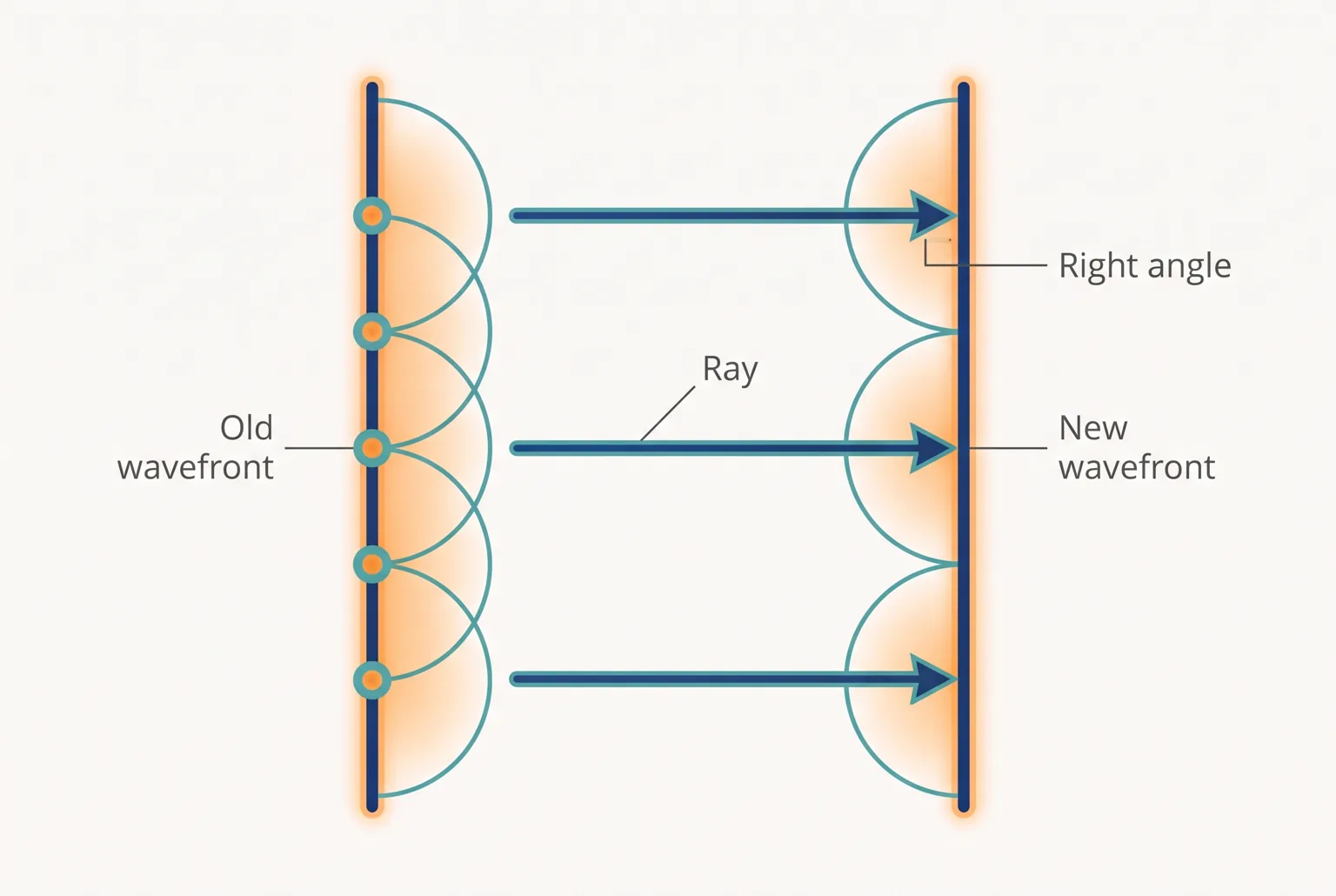
Wavefronts as surfaces of constant phase
The chapter rests on one definition. A wavefront is the locus of all points that oscillate in the same phase, so it is a surface of constant phase. Any two points on the same wavefront therefore have zero phase difference. Several short questions turn on this, such as asking for the phase difference between two marked points on one spherical front.
A ray is a different object. It is a line drawn in the direction of energy flow. In a homogeneous, isotropic medium, rays are the normals to the wavefront, so the angle between a ray and its wavefront is a right angle.
The set expects you to state this distinction cleanly. A wavefront describes phase. A ray describes the direction of travel. Successive wavefronts that differ in phase by are one wavelength apart.

Wave Optics | Class 12 | CBSE Assessment
In the StudentCurio app
154 Class 12 Physics questions on wave optics, arranged by NCERT topic and matched to the 2025-26 CBSE syllabus, with step-by-step worked solutions. Five topic sections (Huygens principle; reflection and refraction of plane waves; coherent and incoherent addition; interference and Young's experiment; diffraction), each with MCQs, 2-, 3- and 5-mark questions and a 4-mark case-based question, plus assertion-reason items.
Matching wavefront shape to its source
The shape of a wavefront depends on the source, and each shape follows from equal travel times. In an isotropic medium light moves at the same speed in every direction. After a time it reaches every point a distance from the source.
- Point source: points at a fixed distance from a point form a sphere, so the wavefronts are spherical.
- Line source (a long slit or filament): points at a fixed perpendicular distance from a line lie on a cylinder.
- Very distant source (the Sun or a star): the front is a sphere of enormous radius. Its curvature is close to zero, so the small part intercepted on Earth is practically plane.
A convex lens with a point source at its focus also gives a plane wavefront, because it makes the rays parallel. For a stated growth time, the radius of a spherical front is simply .
Huygens' construction and the missing backwave
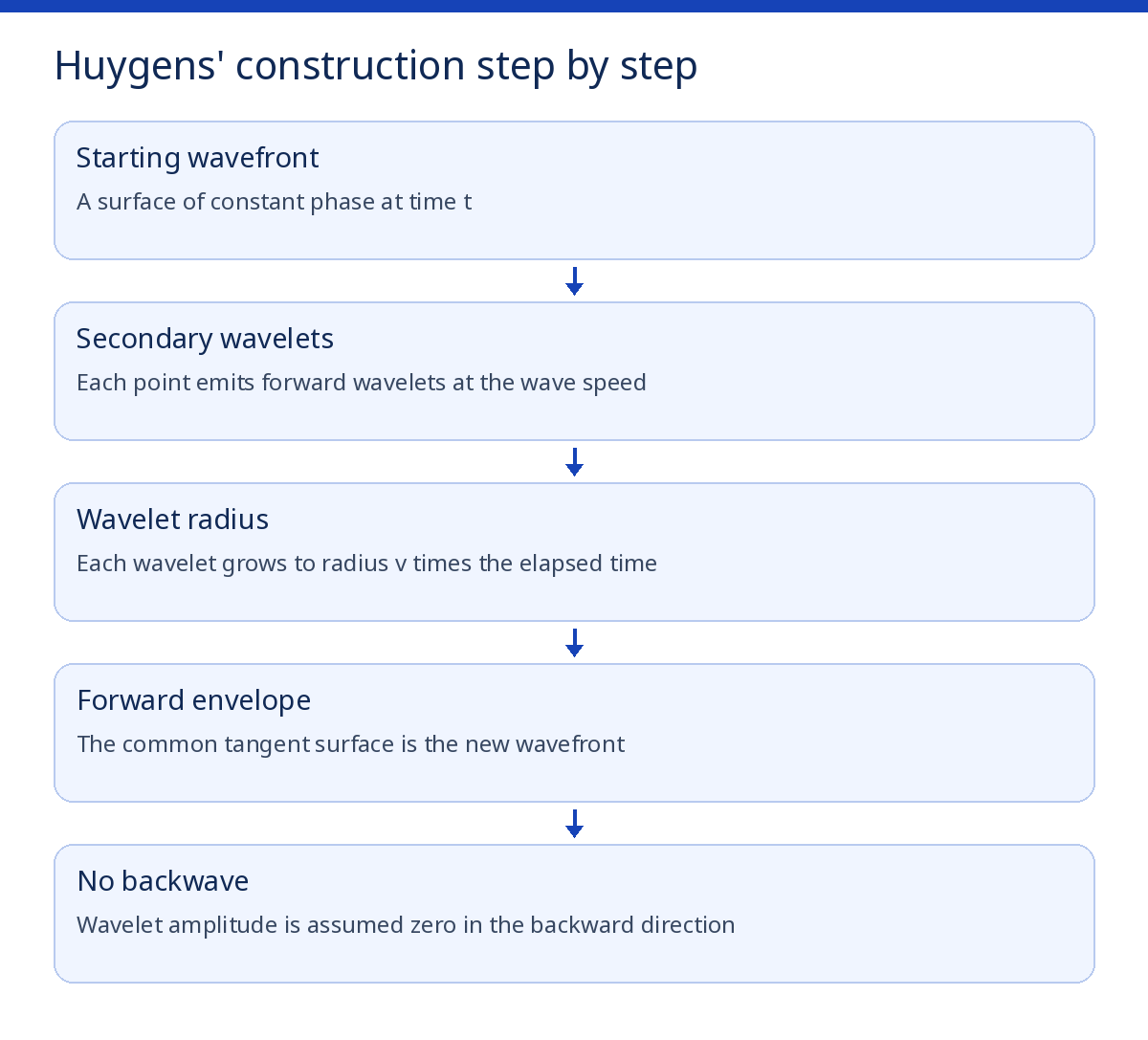
Huygens' principle locates a wavefront at a later time. Every point on a given wavefront acts as a source of secondary wavelets. These wavelets spread forward at the wave speed in that medium. The new wavefront is their forward envelope, the common tangent surface.
For a plane front, wavelets of radius drawn from each point give a new plane parallel to the first, a distance ahead. For a sphere of radius , wavelets of radius give a sphere of radius about the same centre.
Five-mark answers often ask why no backward wave is drawn. The wavelets also have a backward envelope of radius . Huygens assumed the amplitude of the secondary wavelets is maximum forward and zero backward. The source calls this an ad hoc assumption that wave theory later justified.
A strong answer combines three things: a labelled diagram, the envelope argument, and this assumption.
Where Huygens' theory reaches its limits
Huygens' principle does not require transverse waves. It only needs each point of a wavefront to act as a source of secondary disturbances. It therefore applies to longitudinal sound waves: each layer of air passes its compressions and rarefactions on to the next.
The wavelet construction explains reflection and refraction. With Fresnel's addition of superposition, it also explains diffraction. It cannot explain the origin of atomic line spectra. Those come from quantised energy levels of atoms, which wave optics does not describe.
Common mistake: confusing Huygens' original model with modern understanding. Huygens pictured light as a longitudinal mechanical wave in the ether. Light is in fact a transverse electromagnetic wave, with and oscillating perpendicular to the direction of travel.
Speed, wavelength and frequency across a boundary
The refraction questions (NCERT 10.3) test what changes when light crosses into another medium. In a medium of refractive index , the speed is and the wavelength is . Speed and wavelength fall by the same factor, so the frequency stays the same.
For glass or water, is greater than 1, so light travels more slowly there than in air. Assertion-reason items deliberately pair a correct statement with a reason that reverses this.
The questions also ask whether this speed is the same for every colour. They then ask you to draw emerging wavefronts:
- Thin prism: the wavefront is tilted because the prism is thicker at its base.
- Convex lens with a point source at its focus: the emerging wavefront is plane.
In these diagrams, show which part of the wavefront travels through more glass.
Reading redshift and Doppler questions
The same topic set covers the Doppler effect for light. A shift appears when the source and observer have relative motion along the line joining them. A redshift means the observed light has a longer wavelength and a lower frequency than when it was emitted.
The numerical items give a small fractional shift in a spectral line, or a small radial speed in km s. They ask you to link the two through the speed of light , then state whether the source is approaching or receding.
Before you move on: can you explain why only the line-of-sight component of the motion matters? Can you say which direction of motion produces a redshift?
Working through the five NCERT topic sets
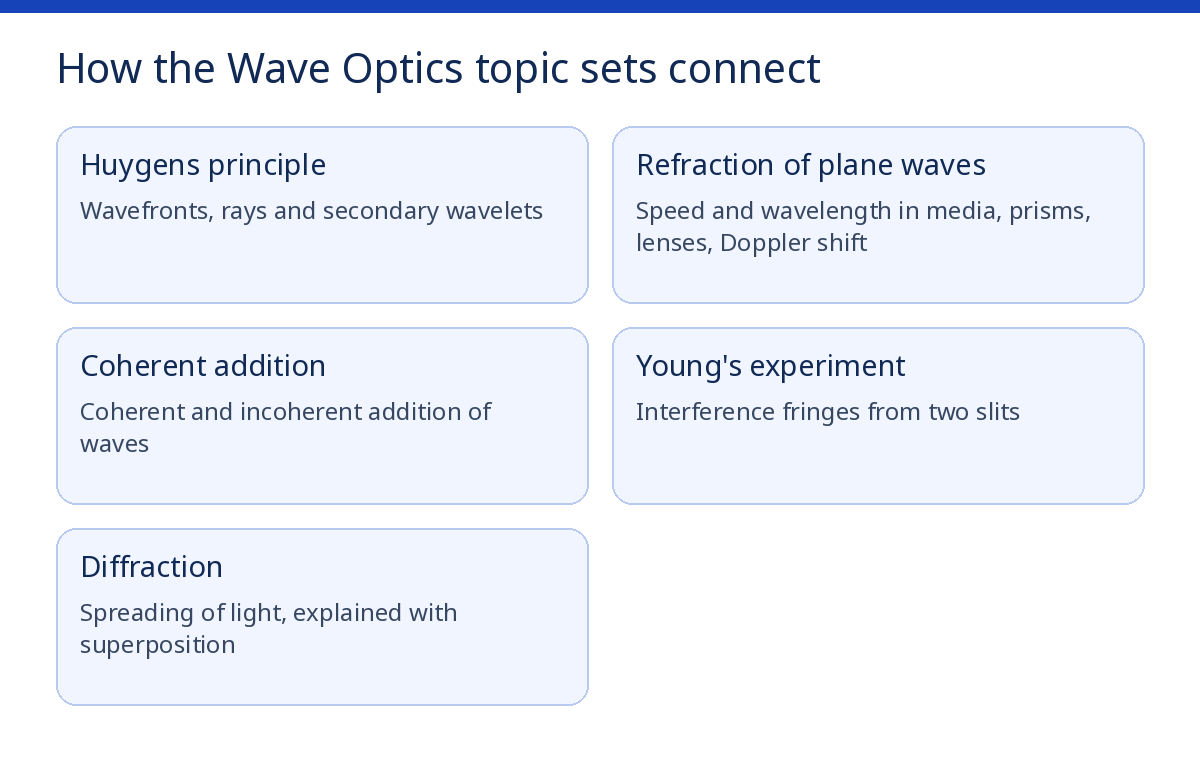
The assessment has 154 questions in five sections. The sections follow NCERT 10.2 to 10.6:
- Huygens principle (21 questions)
- Reflection and refraction of plane waves (32)
- Coherent and incoherent addition of waves (32)
- Interference and Young's experiment (37)
- Diffraction (32)
Questions are numbered continuously. Within each section they follow the CBSE order: MCQs (1 mark), very short answer (2), short answer (3), case-based (4) and long answer (5). Assertion-reason items sit among the MCQs.
In the case-based questions, you read a passage and answer any four of five parts. The long answers typically combine a definition, a Huygens construction and a numerical part.
Every question has a step-by-step worked solution, linked by a Solution arrow. Attempt a full section before opening any solution. Then compare your steps, not just your final option.
Work the topic sets in order, because the later sections build on wavefronts and superposition. Return to the earlier sections for mixed revision.
Frequently asked questions
Which NCERT topics does this Wave Optics assessment cover?
It has five sections matching NCERT 10.2 to 10.6: Huygens principle, reflection and refraction of plane waves, coherent and incoherent addition of waves, interference and Young's experiment, and diffraction.
What question formats are included?
Each section has 1-mark MCQs, 2-mark very short answers, 3-mark short answers, a 4-mark case-based question and 5-mark long answers. Assertion-reason items are also included.
Does the assessment include solutions?
Yes. Every question has a step-by-step worked solution, linked from the question.
Spotted an error? Report a correction. Practise this in the app: notes, formula sheets and mind maps.













































































































































































Loading comments…