CBSE Class 12 Physics 2026 Supplementary Paper 55/7/2
CBSEPhysics2026 Previous Year Paper
Paper code: 55/7/2 · 2026Use the full English-language CBSE Class 12 Physics supplementary paper for 2026 as a three-hour practice test. Then use the worked solutions to check not just your results but also your choice of model, diagram and reasoning.
This set is one of the year's papers. See every set from 2026, grouped by series.
Know the format before starting the clock
This year-wise resource contains the 2026 supplementary or compartment paper, code 55/7/2, with its questions, options and diagrams. The paper is worth 70 marks, contains 33 questions, and does not allow calculators. Use the physical constants supplied in the paper rather than looking them up during a timed attempt.
- Section A: 16 one-mark multiple-choice questions, including assertion–reason items.
- Section B: Five two-mark very short-answer questions.
- Section C: Seven three-mark short-answer questions.
- Section D: Two four-mark case studies.
- Section E: Three five-mark long-answer questions.
All questions are compulsory, but some questions in Sections B through E offer an internal choice. That lets you choose between the alternatives where an OR is printed; it does not let you skip the question. Save any unattempted alternatives for untimed revision.

Physics Supplementary 2026| Class 12 | Previous Year Paper | Code 55/7/2
In the StudentCurio app
Complete CBSE Class 12 Physics supplementary examination paper 55/7/2 for 2026, with worked solutions. It includes questions across topics such as electrostatics, optics, current electricity, magnetism, electronic devices and modern physics.
Electrostatics and circuits: separate the quantities
The electrostatics questions move between field graphs, charged wires, the potential energy of a charge system, and capacitors. When finding a net electric field, work out the direction of each contribution before adding them. Electric potential and potential energy, by contrast, are scalars: their contributions can have signs, but they do not have directions. If the question introduces an external potential, distinguish its contribution from the interaction energy of the charges with one another.
The current electricity questions ask you to interpret resistor networks, compare electric fields in different parts of a wire, and reason about a cell with internal resistance. In a steady current through successive parts of the same unbranched wire, the current is the same even if the cross-sectional area changes. Do not assume that the current density or electric field must therefore be the same.
Magnetism and AC: check what the model assumes
The paper moves from fields produced by wires and coils to forces on moving charges and current-carrying conductors. A useful first step is to distinguish the source of the magnetic field from the particle or conductor on which it acts. When more than one source contributes a field, find each direction before combining the contributions. In the case study on electric and magnetic forces, keep the two forces separate before considering their vector sum.
The alternating-current questions include series LCR resonance, power transmission and an AC generator. In a series LCR circuit, resonance means that the inductive and capacitive reactances cancel; it does not mean that resistance disappears. In a power calculation, check whether a voltage or current is given as an rms value or a peak value before substituting.
Optics: decide what your diagram needs to show
Ray optics questions cover mirror imaging, refraction, a thin lens in a surrounding medium, and a combined lens–mirror arrangement. In a diagram for a combination, track which element the light reaches first and what object the next element sees. In refraction, mark the normal at the surface before measuring an angle. Total internal reflection is possible only when light travels toward a medium of lower refractive index and its angle of incidence exceeds the critical angle. A refracted ray that just grazes the boundary marks the critical condition itself.
Wave optics calls for a different approach. The paper asks about interference, diffraction and Young’s double-slit fringes. Distinguish fringe spacing, which describes the pattern’s geometry, from intensity at a point, which depends on the phase relationship there. Check which quantity the question asks you to find before choosing a relation.
Quick self-check: explain the mechanism before calculating
Modern physics appears through atomic spectra, closest approach in a head-on encounter, and the photoelectric effect. The photoelectric material includes a short-answer question and a case study. Before calculating, ask yourself: Can I distinguish the energy needed to free an electron from the kinetic energy it can carry away? The work function sets the threshold for a given surface; an energy-balance calculation for emitted electrons presupposes that the incident photons meet that threshold.
For electronic devices, the paper includes diode bias, circuit interpretation and full-wave rectification. Before drawing an output waveform, ask: Which path conducts during each half-cycle, and what direction does current take through the load? Using the circuit to justify the waveform makes the diagram an explanation rather than a sketch learned by rote.
Use the worked solutions to diagnose your first wrong step
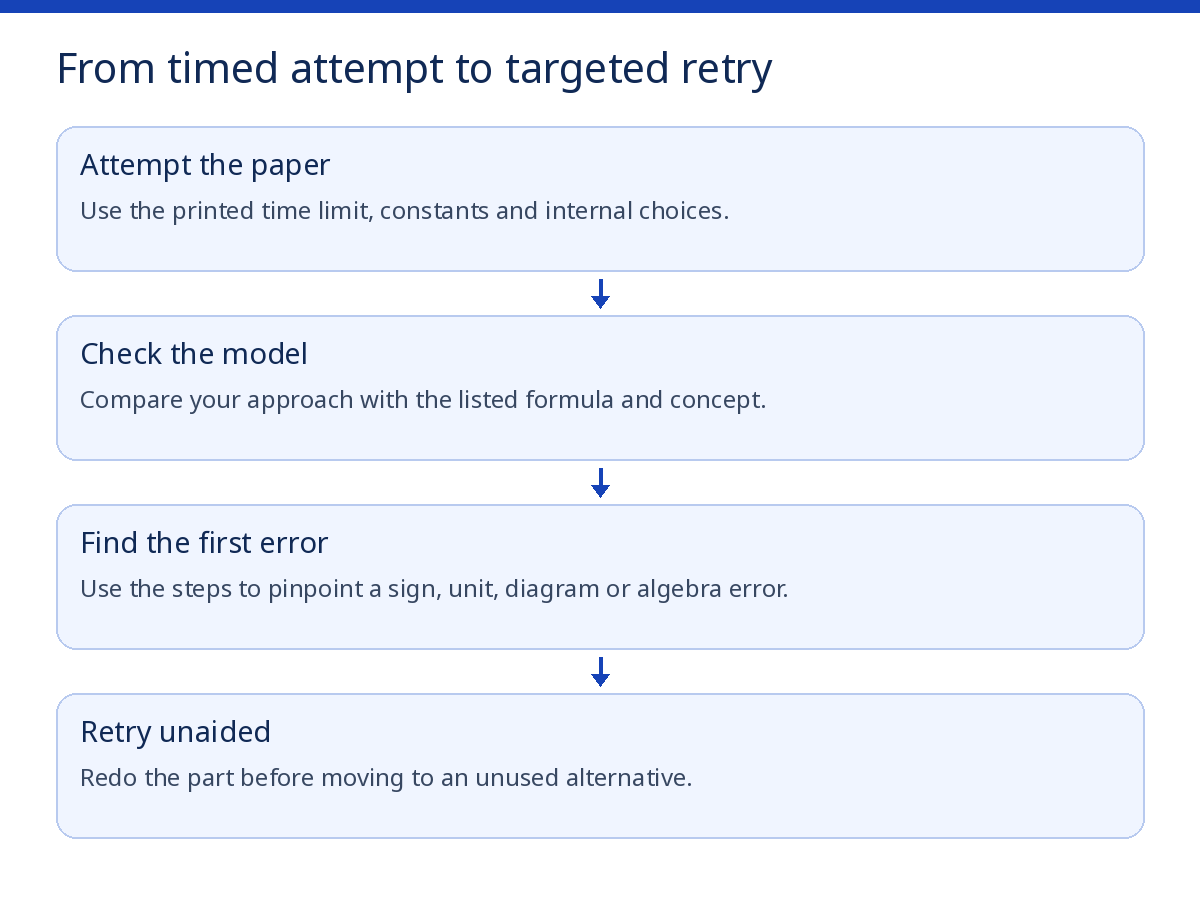
Attempt the paper before opening the worked solutions. For assertion–reason items, judge each statement on its own before deciding whether the reason explains the assertion. For longer questions, follow the verbs in the prompt: a derivation, ray diagram or waveform is part of the requested response, not something a final number can replace.
The solution pages separate the formula used, concept used and explanation in steps. Compare your work in that order, looking for the first place your reasoning diverged: the model you chose, a direction or sign, a unit conversion, or the algebra. Then retry that part without looking. Use the printed alternatives for a second pass rather than consulting both routes during the timed attempt. The photoelectric case study is still useful for revision, but its slope-and-intercept item, Q30(ii), is not discussed here because the printed sign is disputed.
Spotted an error? Report a correction. Practise this in the app: notes, formula sheets and mind maps.













































































































































































Loading comments…