Class 12 Wave Optics: A Case-Based Study of Light Phenomena
CBSEPhysicsWave Optics
This comprehensive resource provides 15 case-based assessment modules featuring 69 questions on Huygens’ principle, interference, and diffraction for CBSE Class 12 Physics learners.
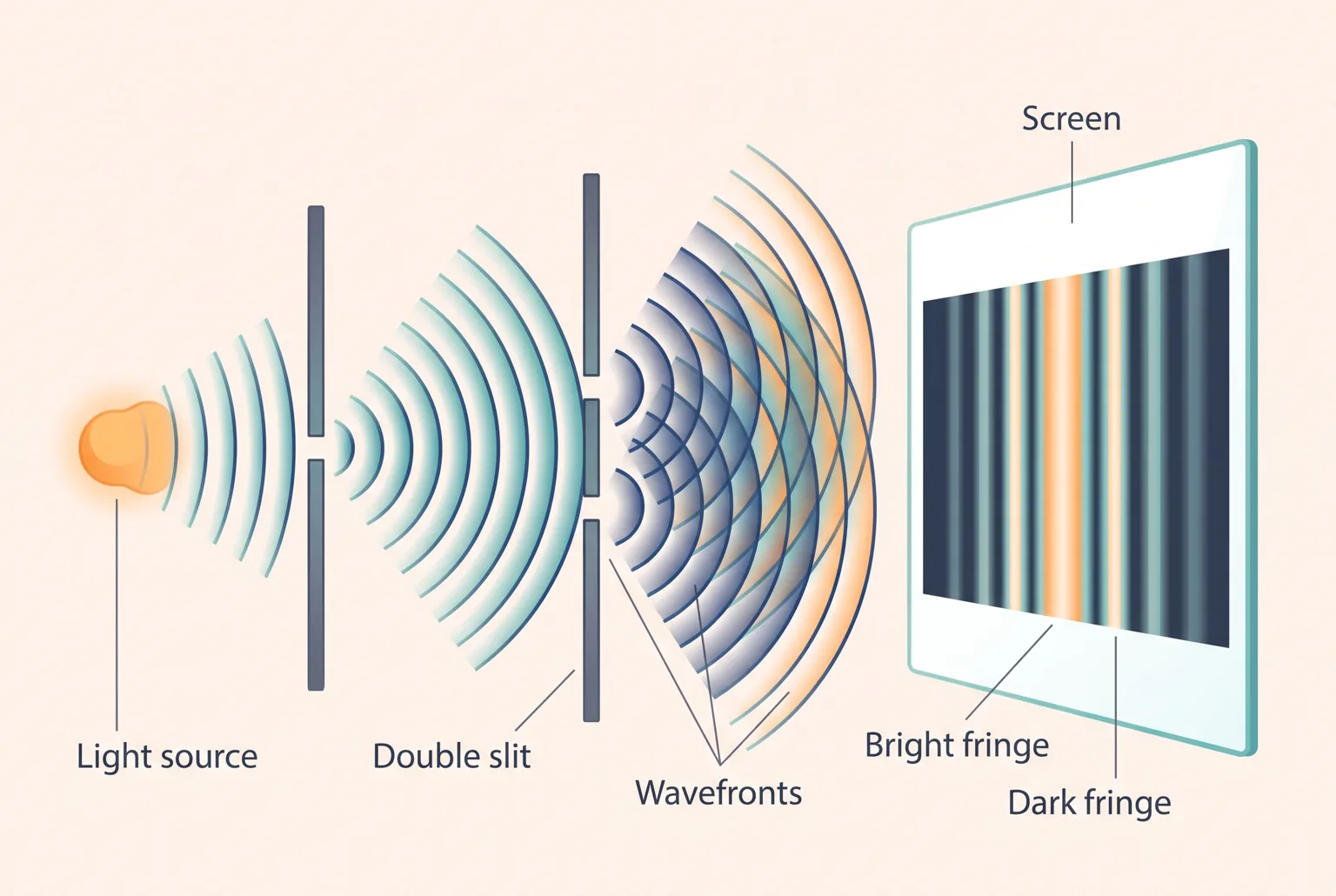
Foundations of Wave Theory and Huygens’ Principle
Wave optics begins with the fundamental concept of the wavefront, defined as a surface over which an optical wave maintains a constant phase. The source material explores different wavefront geometries, such as those radiating from a point source in a homogeneous three-dimensional medium. In such cases, the intensity of the light decreases inversely as the square of the distance from the source. Understanding these geometries is essential for applying Huygens’ principle, which treats every point on a wavefront as a source of secondary wavelets.
Learners can use these modules to practice the geometrical method of finding a new wavefront position. This construction is a cornerstone of wave theory, providing a physical explanation for how waves evolve over time. The material emphasizes that Huygens’ concepts are not merely theoretical but serve as the basis for understanding how light bends and propagates through various media. By working through the questions on spherical and plane wavefronts, students can solidify their grasp of how light behaves as a wave rather than just a ray.

Wave Optics | Class 12 Physics| CBSE Case-based Assessment
In the StudentCurio app
A comprehensive collection of 15 case-based assessment modules for Class 12 Physics Wave Optics, including detailed solutions for topics like Huygens' principle, YDSE, and single-slit diffraction.
The Superposition Principle and Optical Interference
Interference is the phenomenon where two or more waves overlap, resulting in a new wave pattern. This is governed by the superposition principle, which states that the resultant displacement at any point in a linear medium is the vector sum of the individual displacements produced by each wave. The resource illustrates this through practical examples, such as overlapping circular ripples in water or the disturbance of TV reception caused by aircraft-reflected radio waves.
For a stable interference pattern to be observable, the sources must be coherent. The material highlights that independent light sources, such as two separate sodium lamps, do not produce stable fringes because their relative phase fluctuates rapidly—typically on a characteristic time scale of s. This distinction between coherent and incoherent superposition is vital for solving numerical problems involving intensity ratios and resultant amplitudes. When two coherent waves of the same amplitude add constructively, the resultant intensity is four times the intensity of a single wave, a relationship frequently tested in Class 12 examinations.
Analyzing Young’s Double Slit Experiment
Young’s Double Slit Experiment (YDSE) is the primary tool for studying interference in the classroom. This collection covers the standard transverse arrangement where the fringe width is determined by the formula , where is the wavelength, is the distance to the screen, and is the slit separation. The modules guide learners through various modifications of this setup, such as changing the slit separation or the slit-to-screen distance.
A significant focus is placed on the use of different light sources. For instance, replacing monochromatic light with white light results in a unique pattern: a white central maximum surrounded by colored fringes. This happens because the zero-order fringe () corresponds to a zero path difference for all wavelengths, causing them to overlap perfectly at the center. The resource also introduces more complex configurations, such as axially separated sources that produce concentric circular fringes rather than straight lines, challenging students to apply their knowledge to non-standard geometries.
Interference in Media and Thin Films
The behavior of light changes when it travels through different media, a concept explored through thin-film interference and the immersion of experimental setups. When light reflects from the upper and lower surfaces of a thin film, such as an oil drop on water or a soap bubble, the resulting interference produces vibrant colors. This effect depends on the film's thickness, its refractive index, and the specific wavelengths being reinforced or suppressed.
The resource provides specific scenarios for calculating optical path differences. For example, placing a transparent sheet of refractive index and thickness in one path of a YDSE setup introduces an extra optical path difference of . Furthermore, if the entire apparatus is immersed in a liquid with refractive index , the wavelength and the fringe width both decrease by a factor of (expressed as ). These modules help learners practice the precision required for these calculations, ensuring they account for the medium's properties in wave equations.
Single-Slit Diffraction and Angular Spreading
Diffraction is the spreading of waves around the edges of an obstacle or through an aperture into the region of the geometrical shadow. This effect is most pronounced when the size of the aperture or obstacle is comparable to the wavelength of the light. In single-slit Fraunhofer diffraction, the central maximum is the brightest and widest part of the pattern, with its linear width at a distance being approximately for a slit of width .
The modules distinguish between interference (the result of superposition from a few discrete sources) and diffraction (the result of superposition from a continuous distribution of secondary wavelets within a single slit). Students are encouraged to compare the two patterns, noting that while interference fringes are often of equal width, diffraction bands decrease in intensity and width as they move away from the center. The resource also provides a practical comparison between light and sound, explaining why sound waves bend more easily around common obstacles like partition walls due to their much larger wavelengths.
Intensity Distribution and Mathematical Relations
A deep understanding of wave optics requires mastering the mathematical relationship between phase difference, amplitude, and intensity. The resultant intensity at a point where two waves with phase difference superpose is proportional to . The modules include exercises on calculating the ratio of maximum intensity () to minimum intensity () based on the amplitudes or intensities of the individual sources.
Specific cases in the material, such as the circular tube arrangement where a source's intensity is split between two paths, provide rigorous practice for these calculations. Learners must determine which wavelengths result in constructive interference (maxima) at a detector based on path differences. These modules also cover the effects of changing slit widths; for instance, doubling the width of a slit under uniform illumination affects the central-direction amplitude, which in turn alters the resulting interference pattern. By navigating through these 15 modules, students transition from qualitative understanding to the quantitative precision required for the CBSE Class 12 Physics curriculum.
Frequently asked questions
What happens to the interference pattern if the YDSE apparatus is immersed in water?
The fringe width decreases. Because the wavelength of light in a medium is , where is the refractive index, the fringe width also scales down to .
Why does white light produce a white central fringe in Young's experiment?
At the central point, the optical path difference is zero for all wavelengths present in white light. Since every color undergoes constructive interference at this point, they superpose to form a white fringe.
What is the condition for obtaining the first minima in single-slit diffraction?
For a slit of width , the first minima occur when the path difference satisfies the condition .
How does the width of the central diffraction maximum change with wavelength?
The width of the central maximum is directly proportional to the wavelength. If the wavelength is increased while the slit width and screen distance remain fixed, the central maximum becomes wider.
Spotted an error? Report a correction. Practise this in the app: notes, formula sheets and mind maps.













































































































































































Loading comments…