Ray Optics and Optical Instruments: CBSE Class 12 PYQs and Solutions
CBSEPhysicsRay Optics
This guide explains what CBSE Class 12 board papers ask on Ray Optics and Optical Instruments, drawing on a chapter-wise collection of previous year questions. It covers total internal reflection, apparent depth, refraction at spherical surfaces, lens combinations and optical instruments, and how MCQ, assertion-reason and derivation questions are framed.
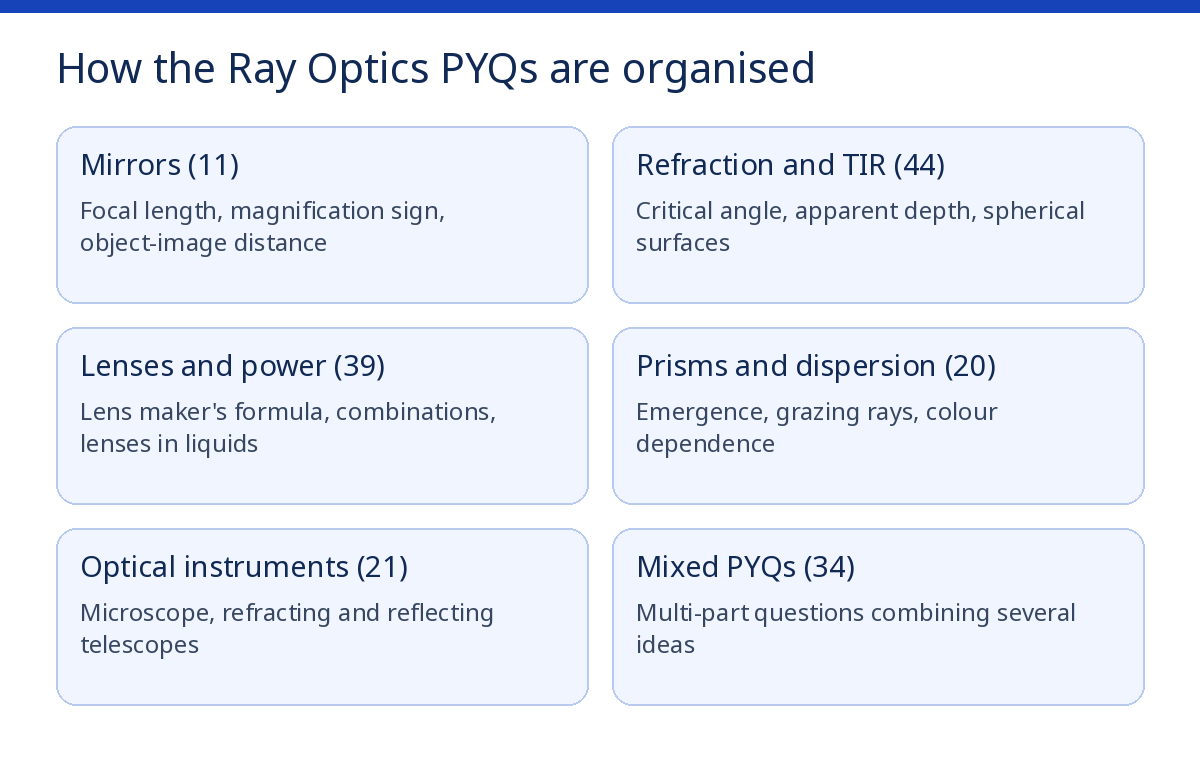
Six tested areas in the Ray Optics topic index
The collection prints 169 previous year questions with exam-year coverage of 2022–2026. A topic index groups them under six heads:
- Reflection and spherical mirrors (11 questions)
- Refraction and total internal reflection (44)
- Lenses and optical power (39)
- Prisms and dispersion (20)
- Optical instruments (21)
- Mixed ray-optics PYQs (34)
Refraction and lenses together make up nearly half the set. The laws of refraction and the lens relations therefore deserve the most revision time. Original question numbers and CBSE labels are retained, including Delhi, Outside Delhi, Compartment and set codes.

Ray Optics | Class 12 | Previous Year Paper
In the StudentCurio app
A comprehensive 159-page collection of solved previous year questions for CBSE Class 12 Physics, covering reflection, refraction, lenses, prisms, and optical instruments.
When total internal reflection can happen
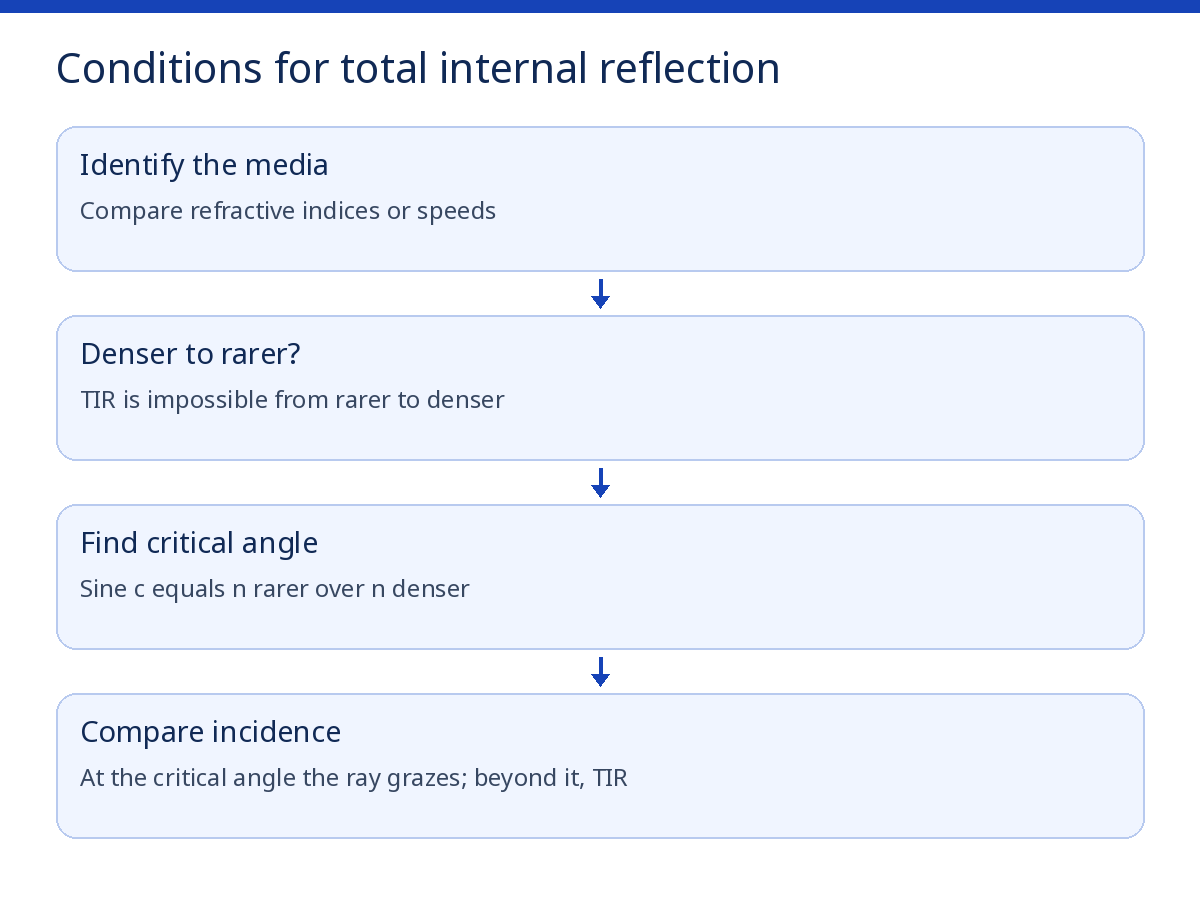
Many refraction questions test the conditions for total internal reflection (TIR). Both of these must hold:
- Light travels from the optically denser medium (higher refractive index, lower speed) toward the rarer one.
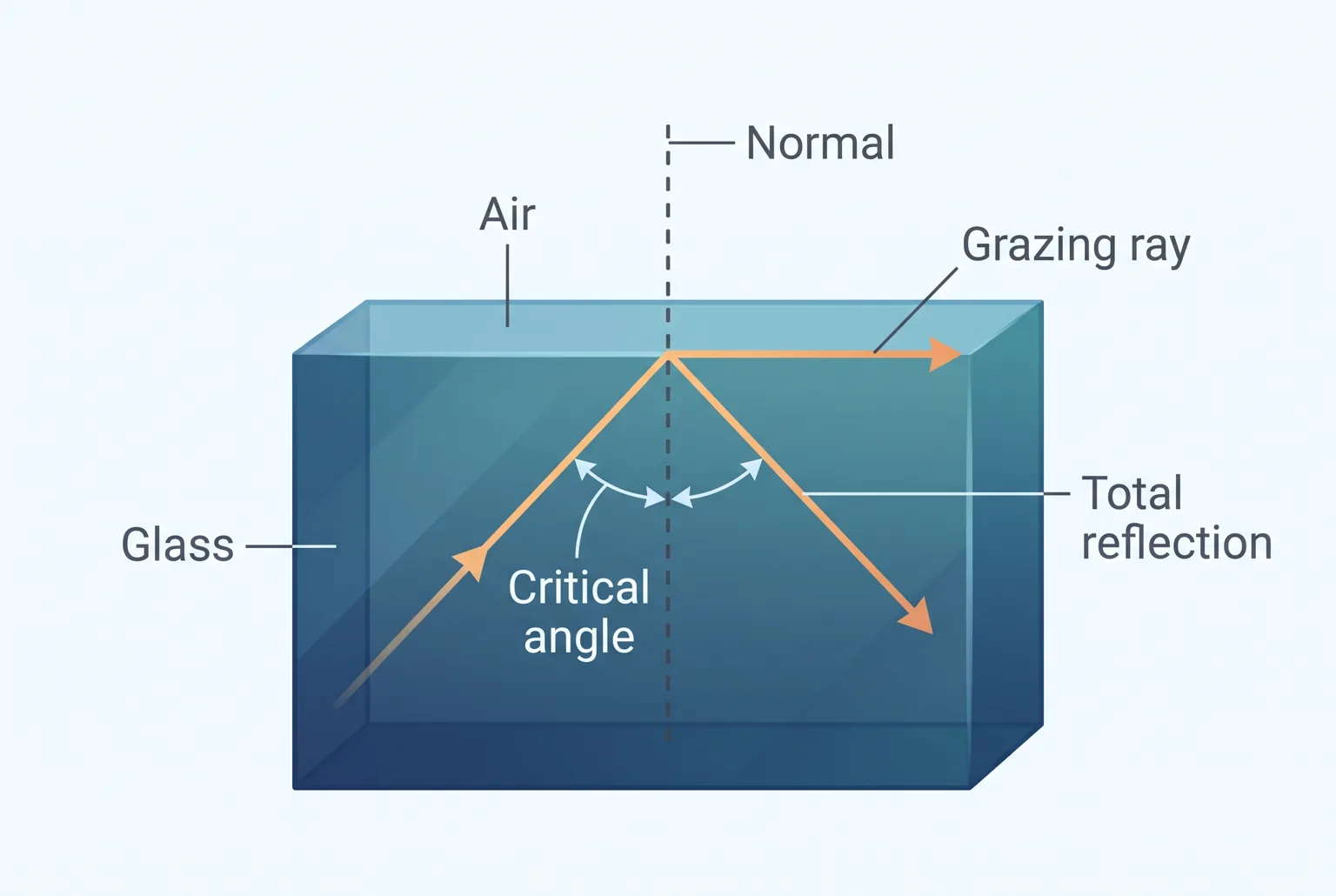
- The angle of incidence exceeds the critical angle , where .
Because , the condition can also be written using the speeds of light in the two media. Some board questions give speeds instead of refractive indices.
At exactly the critical angle, the refracted ray grazes the boundary. Several stems use a grazing ray as the given condition, such as a ray just skimming a surface or emerging along a prism face.
Other items ask which effects rely on TIR, such as optical fibres, reflecting prisms and the brilliance of diamonds. Because refractive index depends on colour, the critical angle also changes when the colour of light changes.
Apparent depth, slab shift and finding refractive index
A second cluster deals with refraction at plane surfaces. An object under a liquid appears raised when viewed along the near-normal direction. For such viewing, the ratio of real depth to apparent depth equals the liquid's refractive index. A glass slab placed over printed text shifts the letters in a similar way.
Questions also find refractive index from the distance light travels in a sheet in a given time, or from the change in wavelength on entering a medium. Both routes rest on . The frequency stays the same on refraction, so only the speed and the wavelength change.
From one spherical surface to the lens maker's formula
Subjective questions ask for a ray diagram of a point object in front of a convex spherical surface and a derivation relating , , and . The standard result is:
MCQs apply this result to decide whether an image is real or virtual, or how it changes as the object moves toward the surface.
Applying the surface result to both faces of a thin lens gives the lens maker's formula. One compartment question uses a lens of index in a surrounding medium of index :
This explains a recurring theme: a lens immersed in a liquid. Its power depends on the lens's refractive index relative to the surrounding medium, an idea assertion-reason items test directly.
Lens combinations, cut lenses and silvered lenses
For thin lenses placed coaxially in contact, powers add:
More than one set asks for the derivation of this result with a ray diagram. MCQ variations include:
- an equiconvex or concave lens cut into two plano halves, which leaves each half with one curved face;
- convex and concave lenses combined in contact;
- a plano-convex lens with its plane face silvered, which then behaves as a mirror;
- goggle lenses that have curved surfaces but no power.
One item asks for the minimum object–real image distance for a convex lens, and a parallel item asks the same for a concave mirror. Comparing the two is useful revision.
What microscope and telescope questions demand
Instrument MCQs ask for:
- the magnifying power of a compound microscope for relaxed-eye viewing;
- the tube length of a microscope;
- the magnifying power and tube length of a telescope;
- which objective and eyepiece focal lengths give large magnification.
Subjective items require a ray diagram of a refracting telescope and its angular magnification in normal adjustment. Some also ask why a reflecting telescope is preferred over a refracting one. One compartment question describes two lenses 147 cm apart used to view a distant tree. It asks for the diagram, the final image position and the magnification.
Assertion-reason statements here concern the sign of a microscope's magnifying power and chromatic aberration in reflecting telescopes.
Common mistakes with signs, media and wording
- Dropping the sign convention. The sign of the magnification shows whether an image is erect or inverted, and the sign of decides real or virtual. Substitute , , and with their signs.
- Applying TIR in the wrong direction. Light passing from a rarer to a denser medium never undergoes total internal reflection, whatever the angle.
- Treating a lens's focal length as fixed. It depends on the surrounding medium through . Check whether refraction is involved before carrying this idea over to mirrors.
- Missing chapter boundaries. One internal-choice question pairs a ray-optics derivation with a double-slit fringe calculation from wave optics.
Practising with MCQs, assertion-reason and derivations
All questions come first, divided into MCQ (Single Correct Answer) and Subjective, and complete worked solutions follow. Assertion-reason items use the board's four standard codes. Judge each statement's truth separately before deciding whether the reason explains the assertion.
A workable practice order:
- Work through one index topic at a time, starting with its MCQs.
- Move to subjective items that demand ray diagrams and derivations.
- Finish with the mixed questions, which combine ideas as a full paper does.
Open the solutions only after a complete attempt.
Quick self-check: Can you explain, without numbers, why the critical angle at a diamond–air boundary differs from that at a glass–water boundary?
Frequently asked questions
How many questions does this Ray Optics collection contain?
The cover prints 169 previous year questions with exam-year coverage of 2022–2026. They are organised into six topic groups and come with complete worked solutions.
Which question formats appear?
The collection contains single-correct MCQs, including assertion-reason items, and subjective questions. The subjective questions ask for ray diagrams, derivations and numerical work, sometimes with an internal OR choice.
Spotted an error? Report a correction. Practise this in the app: notes, formula sheets and mind maps.













































































































































































Loading comments…