Ray Optics: Class 12 CBSE Assessment Guide to Mirrors and Practice
CBSEPhysicsRay Optics
Ray Optics and Optical Instruments is a Class 12 CBSE Physics chapter. This guide explains the spherical-mirror ideas its first topic tests (the Cartesian sign convention, the mirror equation, magnification and ray rules) and maps the assessment's question formats and six NCERT topic sections.
Cartesian sign convention and the mirror equation
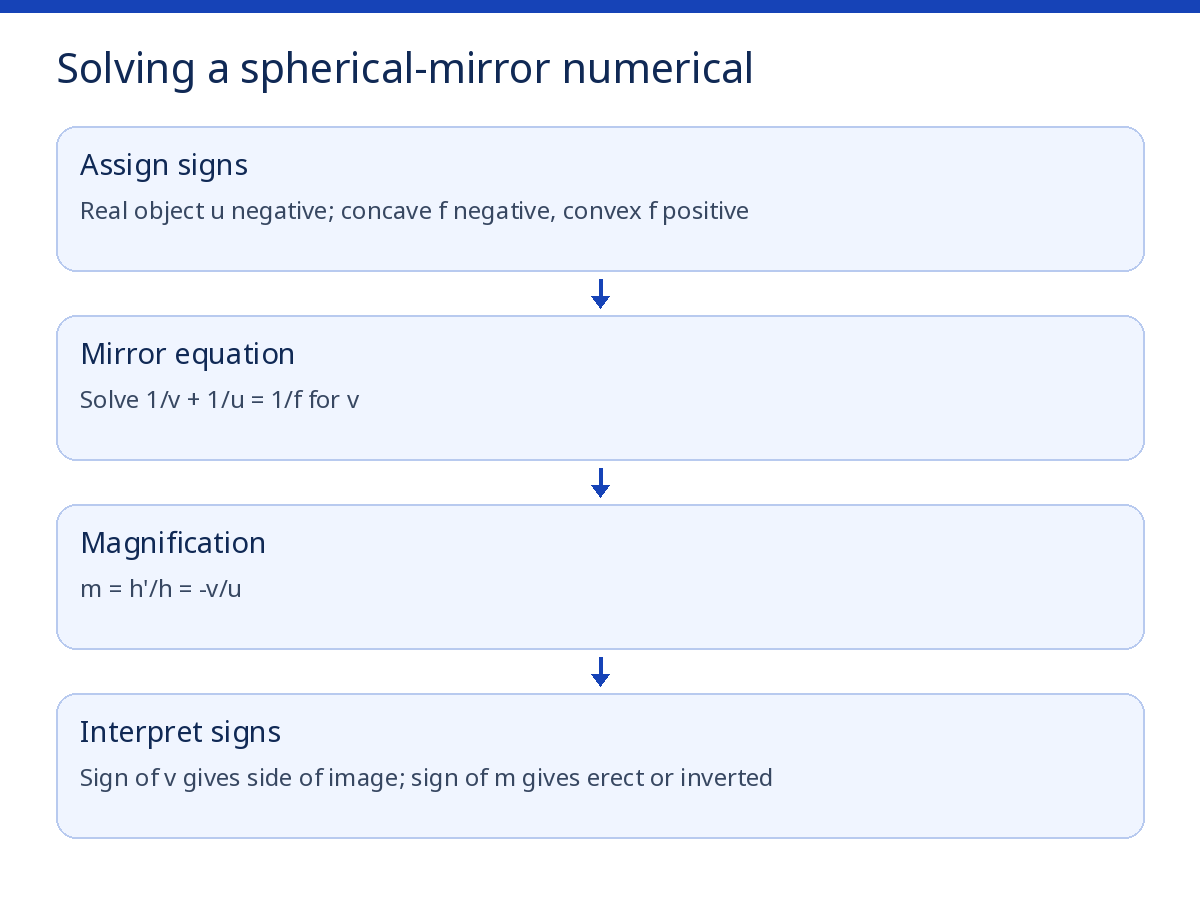
Almost every mirror numerical in this assessment rests on one relation, , used with the Cartesian sign convention. The worked solutions fix every sign before they substitute any value:
- a real object in front of the mirror has negative ;
- a concave mirror has negative ;
- a convex mirror has positive .
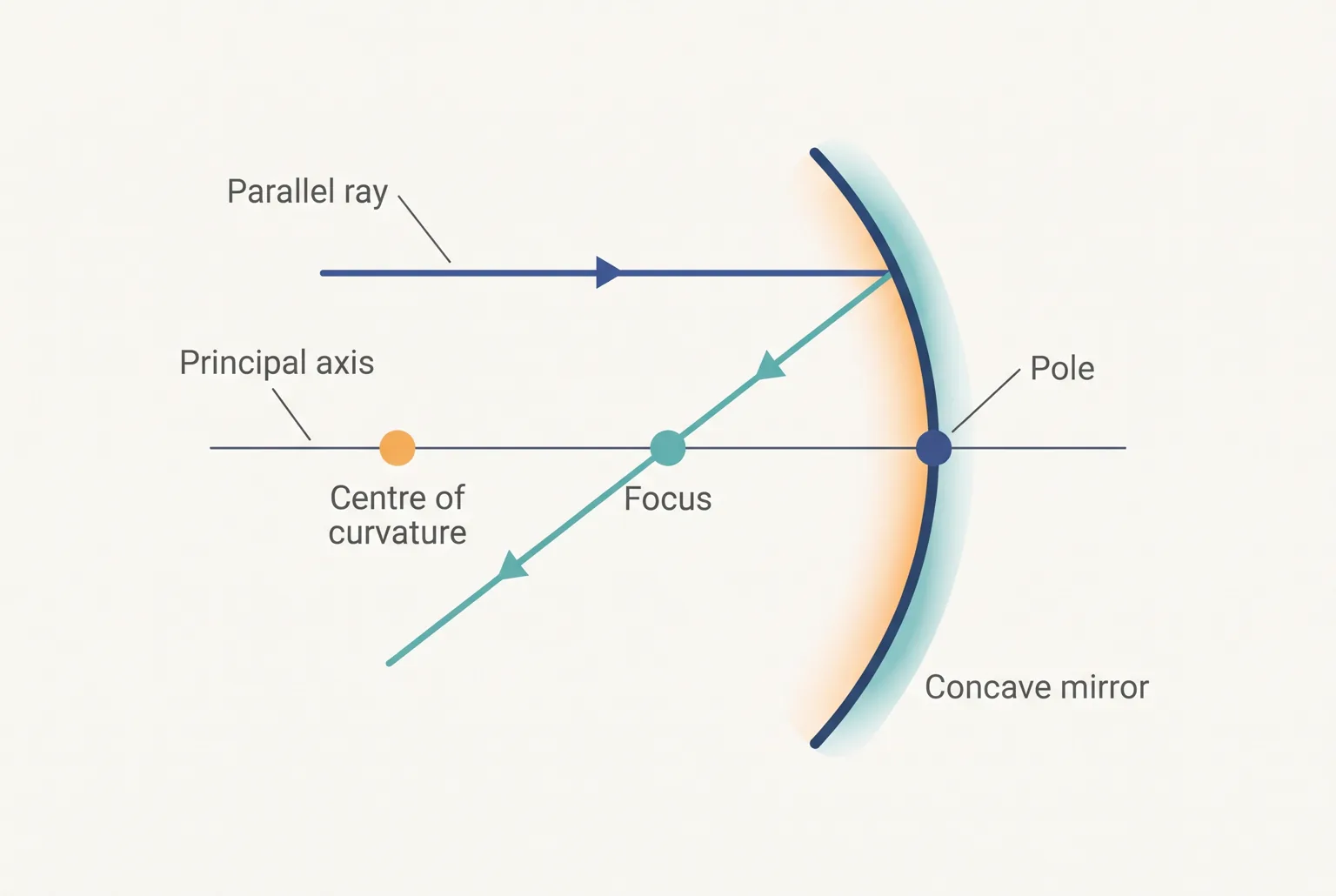
For a spherical mirror of small aperture, the principal focus lies midway between the pole and the centre of curvature, so .
Linear magnification is . A real image formed by a mirror is inverted, so its height is taken as negative. A positive means an erect image. Board answers are expected to state the nature of the image as well as its position.

Ray Optics | Class 12 | CBSE Assessment
In the StudentCurio app
190 Class 12 Physics questions on ray optics and optical instruments, arranged by NCERT topic and matched to the 2025-26 CBSE syllabus, with step-by-step worked solutions. Six topic sections (reflection by spherical mirrors; refraction; total internal reflection; refraction at spherical surfaces and by lenses; refraction through a prism; optical instruments), each with MCQs, 2-, 3- and 5-mark questions and a 4-mark case-based question, plus assertion-reason items.
Ray rules, reversibility and normal incidence
Ray-diagram questions test a small set of rules. A paraxial ray parallel to the principal axis of a concave mirror passes through the principal focus after reflection. Because light paths are reversible, a ray that passes through before striking the mirror is reflected parallel to the axis.
Every radius of a spherical surface is normal to it. A ray directed along a radius, towards the centre of curvature , therefore meets the mirror along the normal.
Angles of incidence and reflection are measured from the normal, not from the surface. Normal incidence means , so and the ray retraces its path. The first topic's assertion-reason items check whether you know both what happens and the correct reason for it.
Proving image nature from the mirror equation
Several 3- and 5-mark questions ask you to establish, using the mirror equation, where an image forms and what kind it is. Typical cases include:
- an object between and of a concave mirror;
- an object between the pole and the focus;
- any real object in front of a convex mirror.
The expected method is algebraic, not pictorial. Write and insert the sign of each quantity. Then argue whether is positive or negative, and how its size compares with .
The sign of tells you which side of the mirror the image lies on, and therefore whether it is real or virtual. Comparing with through decides whether the image is enlarged or diminished. Write each inequality explicitly rather than only stating the conclusion.
Paraxial conditions and extended objects
The mirror relations in this chapter are paraxial results. They hold for rays close to the principal axis, which is why is stated for mirrors of small aperture. One short-answer question asks you to name the limitation of the mirror formula, and another links aperture to image sharpness. Both depend on this condition.
Objects lying along the axis need extra care. For a short object of length at distance from a concave mirror, the image length is approximately , provided . Because the result depends on , different parts of a longer object are magnified by different amounts. This idea recurs in questions about pencils and rods placed along the axis.
Sign slips the worked solutions guard against
- Measuring angles from the surface. Normal incidence is , not .
- Forgetting the inverted-image sign. For a real mirror image, take as negative before you compute or .
- Mixing magnitudes and signed values. The pinhole-camera problem uses similar triangles with magnitudes. The mirror equation needs signed values throughout.
- Dropping stated approximations. If a question says to use the paraxial approximation, or gives a condition such as , show where you rely on it.
Case-based and 5-mark formats in the mirror topic
Each topic section follows the same marks ladder: MCQs (1 mark), very short answers (2 marks), short answers (3 marks), a case-based question (4 marks) and long answers (5 marks). Assertion-reason items also appear.
In the mirror topic, the case-based question is built around a vehicle's convex rear-view mirror. You attempt any four parts, each worth one mark, using the Cartesian sign convention. The parts move from focal length to image position, magnification and the reason a convex mirror is chosen.
The long answers combine derivation with application. One asks you to state the sign convention, derive the mirror formula for a concave mirror forming a real image, and obtain the magnification. Others are extended numericals, such as the image of a moving cyclist or of a square wire frame.
Working through the six NCERT topic sections
The assessment follows NCERT order:
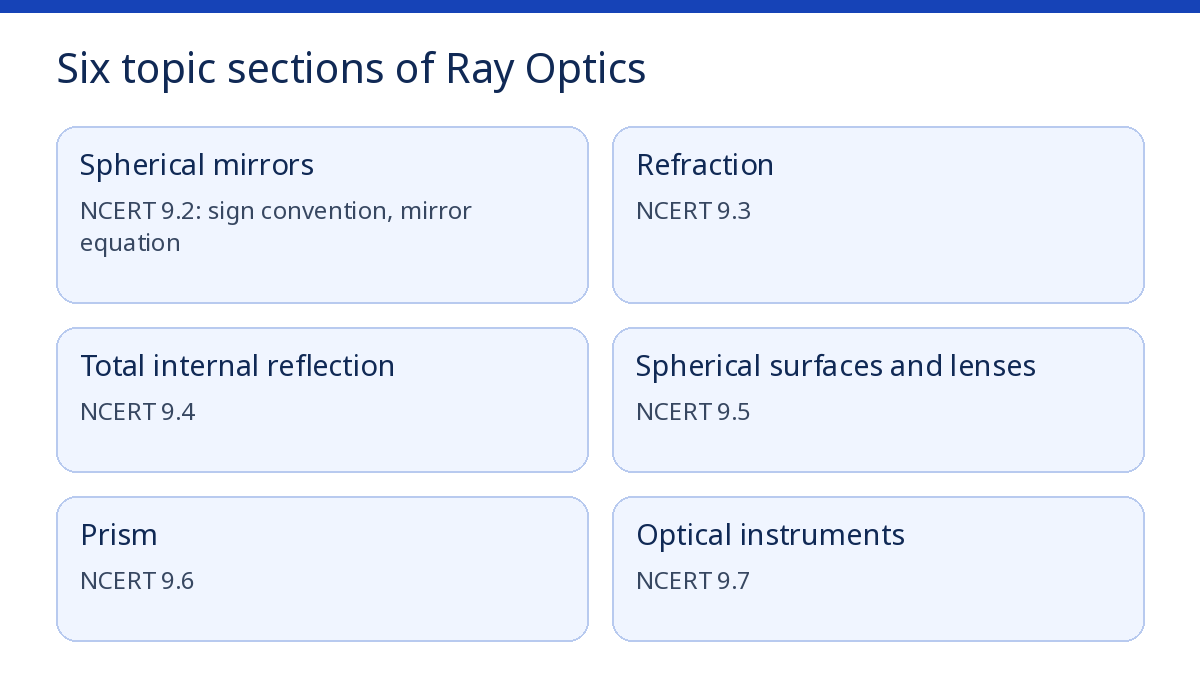
- reflection by spherical mirrors (9.2);
- refraction (9.3);
- total internal reflection (9.4);
- refraction at spherical surfaces and by lenses (9.5);
- refraction through a prism (9.6);
- optical instruments (9.7).
Each section has step-by-step worked solutions. Questions are numbered 1 to 190 across the chapter, and each case-based question has five parts, of which you attempt any four.
Finish each topic set before you attempt mixed practice. Signed substitution, learned with mirrors, carries into the later refraction and lens sections.
Attempt a whole section before opening its solutions. Then compare your steps, not only your final values. The solutions show where each sign is assigned and which law justifies each step.
Quick self-check: if half of a concave mirror is covered, which image properties could change and which are fixed by and ? Reason it out before checking.
Frequently asked questions
Which class and exam is this assessment for?
It is a CBSE Class 12 Physics assessment for Ray Optics and Optical Instruments, aligned with the NCERT syllabus and the CBSE board exam pattern.
What question formats does it include?
Each topic has MCQs (1 mark), very short answer (2 marks), short answer (3 marks), case-based (4 marks) and long answer (5 marks) questions, plus assertion-reason items, with step-by-step worked solutions.
Spotted an error? Report a correction. Practise this in the app: notes, formula sheets and mind maps.













































































































































































Loading comments…