CBSE Class 12 Physics Supplementary Paper 2026
CBSEPhysics2026 Previous Year Paper
Paper code: 55/7/1 · 2026Use the full English-language CBSE Class 12 Physics Supplementary / Compartment paper (55/7/1) for a three-hour practice attempt, then review the worked explanations to see where your reasoning, diagrams or calculations need attention.
This set is one of the year's papers. See every set from 2026, grouped by series.
What the paper asks you to do
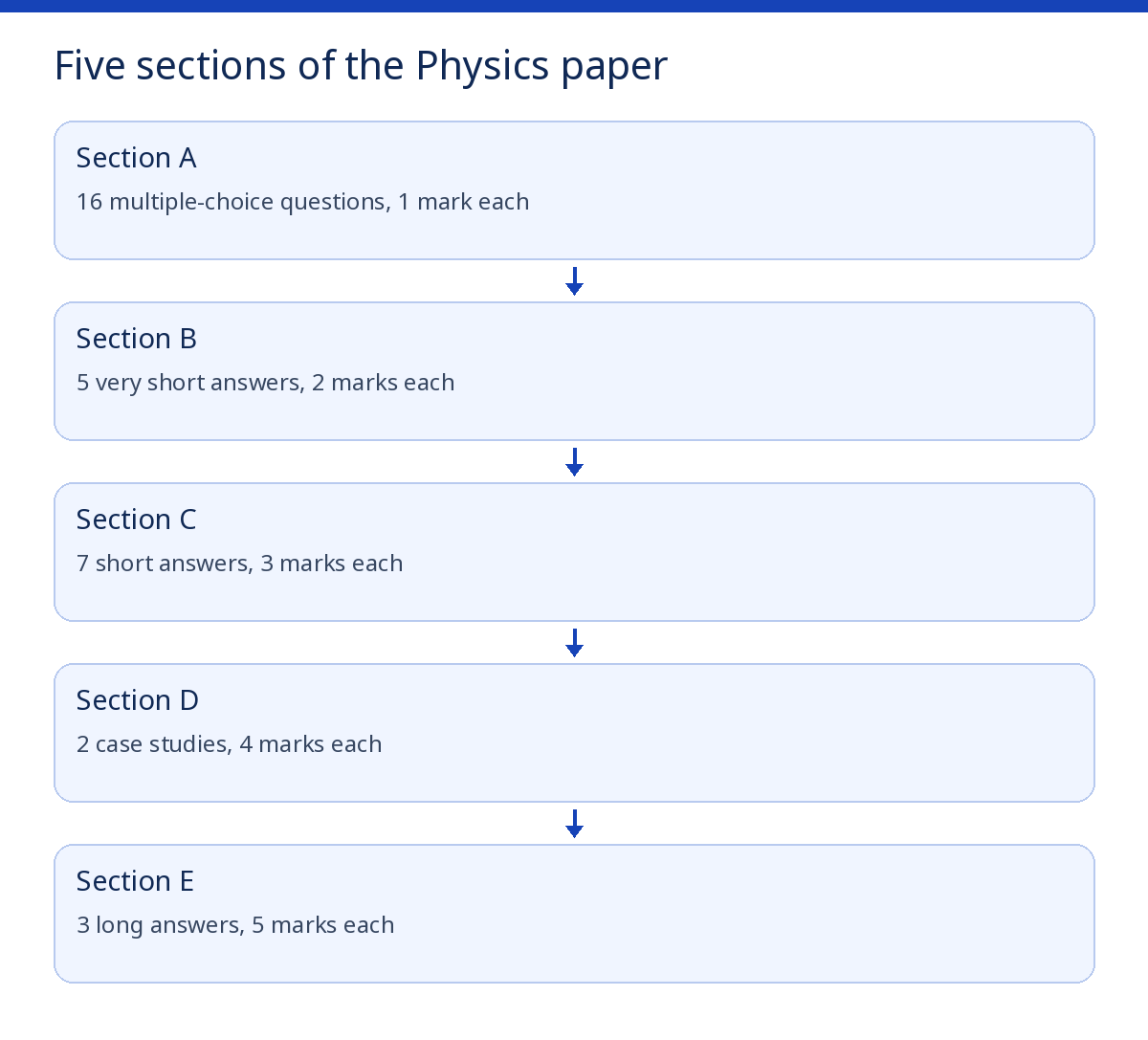
This year-wise resource pairs the original question paper, including its options and diagrams, with worked explanations. The paper is worth 70 marks and contains 33 compulsory questions across five sections. Some questions in Sections B to E offer internal choices, but there is no overall choice: an alternative replaces the other branch of that question, not a different question elsewhere in the paper.
Section A has sixteen one-mark multiple-choice questions, including four assertion–reason items. Section B has five two-mark very short answers, and Section C has seven three-mark short answers. Section D contains two four-mark case studies, while Section E has three five-mark long answers. The paper prohibits calculators and supplies physical constants for use where needed.

Physics Supplementary 2026 | Class 12 | Previous Year Paper | Code 55/7/1
In the StudentCurio app
A CBSE Class 12 Physics supplementary examination paper with worked solutions, covering topics including optics, electricity, magnetism, electrostatics and modern physics. Helps students practise board-exam questions and review solution methods.
Electrostatics and circuits: identify what stays fixed
The electrostatics questions move between fields, potential and stored energy. A conducting-sphere graph tests whether you distinguish the interior of a conductor in electrostatic equilibrium from the exterior. The questions on multiple sources require another distinction: electric fields combine as vectors, whereas electrostatic potential is a scalar. In an energy calculation with an external potential, distinguish the interaction between the charges from each charge’s contribution due to the external potential.
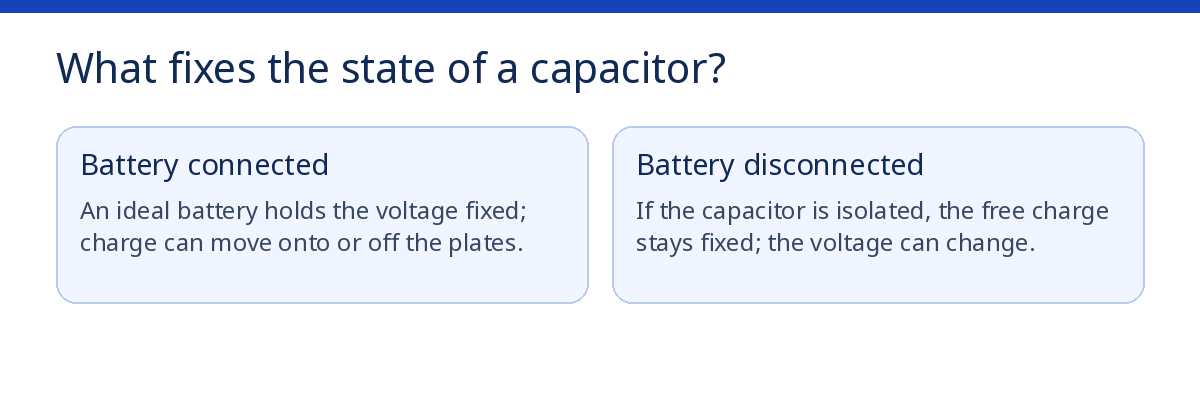
The capacitor question makes the order of events important: charging, disconnecting the battery, then inserting a dielectric. In the ideal isolated-capacitor model, disconnecting the source leaves the free charge on the plates fixed; the battery no longer holds the voltage fixed. In current electricity, look for a different distinction: a cell’s emf is not generally its terminal voltage when it supplies current through a circuit.
Common mistakes with directions and AC quantities
The magnetism questions call for more than a field magnitude. For a straight wire, the distance in the field expression is the perpendicular distance to the wire, not the distance to a conveniently chosen origin. When more than one current contributes, find each field direction before combining the fields. For a moving charge, distinguish a change in velocity direction from a change in speed: a magnetic force alone does no work because it is perpendicular to the velocity.
In the series LCR questions, do not confuse cancellation of reactances with disappearance of impedance. At resonance the inductive and capacitive reactances cancel, but the resistance remains. Also check whether a voltage or current is an rms value or a peak value before using it in an AC power expression.
Optics: make the diagram explain the method
The optics coverage includes refraction at a spherical surface, prism deviation, a refracting telescope, total internal reflection and wave optics. In ray optics, start by marking the normal at the relevant surface and identifying the direction of incident light. For a spherical surface or a lens–mirror combination, a sketch helps you assign signed distances consistently instead of substituting unsigned lengths into a refraction or imaging relation.
The longer questions ask for different kinds of representations. A prism deviation plot relates two angles; a telescope ray diagram shows how the objective and eyepiece work together in normal adjustment. In wave optics, separate the comparison of interference and diffraction from the Young’s double-slit calculation: a path difference at one point and the spacing between successive fringes are different quantities.
Modern physics and semiconductors
Modern physics appears through Bohr’s hydrogen model, the de Broglie wavelength of an electron, nuclear interactions and a case study on the photoelectric effect. These questions use energy in different ways. For instance, a negative Bohr energy is measured relative to the ionisation limit, whereas the work function in photoemission is the minimum energy needed to release an electron from the surface. In the photoelectric case study, keep the threshold for emission, the maximum kinetic energy and the measured current separate. One printed subpart with a sign issue is omitted from this guide.
The semiconductor questions connect the behaviour of a biased junction with circuit applications. When reviewing the full-wave rectifier, use the labelled circuit to trace which path conducts in each half-cycle, then check that your output waveform matches the direction of current through the load.
Use the worked solutions after a timed attempt
For a board-style practice run, allow three hours, use the supplied constants where needed and leave the solution links unopened. On assertion–reason items, judge each statement separately before deciding whether the reason actually explains the assertion. For longer responses, check the question’s verbs: a request to derive, plot or draw a labelled diagram is not satisfied by writing down a final relation alone.
After the attempt, use the question-number navigation to compare your work with the formula, concept and steps in each explanation. Look for the first point where your approach diverged: a wrong physical model needs a different fix from a unit conversion or a missed label. The explanations include the printed internal choices, so you can also practise the branch you did not select without treating it as part of the timed attempt.
Spotted an error? Report a correction. Practise this in the app: notes, formula sheets and mind maps.













































































































































































Loading comments…