2024 CBSE Class 12 Physics Supplementary Paper (55/S/2)
CBSEPhysics2024 Previous Year Paper
Paper code: 55/S/2 · 2024Practise with the full English version of the 2024 CBSE Class 12 Physics supplementary paper, set 55/S/2. Use it as a three-hour mock, then review your reasoning with the linked worked solutions and revisit the internal choices you did not attempt.
This set is one of the year's papers. See every set from 2024, grouped by series.
What the full paper lets you practise
This is a year-wise previous paper, not a chapter worksheet. It retains the original English questions, options and diagrams, so you can practise moving between topics without a chapter heading telling you which principle to use. That matters in physics: identifying the model is part of the task, whether the prompt begins with a circuit, a graph, a ray diagram or a description of an experiment.
The mix includes electrostatics, current electricity, magnetism, electromagnetic induction and alternating current, electromagnetic waves, optics, semiconductors, and atomic and nuclear physics. Some prompts ask for a distinction between related quantities; others call for a derivation, a labelled diagram or a calculation. The value of sitting the whole paper is seeing how readily you can switch between those forms of reasoning.

Physics Supplementary 2024 | Class 12 | Previous Year Paper | Code 55/S/2
In the StudentCurio app
Complete CBSE Class 12 Physics supplementary examination paper 55/S/2 for 2024, with worked solutions. It covers questions across the syllabus and helps students practise board-exam problems and review their solutions.
Read the five-section structure before starting
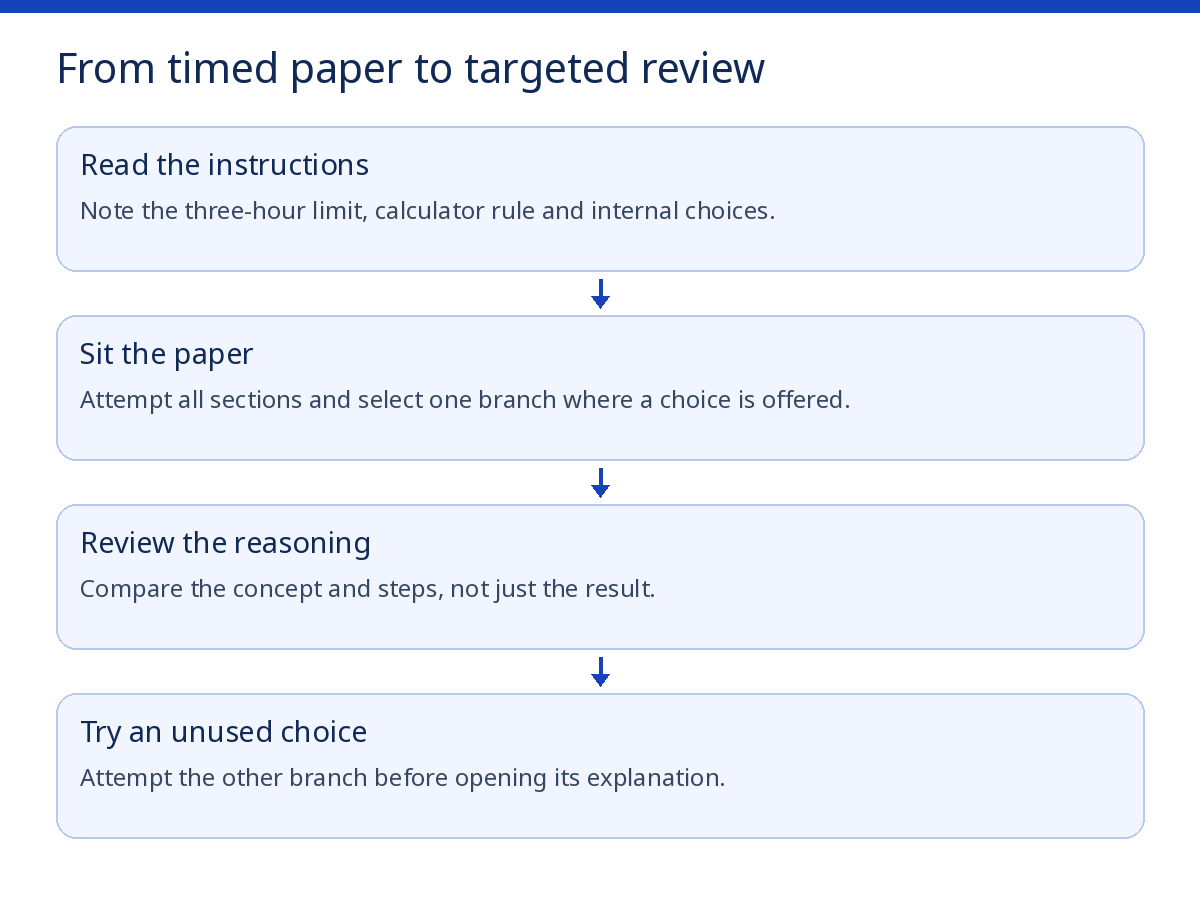
The paper allows three hours for 70 marks and does not permit calculators. Section A contains 16 one-mark multiple-choice questions, including assertion–reason items. Section B has five two-mark very short answers, while Section C has seven three-mark short answers. Section D has two four-mark case studies, and Section E has three five-mark long answers.
All 33 questions are compulsory, but some questions outside Section A offer an internal choice. There is no overall choice: an alternative lets you choose a branch within that question, not skip the question altogether. For a timed attempt, answer only the branch you select. Save the other branch for review; it may test a different topic or require a different kind of explanation.
Common mistakes: mixing up directions and regions
In questions involving electric or magnetic fields, decide first where the field is being evaluated and which direction each contribution takes. Superposition means adding field vectors, not adding their magnitudes regardless of direction. The paper gives you several settings in which to practise that distinction, including point charges, charged sheets and coaxial coils. A small sketch can make the relevant region or axis explicit before you start the algebra.
In an electromagnetic-wave expression, distinguish the direction of the field component from the direction in which the phase travels. The component label identifies the orientation of the field, while the spatial coordinate in the phase tells you the axis along which the wave varies. Conflating those two cues can send you looking for a relationship that the expression already lets you analyse.
Optics and AC: make the conditions visible
The optics questions move between wavefronts, refraction, interference, diffraction and optical instruments. Start by identifying what the question asks you to describe: a ray’s direction, the position of an image, or an intensity pattern. Those are different tasks. For total internal reflection, the direction of travel across the interface matters: the critical-angle condition applies to light incident from the higher-index medium towards the lower-index medium. For a telescope derivation, keep the specified final-image position in view rather than assuming every viewing arrangement has the same magnifying power.
Carry the same habit into alternating current. An inductor’s inductive reactance is for sinusoidal AC, with the angular frequency. Reactance is not the same as the coil’s resistance. When a prompt compares DC and AC or specifies resonance in a series circuit, write down what changes between the conditions before selecting a circuit relation.
Quick self-check: connect the case passage to the figure
The two case studies are on rectification and dipoles. In the rectifier case, use the circuit and the input polarity together. Before considering the options, can you tell which information comes from the description of diode bias and which comes from the way the diode is connected in the figure? That distinction keeps you from applying a statement about one circuit orientation to another.
For the dipole case, ask whether the subpart concerns a dipole moment, a field produced by a dipole or a torque in an applied field. Mark the observation point or the relevant angle on your sketch. If the prompt places an observation point far from the dipole compared with the charge separation, note that condition before choosing a field expression.
Use the worked solutions to diagnose your reasoning
On the first pass, keep the worked solutions closed and use the constants printed in the instructions where needed. In the longer questions, check each subpart for its requested output. A labelled diagram, a derivation and a numerical result serve different purposes, even when they belong to the same question. For assertion–reason items, check the truth of each statement separately before deciding whether the reason explains the assertion.
Afterwards, use the file’s question links to compare your attempt with the formula, concept and explanation in steps. Find the first point where your reasoning diverged: perhaps you chose the wrong physical model, missed a direction, or used the right relation under the wrong conditions. Then try an unattempted internal choice without consulting its explanation. This guide leaves out the worked conclusion for Question 10 because it depends on a refractive-index assumption not specified in the question.
Spotted an error? Report a correction. Practise this in the app: notes, formula sheets and mind maps.













































































































































































Loading comments…