CBSE Class 12 Physics 2026 Previous Year Paper: Set 55/1/2
CBSEPhysics2026 Previous Year Paper
Paper code: 55/1/2 · 2026Use the complete English-language CBSE Class 12 Physics 2026 main examination paper for a three-hour practice attempt. Then use the worked solutions to review how you chose a physical model, read a graph or diagram, and justified each step.
This set is one of the year's papers. See every set from 2026, grouped by series.
Know the format before starting the clock
This year-wise resource contains the full 2026 main examination, Set 55/1/2, rather than a chapter-wise selection. The paper has 33 questions for 70 marks, with three hours allowed and no calculator. The instructions provide physical constants for use where needed, so keep that page available during your attempt.
- Section A: Questions 1–16 are multiple-choice questions worth 1 mark each, including an assertion–reason block.
- Section B: Questions 17–21 are very short answers worth 2 marks each.
- Section C: Questions 22–28 are short answers worth 3 marks each.
- Section D: Questions 29 and 30 are case studies worth 4 marks each.
- Section E: Questions 31–33 are long answers worth 5 marks each.
There is no overall choice: all question numbers are compulsory. Internal choices appear in some questions outside Section A. For a timed attempt, answer one branch where a choice is given; save the other branch for review. This guide does not use Q13 or Q14 as assertion–reason examples because the printed label for the first statement differs from the section instructions.

Physics 2026 | Class 12 | Previous Year Paper | Code 55/1/2
In the StudentCurio app
Complete CBSE Class 12 Physics examination paper for 2026, Set 55/1/2, with worked solutions across the syllabus. It helps students practise the full exam format and review step-by-step approaches to questions.
Recognise familiar ideas in different question formats
The paper draws on electrostatics, current electricity, magnetism, optics, and modern physics, among other topics. A one-mark item may ask you to distinguish related quantities, while a written question can require you to explain the same underlying physics. In electrostatics, for example, the paper moves from the relationship between electric field and potential to field reasoning with charged sheets and a dipole. When reviewing, separate what describes a point from what describes a change between two points; that distinction helps you set up the problem before doing any arithmetic.
The shorter written sections also ask for different kinds of evidence. A drift-velocity question calls for a relationship to be deduced, a nuclear physics question asks for a graph and an interpretation, and a compound microscope question needs a labelled ray diagram as well as a derivation. Check that your response delivers what the question asks for, not just a familiar formula from the topic.
Common mistake: using a familiar rule in the wrong setup
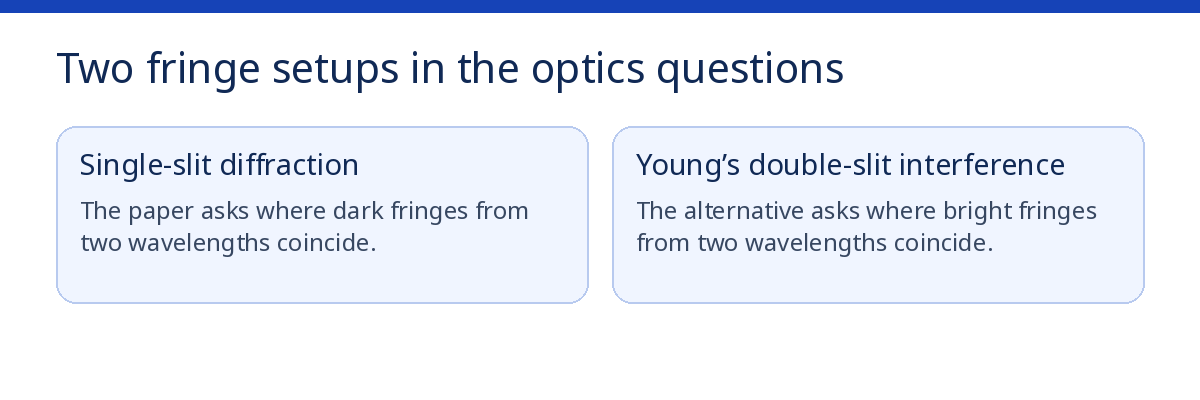
The optics questions make this easy to spot. Single-slit diffraction and Young’s double-slit interference both produce fringes, but they are not interchangeable setups. In the paper’s two-wavelength alternatives, one concerns coinciding dark fringes in single-slit diffraction and the other concerns coinciding bright fringes in double-slit interference. Identify both the setup and the kind of fringe before choosing a condition.
Likewise, adding the powers of thin lenses applies to lenses in contact. Do not transfer that shortcut to the long-answer setup with three separated lenses. In that setup, track the image from one lens as the object for the next, using the actual lens positions and a consistent sign convention. A sketch can help you distinguish the position of the final image relative to the last lens from its distance from the original object.
Read the graph and the instrument in the case studies
The photoelectric-effect case study gives a graph of stopping potential against incident frequency for two metals. Begin with the axes: frequency is not intensity, and stopping potential is a voltage, not an energy. During review, say what an intercept or a slope represents in physical terms before connecting it to a quantity in the question. This helps distinguish reading a value from using a relationship to interpret it.
The moving-coil galvanometer case study starts from the balance between magnetic deflecting torque and the spring’s restoring torque. It then moves from the instrument’s response to its conversion into an ammeter or voltmeter. Keep these tasks separate: explaining why the coil deflects is not the same as deciding how an added resistance changes the instrument’s range. When reviewing a conversion, sketch the connections so that the current paths and measured quantity are clear.
Make the assumptions visible in long answers
Section E pairs extended reasoning with applications. Its alternatives include electromagnetic induction and transformers, dipole fields and cells in parallel, and lens and mirror image formation. When a derivation and an application share a question, write the assumptions where they enter rather than adding them after the calculation.
For example, the dipole prompt distinguishes the general equatorial field expression from the far-field case, where the distance from the centre is much larger than the half-separation of the charges. Keep that approximation separate from the general expression. Similarly, the induction question specifies a long, air-filled solenoid, while the numerical transformer alternative specifies an ideal transformer. Noting these conditions shows why a model is appropriate, rather than merely which formula you remember.
Quick self-check before opening a worked solution
The file links question numbers to worked explanations organised around the formula used, concept used, and explanation in steps. After the timed attempt, use those three parts to find the first place your reasoning diverged. Could you explain why the rule applied? Did you read the diagram correctly? If your setup was sound, did a sign, unit conversion, or calculation change the result?
Redo the question from that point without looking at the remaining steps. Then try an internal-choice alternative you left unanswered. Comparing the two attempts can show whether you need to revisit a physical concept or practise expressing it in a particular form, such as a labelled diagram or a derivation.
Spotted an error? Report a correction. Practise this in the app: notes, formula sheets and mind maps.













































































































































































Loading comments…