CBSE Class 12 Physics 2026 Question Paper With Solutions
CBSEPhysics2026 Previous Year Paper
Paper code: 55/3/3 · 2026Practise the full English-language CBSE Class 12 Physics main examination paper for 2026, set 55/3/3. Use the original questions and diagrams for a three-hour attempt, then compare your reasoning with the worked solutions.
This set is one of the year's papers. See every set from 2026, grouped by series.
Know the format before you start
This year-wise resource contains one complete board paper, not a chapter-wise question bank. It has 33 questions for 70 marks and a time limit of three hours. The instructions prohibit calculators and supply physical constants for use where needed. Keep that constants page available during a timed attempt, but leave the solution pages closed.
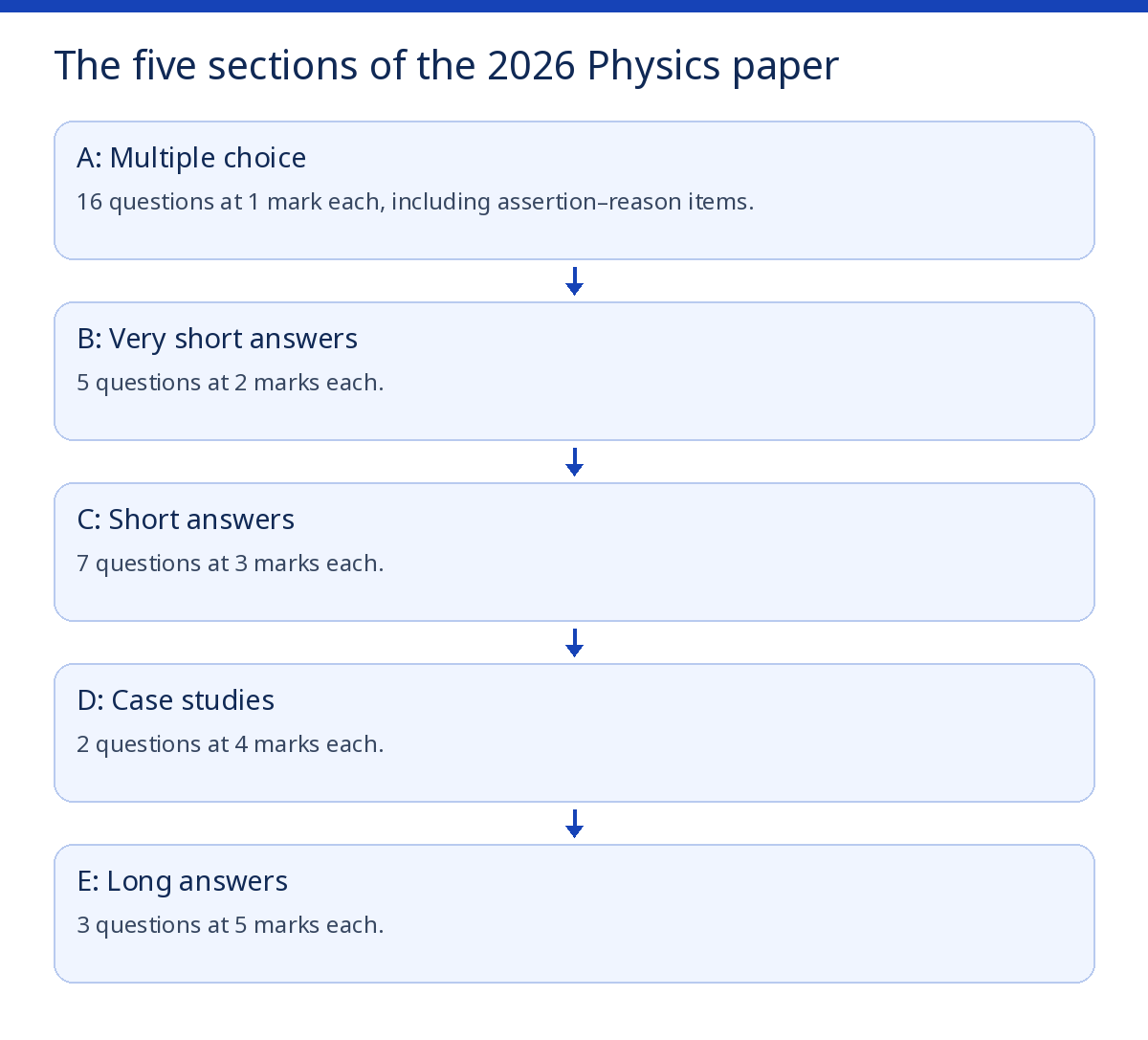
Section A has 16 one-mark questions, including four assertion–reason items. Section B has five two-mark very short answers, and Section C has seven three-mark short answers. Section D contains two four-mark case studies, and Section E has three five-mark long answers. There is no overall choice: answer every question number, choosing one alternative wherever the paper offers an internal choice. Section A has no internal choices.

Physics 2026 | Class 12 | Previous Year Paper | Code 55/3/3
In the StudentCurio app
A complete CBSE Class 12 Physics examination paper with worked solutions, covering questions across multiple syllabus chapters. It helps students practise the board-exam format and review solution methods.
What the paper asks you to do
The questions span electrostatics, current electricity, magnetism, electromagnetic induction, alternating current, electromagnetic waves, optics, semiconductors, photoelectric emission, and atomic and nuclear physics. The breadth matters because the paper changes not just the topic but also the kind of reasoning required. You move between interpreting a graph, reading a circuit, comparing physical quantities, drawing a diagram, and developing a derivation.
Optics is a useful example of that variety. The paper includes ray diagrams and refraction at a spherical surface, as well as interference in Young’s double-slit experiment. In ray optics, the geometry and sign convention are part of setting up the calculation. In interference, the phase relationship and the conditions of the arrangement matter. A missed optics question therefore does not necessarily point to the same gap as another one from that topic.
Read each case study as a physical setup
Section D uses two different settings: a capacitor network and charged particles accelerated before entering a magnetic field. In the capacitor case, read the diagram alongside the passage. The words for a long time tell you to analyse the established state of the circuit rather than the charging transient. Trace the actual connections before deciding which series or parallel rule is relevant. A rule that combines capacitances does not, by itself, tell you what happens in every resistor branch.
In the charged-particle case, separate the stages before comparing quantities. The potential difference belongs to the acceleration stage; the uniform magnetic field belongs to the subsequent motion. Carry the appropriate quantities from one stage to the next, and distinguish a comparison of magnitudes from a question about direction. That distinction determines whether the sign of charge enters your reasoning.
Good to remember: name the angle and the conditions
For a current-carrying planar coil in a uniform magnetic field, the angle in the torque expression is between the field and the normal to the coil, not between the field and the plane. Those angles are complementary. Sketching the normal is a quick way to check that the angle you read from the question is the angle your formula uses.
The same habit applies to choosing an optical model. Adding lens powers directly is the rule used here for thin lenses in contact, not a general rule for separated lenses. When reviewing a derivation, write the assumptions beside the first line, rather than treating the final expression as something that applies to every arrangement with two lenses.
Review the steps, not just the final line
The file provides question-number navigation and worked explanations organised around formula used, concept used, and explanation in steps. After attempting a question, compare your setup with the stated concept before checking substitution or arithmetic. That order helps you distinguish a wrong model from a correct model followed by a unit conversion or calculation error.
Give written questions a different kind of review from multiple-choice items. For a circuit explanation, check that your diagram shows the connections your prose describes. For a derivation, find the first step that you cannot justify without looking back. The resource includes explanations for the printed internal alternatives, so after the timed attempt you can revisit the branch you did not choose and see whether it exposes a different gap.
Quick self-check before opening a solution
For an assertion–reason item, can you judge each statement independently, then decide whether the reason actually explains the assertion if both are true? Two true statements do not necessarily form an explanation. For a graph or diagram question, can you name the feature that supports your conclusion before writing it down? This is especially useful when the plotted horizontal quantity is reciprocal distance rather than distance itself.
For a long answer, can you account for every part of the prompt? A numerical result cannot substitute for a requested ray diagram, and stating a law is not the same as explaining how it applies. On a second attempt, redo the earliest step you could not justify instead of copying the completed solution. This guide leaves out individual answer choices and worked results, including those for the colour-dependent total internal reflection item and the external-field potential-energy calculation.
Spotted an error? Report a correction. Practise this in the app: notes, formula sheets and mind maps.













































































































































































Loading comments…