CBSE Class 12 Physics 2025 Solved Paper: Set 55/4/2
CBSEPhysics2025 Previous Year Paper
Paper code: 55/4/2 · 2025Practise the full 2025 CBSE Class 12 Physics main examination with this English-language paper and its worked solutions. Use the three-hour, 70-mark format to test your pacing, then review the physical reasoning behind your answers.
This set is one of the year's papers. See every set from 2025, grouped by series.
Know the format before you start
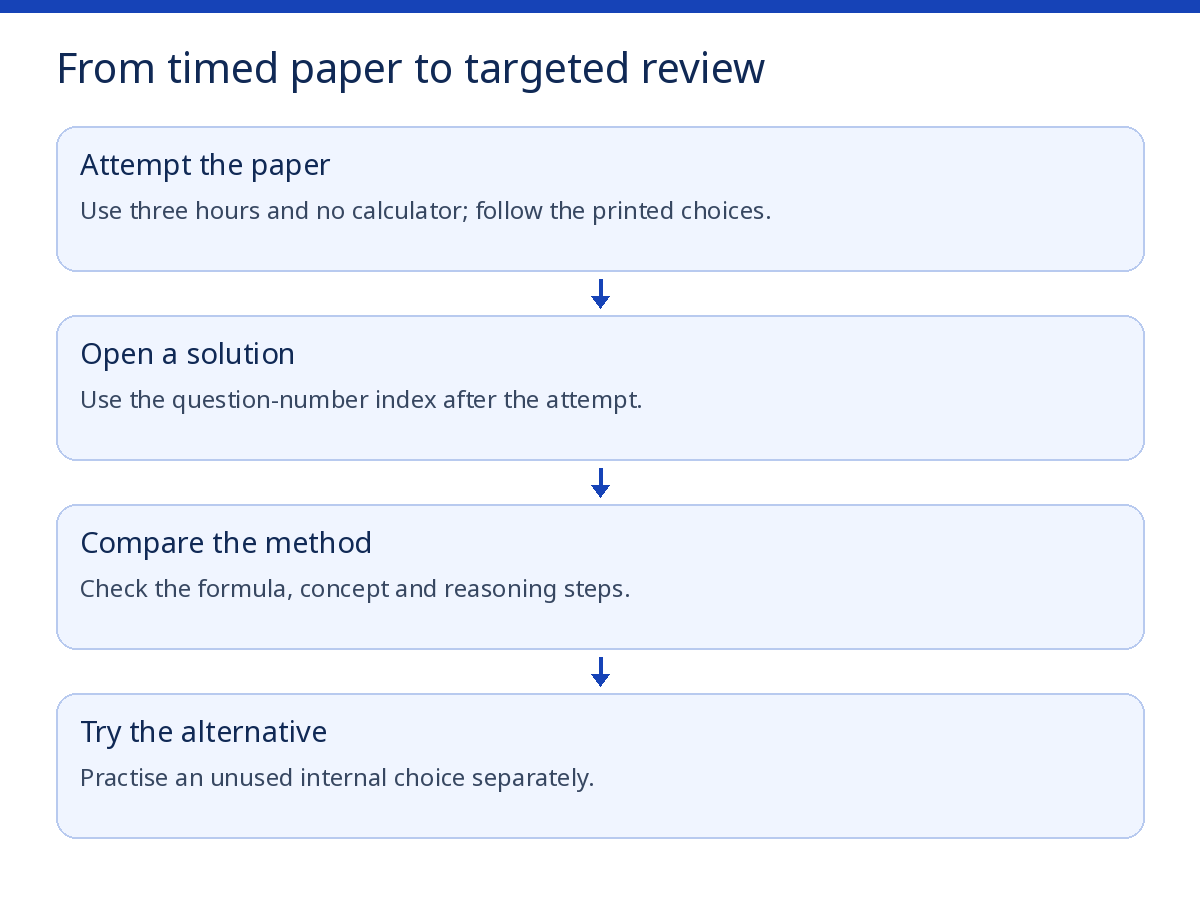
This year-wise resource contains the full paper for set 55/4/2, not a chapter-wise collection. It retains the original English questions, options and diagrams. The question-number index lets you jump directly to a worked solution, and the explanations cover the printed internal choices. For a timed attempt, stay in the question-paper portion and save the solution links for review.
The paper has 33 questions across five sections. Section A has sixteen one-mark questions, including assertion–reason items. Section B has five two-mark very short answers; Section C has seven three-mark short answers. Section D has two four-mark case studies, and Section E has three five-mark long answers. There is no overall choice: all questions are compulsory, with internal choices in some questions outside Section A. Follow the paper’s no-calculator rule to make the attempt comparable to the original exam conditions.

Physics 2025 | Class 12 | Previous Year Paper | Code 55/4/2
In the StudentCurio app
Complete solved CBSE Class 12 Physics board paper for 2025, set 55/4/2, with worked solutions covering topics across the syllabus. Useful for full-paper exam practice and reviewing solution methods.
Connect field, flux and circuit questions
The paper revisits electricity and magnetism in several forms: field directions in objective questions, circuit reasoning in short answers, and electromagnetic induction and alternating current in the long-answer section. A useful distinction is that a magnetic field is defined at a point, whereas magnetic flux refers to a surface. For a flat surface in a uniform field, , where is measured from the surface normal, not from the plane. Sketching that normal makes the geometry explicit before you consider whether the flux changes.
Circuit questions call for a different kind of sketch. When a switch changes the connections, redraw the circuit for each switch position rather than assuming the same branches still carry current. In alternating-current questions, check whether the quantity under discussion is a peak or an rms value, and use the phasor diagram to keep track of which quantity leads or lags.
When to use an optics formula or a sketch
The optics questions call for several different representations: image formation by lenses, refraction at an interface, and bright or dark features in interference and diffraction patterns. Start by identifying what the question asks you to locate or describe. A ray diagram can help with image position, while a wavefront sketch represents the orientation of the wavefront before and after refraction. In a lens-in-liquid problem, the refractive index of the surrounding medium matters; do not carry over a lens-in-air calculation unchanged.
For the pattern questions, label the central maximum and mark the features named in the prompt. A distance from the centre to one minimum is not the same measurement as the distance between minima on opposite sides. Also distinguish slit separation in a double-slit interference setup from slit width in single-slit diffraction: even though both are lengths, they describe different parts of the setup.
Read modern physics and semiconductor prompts precisely
The photoelectric questions ask you to distinguish the onset of emission, the maximum energy of emitted electrons and the interpretation of a voltage–frequency graph. In review, name the quantity on each axis and say what is held fixed before explaining a trend. The hydrogen questions shift the focus to transitions between energy levels. Keep the energy of an individual level separate from the energy difference between levels, and mark the initial and final states before interpreting an emitted wavelength.
The semiconductor questions move from doping and carrier concentrations to current in a p–n junction. Majority and minority describe relative carrier populations; they do not describe the net charge of the material. When reviewing junction behaviour, distinguish diffusion driven by a carrier concentration gradient from drift driven by an electric field. Naming the cause of each process makes for a more informative explanation than simply listing the two currents.
Case-study self-check: Which details control the model?
The two case studies use a hydrogen-atom model and a dielectric-filled capacitor arrangement. Before looking at the options, ask what the passage fixes and what each subpart asks you to determine. In the atom case, distinguish a quantity associated with one orbit from a quantity associated with a transition. In the capacitor case, mark the electrical connections as well as the physical positions of the plates. Plates drawn separately can share a potential when joined by a conducting connection.
Re-read the setup when a subpart changes the conditions. In particular, a source maintaining a potential difference and a conducting wire joining two points are not interchangeable. Practise stating the new condition in words before deciding which quantities from the earlier setup can still be used.
Review the method, not just the final answer
The worked explanations separate the formula, the concept and the steps. Open the solution for a question you missed and compare those parts with your own work in order: Did you choose the right model, state the relevant condition and carry it through consistently? For a graph or diagram question, compare your labels and directions as well as your written conclusion. After scoring your timed attempt using the choices you actually made, try unused alternatives separately to see whether your reasoning holds in a different setup.
Use the rendered PDF rather than copied text to check signs, powers of ten and diagrams. This guide omits numerical and option details where the extracted notation is incomplete, and does not rely on the room-temperature conductor item, whose carbon option does not specify an allotrope.
Spotted an error? Report a correction. Practise this in the app: notes, formula sheets and mind maps.













































































































































































Loading comments…