CBSE Class 12 Physics 2025 Previous Year Paper: Set 55/7/3
CBSEPhysics2025 Previous Year Paper
Paper code: 55/7/3 · 2025This year-wise resource contains the full English-language CBSE Class 12 Physics 2025 main examination paper, set 55/7/3, and worked solutions. Use it for a three-hour board-paper attempt, then review how your choice of model, diagram or sign convention shaped each response.
This set is one of the year's papers. See every set from 2025, grouped by series.
Know the five-section format before you start
The paper carries 70 marks and contains 33 questions. Section A has 16 one-mark multiple-choice questions, including four assertion–reason items. Section B has five two-mark very short answers; Section C has seven three-mark short answers. Section D contains two four-mark case studies, and Section E has three five-mark long answers.
All questions are compulsory, with no overall choice. Some questions in Sections B to E offer an internal choice; Section A does not. For a timed attempt, follow the printed choices rather than answering both alternatives, and work without a calculator. In assertion–reason items, judge the two statements separately before deciding whether the reason actually explains the assertion. Two true statements do not necessarily form an explanation.

Physics 2025 | Class 12 | Previous Year Paper | Code 55/7/3
In the StudentCurio app
Complete CBSE Class 12 Physics 2025 question paper, set 55/7/3, with worked solutions covering topics including electricity, magnetism, optics, semiconductors, electromagnetic waves and atomic physics. Useful for practising the full board examination and reviewing solution methods.
Electricity: link the circuit to the model
The electricity questions range from capacitor networks and a battery circuit to electric flux, dielectrics and dipoles. In a network, identify which components share the same pair of nodes before combining them: capacitors in parallel share a potential difference, whereas plate charges still need to be tracked with their signs. For a closed surface, distinguish the outward flux through each part of the surface from the net flux used in Gauss’s law.
The metallic-conductor case study shifts from circuit quantities to a microscopic description. It links current to carrier density, drift speed and cross-sectional area, then connects resistivity to relaxation time. When reading that passage, keep current and current density separate. A steady current can pass through successive cross-sections of a wire even when the cross-sectional area is not uniform.
Magnetism and AC: track direction, phase and frequency
Magnetism appears through moving charges, current-carrying coils, magnetic flux, induction and the moving-coil galvanometer. For a diagram-based response, identify the direction that represents the field, the direction of motion or current, and any axis about which a loop can turn. A statement about net force and a statement about torque describe different effects, so one does not settle the other.
The alternating-current questions test both circuit behaviour and its graphical representation. A voltage–current plot shows phase by comparing the positions of corresponding points within a cycle. A reactance graph instead shows how a circuit element’s opposition to alternating current changes with frequency. Label the axes first so that these two kinds of graph don’t get mixed up.
When the optics formula applies
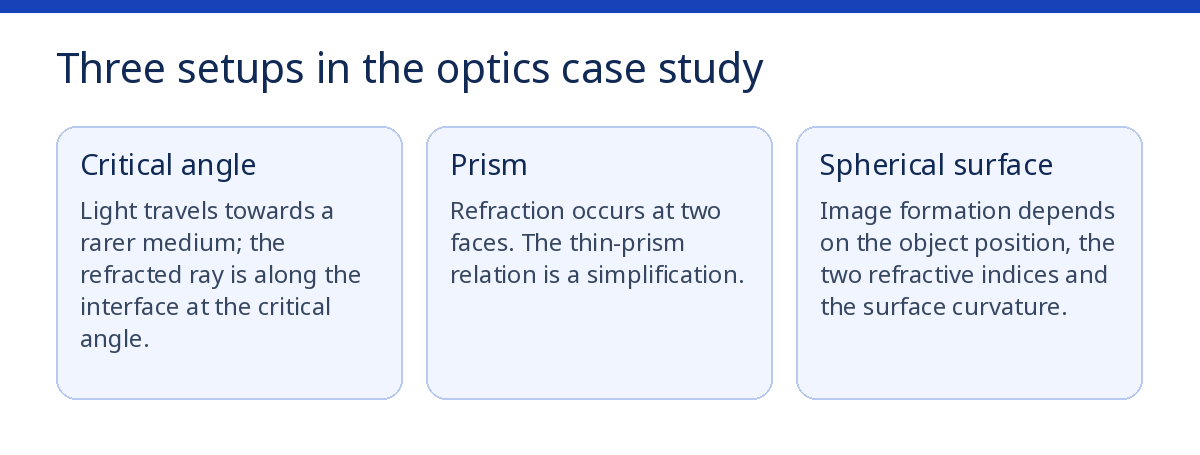
The optics case study covers refraction at a spherical surface, critical angle and prism deviation. The critical angle is defined for light travelling from an optically denser medium towards an optically rarer one, with the refracted ray at 90° to the normal. For a prism, distinguish the relation at minimum deviation from the simplified relation for a thin prism. In the short-answer lens choice, the stated conditions are thin lenses placed coaxially in contact; do not assume the same combination rule applies unchanged to thick lenses.
Elsewhere, the long-answer choices include optical instruments and wave optics. For the telescope diagram, the stated final-image position is part of the setup, not an afterthought. For wave optics, distinguish the superposition of two coherent waves from single-slit diffraction before choosing how to represent the intensity pattern.
Keep carriers, photons and atomic states distinct
The semiconductor questions move between three descriptions: carriers in doped material, donor and acceptor levels on energy-band diagrams, and the behaviour of a p–n junction diode. When practising the diagrams, label the conduction and valence bands as well as the added energy levels. In a rectification explanation, connect the diode’s behaviour under different bias conditions to what it does in a circuit, rather than stopping at a description of the junction.
The paper also covers photon energy, photoelectric observations, hydrogen energy levels and nuclear classification. When reviewing the photoelectric questions, separate the quantity that describes the flow of emitted charge from the quantity that describes the maximum energy of an emitted electron. The electromagnetic-spectrum question calls for both radiation names and frequency ranges, so a name alone leaves part of the task unfinished.
Common mistakes: check the reference before calculating
- Measuring a flux angle from the wrong line. The magnetic flux dot product uses the angle between the field and the area normal. If the question gives the angle to the plane of the coil, mark the normal on your sketch before choosing a trigonometric factor.
- Mixing energy units. When using with Planck’s constant in joule-seconds, express the photon energy in joules. An energy quoted in electron-volts cannot be substituted with the same numerical value.
Some symbols, signs and units are incomplete in the extracted text. This guide leaves those isolated details out; use the printed PDF question and its diagram when setting up a calculation.
Review the method, not just the final line
The file retains the original English questions, options and diagrams. Its question-number navigation takes you to worked explanations organised around the formula, the concept and the steps, including the printed internal choices. After your timed attempt, compare your setup with the explanation before checking the result. If they differ, identify the first point where they diverge: reading the diagram, choosing a relation, setting a direction or carrying out the algebra.
Then try the alternative you left out of a long-answer question. Treat it as a separate practice task, not part of your timed paper. For a derivation or labelled diagram, check whether your response makes the assumptions and intermediate reasoning visible, even if your final expression matches.
Spotted an error? Report a correction. Practise this in the app: notes, formula sheets and mind maps.













































































































































































Loading comments…