CBSE Class 12 Physics 2025 Paper with Worked Solutions
CBSEPhysics2025 Previous Year Paper
Paper code: 55/1/3 · 2025Practise with the full English-language CBSE Class 12 Physics 2025 main examination paper, set 55/1/3. Then use the worked solutions to check whether you chose the right physical model, not just whether you arrived at the right answer.
This set is one of the year's papers. See every set from 2025, grouped by series.
What this year-wise paper contains
This file presents the 2025 main examination paper as a complete set rather than sorting questions by chapter. The original English questions, options and diagrams are retained. The paper carries 70 marks and has a three-hour time limit. Use the question-number index to navigate the file when reviewing individual items.
The worked explanations are organised around the formula used, the concept behind it and the steps that connect the two. They also cover the printed internal choices. That gives the file two distinct uses: you can attempt it as a board paper, then revisit either alternative separately. In the timed sitting, follow the instructions for each choice rather than trying to complete both alternatives.

Physics 2025 | Class 12 | Previous Year Paper | Code 55/1/3
In the StudentCurio app
The complete CBSE Class 12 Physics 2025 paper (set 55/1/3) with worked solutions, covering topics across electricity and magnetism, optics, modern physics, and electronic devices. Helps students practise the board exam format and review solution methods.
Electricity and magnetism: identify what controls the result
The paper moves between electrostatics, current electricity, magnetic forces, induction and alternating current. These topics reward different kinds of reasoning. In electrostatics, an inverse-square relationship tells you how rapidly a magnitude changes with separation. In current electricity, the same potential difference across two conductors does not necessarily mean the same electric field: for a uniform wire, the field magnitude is the potential difference divided by its length.
Magnetic force adds a directional check. The force on a straight current-carrying segment in a uniform magnetic field follows a vector cross product, so the order of the vectors and the signs of their components matter. Induction requires a different check: Lenz’s law says the induced effect opposes the change in linked magnetic flux, not simply the magnetic field itself. When reviewing your work, identify whether an error came from the dependence on a variable, the direction of a vector or the interpretation of a sign.
When the transformer and AC power rules apply
In the transformer material, distinguish the turns ratio, which relates the primary and secondary voltages, from the power balance used to relate their currents. Equating input and output power assumes an ideal, lossless transformer. A voltage change therefore does not, on its own, tell you what happens to power.
For sinusoidal voltage and current of the same frequency, the average power over a full cycle is , where is the phase difference. The phase factor distinguishes average power from a simple product of voltage and current. Before using the relation, check whether the quantities given are peak or rms values. Inserting peak values directly into the rms form introduces a factor-of-two error.
Optics: read the geometry before choosing a formula
The set includes critical-angle geometry, single-slit diffraction and interference. For a critical-angle problem, first identify which medium has the higher refractive index. Total internal reflection can occur only when light travels from the higher-index medium towards the lower-index medium and the incidence angle exceeds the critical angle. At the critical angle, the limiting refracted ray runs along the interface. Mark the angle from the normal, not from the surface, before using the diagram.
For wave optics, distinguish a diffraction minimum produced by contributions across a single slit from the intensity produced by two coherent waves. In the latter case, a path difference corresponds to a phase difference. If you use an expression that assumes equal individual intensities, check that this condition is met; coherence alone does not guarantee equal intensities.
Modern physics and devices: name the quantity first
A stopping potential is a voltage that lets you infer the maximum kinetic energy of emitted photoelectrons. It is not the work function, which is the minimum energy needed to remove an electron from the material. Keeping those quantities separate makes it easier to tell whether you need the work function at all. For matter waves, the de Broglie wavelength depends on momentum. Before comparing wavelengths by mass, check whether the particles have the same speed and whether the non-relativistic expression for momentum applies.
Read the axis labels just as carefully in nuclear physics: binding energy per nucleon measures binding energy relative to the number of nucleons, not the total binding energy of the nucleus. In semiconductor questions, keep carrier type separate from bias. The majority carriers describe the material on each side of the junction; the applied polarity determines whether the junction is forward biased.
Quick self-check after a timed attempt
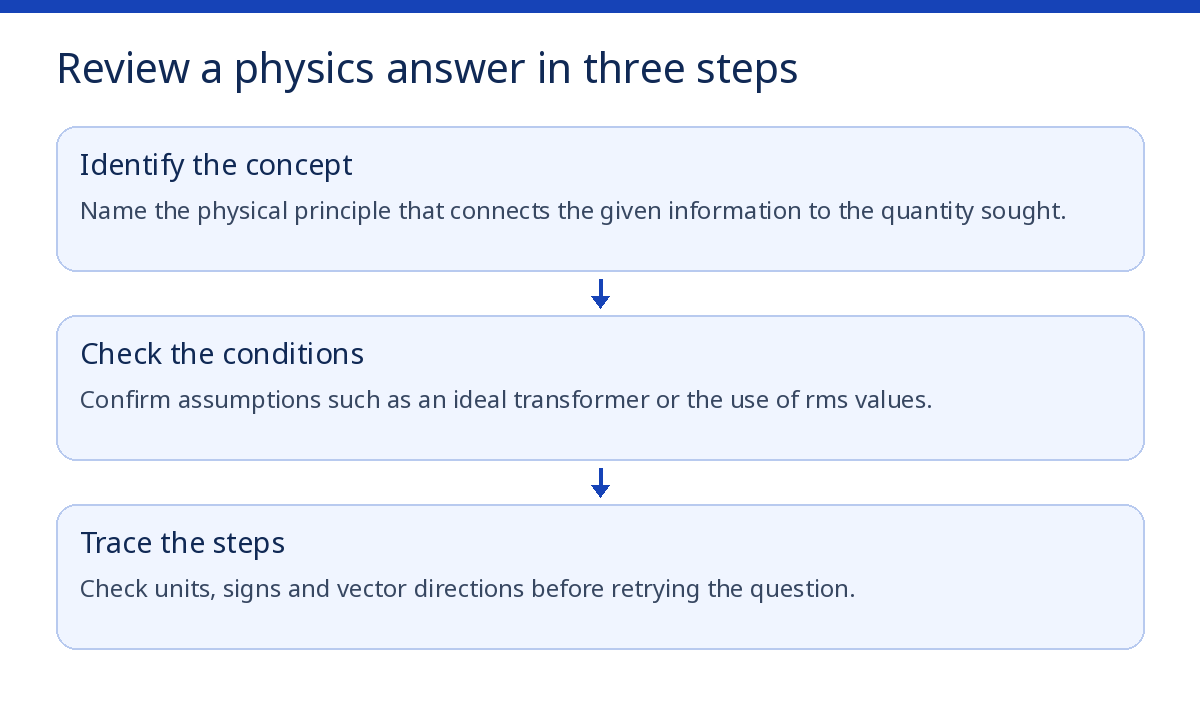
Work through the paper without opening the solutions, and mark any answer for which you were unsure of the physical reasoning. Afterwards, use the explanation headings to find the first point where your approach diverged. If you chose the right concept but the wrong equation, check its conditions. If the equation was appropriate, look next at units, vector direction or the sign convention. The reversed-cell worked result is not reproduced here: the terminal-voltage sign must be checked against the actual current direction.
Before moving on from a flagged item, ask: What assumption made my equation applicable? What feature of the diagram, graph or wording helped me choose it? Then try the item again without looking at the steps. For a question with an internal choice, use the alternative as a separate practice task: see whether you can identify its governing principle before consulting the explanation.
Spotted an error? Report a correction. Practise this in the app: notes, formula sheets and mind maps.













































































































































































Loading comments…