CBSE Class 12 Physics 2025 Previous Year Paper: Set 55/2/1
CBSEPhysics2025 Previous Year Paper
Paper code: 55/2/1 · 2025Practise the complete English-language CBSE Class 12 Physics main examination paper for 2025, set 55/2/1. Use the worked explanations to check not just what you answered, but whether your model, diagram and reasoning fit the question.
This set is one of the year's papers. See every set from 2025, grouped by series.
What this 2025 paper contains
This is a year-wise previous year paper, not a chapter-wise question bank. It retains the original English questions, options and diagrams for set 55/2/1. The printed duration is three hours and the maximum is 70 marks. The file pairs the paper with worked explanations, including those for the printed internal choices. Its question-number links let you move between the paper and individual explanations.
The explanations distinguish the formula, the concept and the steps. Use those labels to diagnose different problems: you may remember the formula but miss the condition that makes it applicable, or choose the right concept but lose a sign when applying it. The full paper lets you see when those slips happen as you switch topics.

Physics 2025 | Class 12 | Previous Year Paper | Code 55/2/1
In the StudentCurio app
Complete CBSE Class 12 Physics question paper for 2025, set 55/2/1, with worked solutions across the syllabus. Helps students practise the full-paper format and review solution methods.
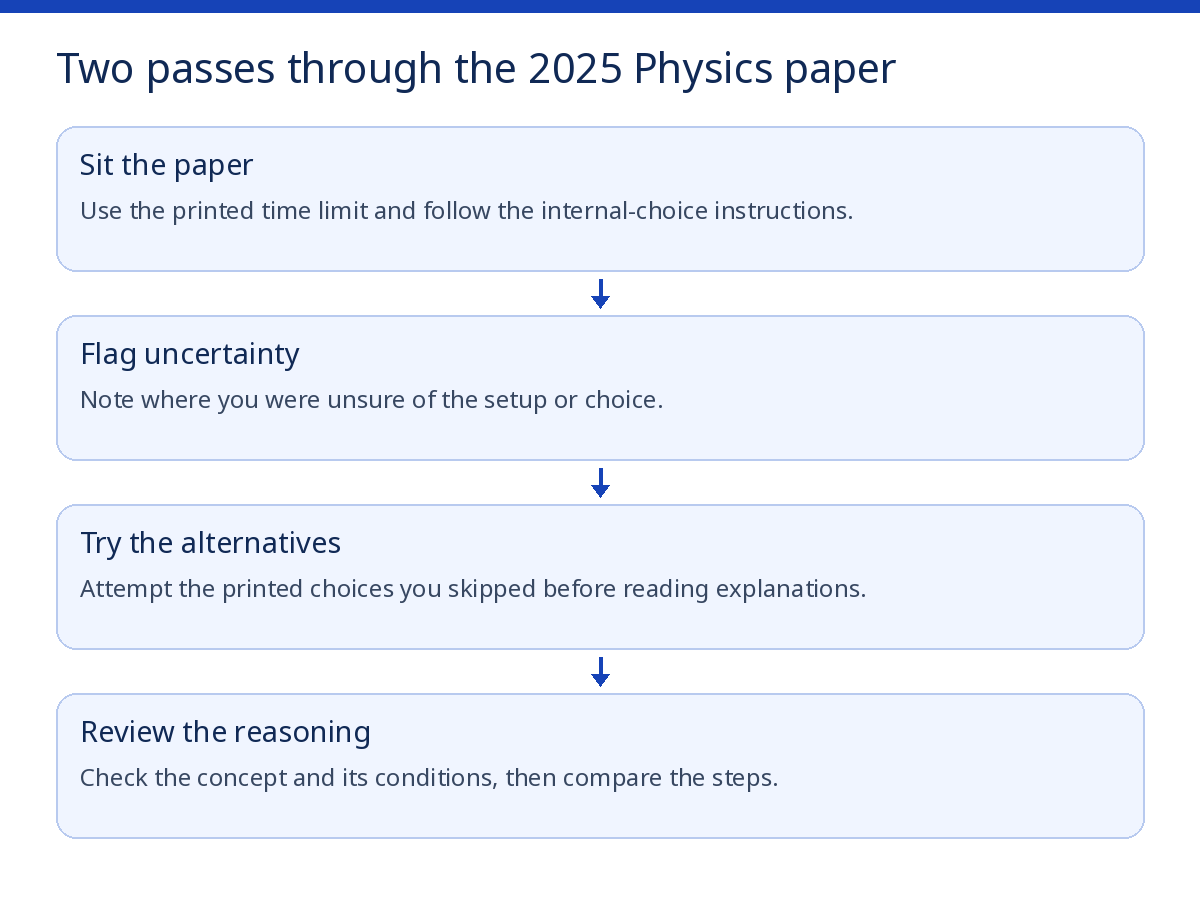
Use internal choices differently on each pass
On your first pass, sit the paper under the printed time limit and leave the worked explanations closed. Follow the instructions for internal choices as printed. If you hesitate between alternatives, note why: one may look familiar even though the other has a diagram or setup you can interpret more confidently. This makes your choice something you can review rather than a decision you have to reconstruct later.
After the attempt, try the alternatives you left out before opening their explanations. That second pass turns the same question slot into extra practice without changing how you sat the paper. For an assertion–reason item, judge each statement on its own before deciding whether the reason actually explains the assertion. Two true statements do not automatically make an explanation.
Common mistakes: reading fields and circuits by appearance
The electrostatics and current electricity items reward careful reading of diagrams. Electric fields add as vectors, not as unsigned magnitudes. If symmetry cancels a component, identify the pair of equal and opposite components; do not assume the entire field cancels. Also distinguish an electrostatic field from an induced electric field: zero work around a closed path is a property of electrostatics, not a rule to apply to every electric field.
In a resistor network, components are in parallel when they share both end nodes, not merely when they are drawn side by side. Resistors in series carry the same current through an unbranched connection. When reviewing a circuit item, trace the connections on the original diagram before deciding whether to combine resistances or write a Kirchhoff equation.
A useful connection: induction depends on change
The paper approaches electromagnetic induction through both a changing magnetic flux and a changing current. In a coil, Lenz’s law says that the induced effect opposes the change in magnetic flux, not simply the flux itself. Before choosing a direction, decide whether the flux through the coil is increasing or decreasing. Then use the winding shown in the diagram to connect the induced field direction to the current direction.
For an ideal inductor with constant inductance, the terminal voltage is when current enters the terminal taken as positive. Read the slope of a current–time graph, not the height of the curve. The transformer items call for a separate model check: the turns-to-voltage ratio and the no-loss power comparison are ideal-transformer relationships.
In optics, check what is being compared
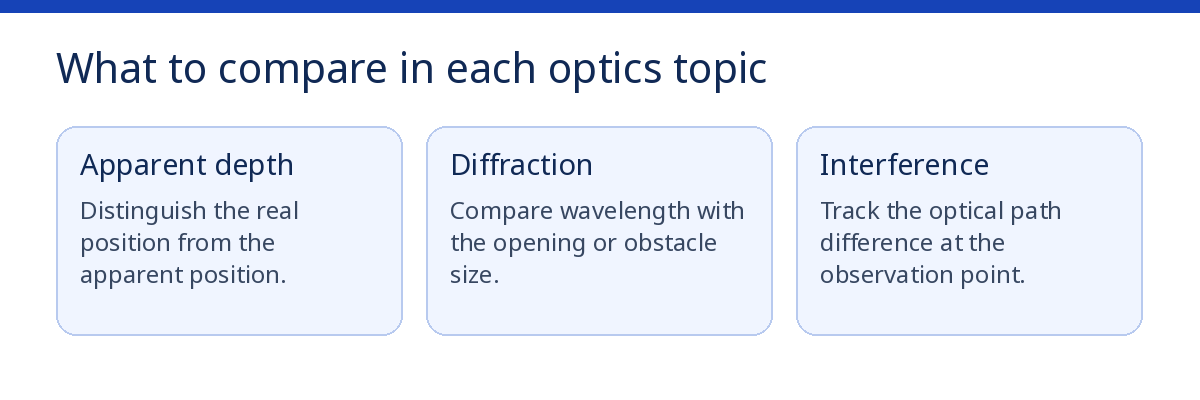
Apparent depth, diffraction and interference appear in the material, but they ask you to track different quantities. For apparent depth at a plane interface, the familiar real-depth to apparent-depth relation for viewing from air assumes near-normal viewing. Keep the apparent position distinct from the actual position, and use the refractive index of the medium when relating light’s speed there to its speed in vacuum.
For diffraction, compare the wavelength with the size of the opening or obstacle. The spreading becomes appreciable when those scales are comparable; a frequency comparison alone does not state that condition. In interference, track the optical path difference. A transparent plate can shift the fringe pattern by changing optical path even though the observation point stays fixed. This is a useful distinction to articulate before checking any fringe calculation.
Quick self-check: name the condition before the formula
The modern physics items give you a way to test whether you can distinguish an energy level from an energy difference. In the hydrogen model, a bound level has negative energy relative to the ionisation limit, while the energy of an emitted photon is the positive difference between the initial and final levels. In a photoelectric question, the comparison is between one photon’s energy and the material’s work function. Ask yourself which of those quantities the question actually gives you.
Apply the same habit to semiconductors. Before using the open-switch analogy for a diode, state the bias and the approximation: an ideal reverse-biased diode is treated as blocking current outside breakdown. Then check whether you can separately explain how forward and reverse bias change the depletion width. The current approximation and the change in junction width describe different aspects of the same device.
Spotted an error? Report a correction. Practise this in the app: notes, formula sheets and mind maps.













































































































































































Loading comments…