CBSE Class 12 Physics 2025 Previous Year Paper: Set 55/5/3
CBSEPhysics2025 Previous Year Paper
Paper code: 55/5/3 · 2025Use the complete 2025 CBSE Class 12 Physics main-examination paper, set 55/5/3, for a three-hour board-exam practice session. Then use the linked worked solutions to see whether each mistake came from choosing the wrong concept, misreading a diagram or losing track of a calculation.
This set is one of the year's papers. See every set from 2025, grouped by series.
The five sections of the 70-mark paper
This year-wise resource brings together the English question paper and worked explanations in one file. The paper contains 33 compulsory questions across five sections. There is no overall choice, but some questions in Sections B to E offer an internal choice. Section A does not. Calculators are not allowed.
- Section A: 16 one-mark multiple-choice questions, including four assertion–reason items.
- Section B: Five two-mark very short-answer questions.
- Section C: Seven three-mark short-answer questions.
- Section D: Two four-mark case studies, on the galvanometer and the photoelectric effect.
- Section E: Three five-mark long-answer questions.
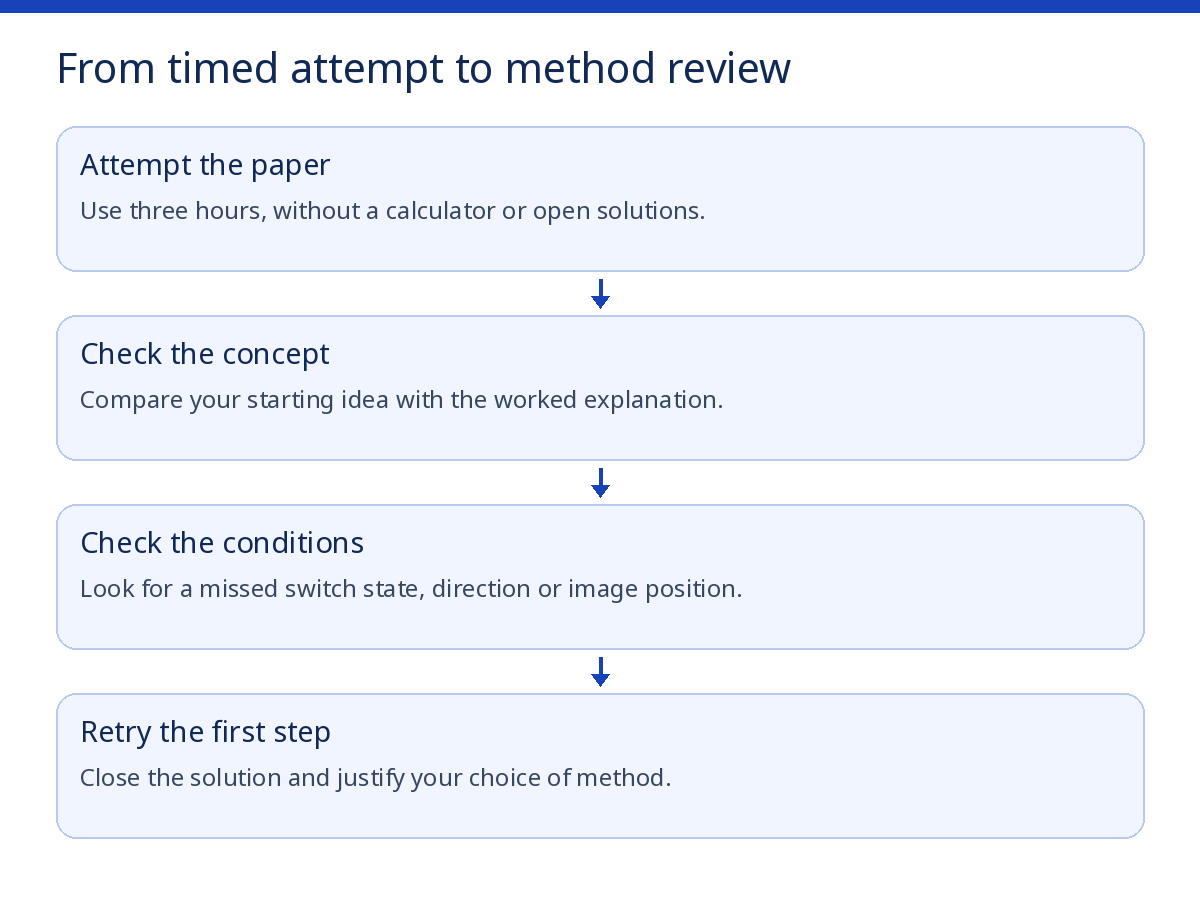
For a timed attempt, follow the printed choice rules and leave the solution links unopened. In a later review, try an alternative you did not choose. The file includes worked explanations for the printed alternatives, so you can use both branches for revision without treating both as compulsory in the mock.

Physics 2025 | Class 12 | Previous Year Paper | Code 55/5/3
In the StudentCurio app
Complete CBSE Class 12 Physics question paper for 2025, set 55/5/3, with worked solutions across the syllabus. Helps students practise board-exam questions and review solution methods.
Common mistakes: reading diagrams by appearance
The paper uses resistor networks in more than one section. Start by marking the terminals between which resistance is requested and checking whether a switch is open or closed. Then label the nodes. Two resistors are in parallel only if both ends connect to the same pair of nodes. Components drawn next to each other need not be in series: a branch at their shared junction can let the current split.
The same attention to the diagram matters in ray optics, where the set moves from refraction at a curved surface to ray tracing and optical instruments. Before deciding how a ray bends, draw the normal at the point of incidence and identify the two media. For instrument questions, note the stated final-image position before drawing rays or choosing a relation. A telescope with its final image at infinity and a microscope with its final image at the near point are not interchangeable setups.
A useful connection: what the setup keeps fixed
Several questions become clearer once you identify what can change. In the capacitor charge-sharing setup, the battery is disconnected before the second capacitor is connected. The battery therefore no longer maintains the original potential difference. Track the total charge of the isolated combination separately from the electrostatic energy stored in it; conservation of charge does not require the stored energy to remain unchanged.
In wave optics, keep phase difference and intensity distinct. When coherent waves superpose, their relative phase determines how their amplitudes combine; intensity is proportional to the square of the resultant amplitude. In the single-slit diffraction question, the requested position is a minimum measured from the central maximum. Identify which pattern the question describes before choosing a condition for a dark point.
Read each case study as a physical model
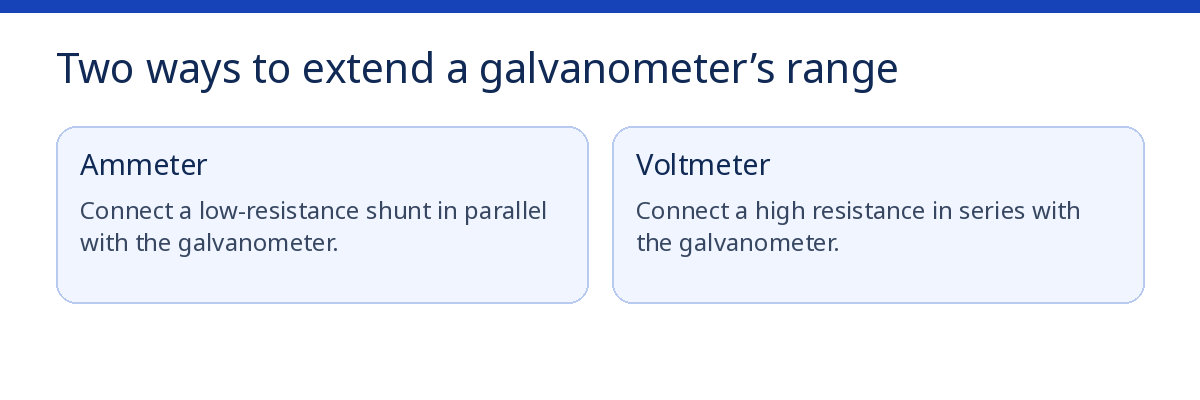
In the galvanometer passage, a current produces a deflecting torque on a coil in a magnetic field. At equilibrium, the spring's restoring torque balances it. Separate that operating principle from the circuit changes used to extend the instrument's range. A galvanometer becomes an ammeter with a suitable low-resistance shunt in parallel; conversion to a voltmeter instead uses a high resistance in series. Sketching the connection makes it easier to see which components share a current or a potential difference.
For the photoelectric-effect case, distinguish incident photon energy, work function and the maximum kinetic energy of emitted electrons. The work function is the minimum energy needed for an electron to escape the surface. The stopping potential concerns the most energetic emitted electrons, not the photocurrent itself. Before interpreting a graph, identify the quantity on each axis and what the question says is held fixed. This guide omits the unclear ammeter cross-reference and does not interpret the saturation-current item.
Definitions, diagrams and graphs need different answers
The paper tests more than numerical substitution. Its semiconductor questions ask for energy-band diagrams at a specified temperature and an explanation of electron–hole pair formation at room temperature. Keep those conditions separate: use the stated temperature for the diagram and the room-temperature condition for the explanation. For the rectifier question, a circuit sketch and an account of how it works serve different purposes. A diagram shows the connections; the explanation follows what happens over the input cycle.
The long-answer questions on inductance likewise distinguish a definition, a derivation and a graph. Before sketching, write down both axis quantities. Induced emf magnitude plotted against the rate of change of current is not the same task as stored energy plotted against current. Even when both graphs concern the same coil, the variables and the physical relationships differ.
Review the method before checking the final answer
Use the question-number navigation after your timed attempt. The worked pages separate Formula used, Concept used and Explanation in steps. Compare your first step with the stated concept before checking arithmetic. In a circuit, that means checking your node labels before comparing a resistance. In a question about a charged particle moving in a magnetic field, check the direction of entry before using a circular-path model, which requires velocity perpendicular to the uniform field.
For an assertion–reason item, test the truth of each statement separately before deciding whether the reason explains the assertion. When you revisit a missed question, rewrite the first step without looking at the solution. If you can name the governing condition as well as select the relation, you have checked more than whether your final answer matches.
Spotted an error? Report a correction. Practise this in the app: notes, formula sheets and mind maps.













































































































































































Loading comments…