CBSE Class 12 Physics 2025 Previous Year Paper Guide
CBSEPhysics2025 Previous Year Paper
Paper code: 55/2/2 · 2025Use the complete English-language 2025 CBSE Class 12 Physics main examination paper for a timed board-exam attempt. Then use the worked explanations to check where you chose the wrong principle, missed a condition or lost track of what the question asked.
This set is one of the year's papers. See every set from 2025, grouped by series.
Identify the paper before you start
This is paper 55/2/2 from the 2025 CBSE Class 12 Physics main examination. The stated duration is 3 hours, and the maximum is 70 marks. The file is organised year-wise as a full paper, not as a chapter-wise question bank. It retains the original English questions, options and diagrams, so you can practise reading the prompts and interpreting the figures as printed.
The cover provides question-number links, and the worked explanations are organised around the formula used, the concept used and the steps of the reasoning. They also cover the printed internal choices. That makes the file useful in two distinct ways: first as an intact paper for an unaided attempt, then as a reference for reviewing individual questions or revisiting an alternative you did not attempt.

Physics 2025 | Class 12 | Previous Year Paper | Code 55/2/2
In the StudentCurio app
Complete 2025 CBSE Class 12 Physics paper with worked solutions covering topics across the syllabus. Helps students practise the board-exam format and review solution methods.
Practise choosing a model, not just recalling a formula
The paper moves between situations that may use similar language but require different physical models. In electrostatics, for example, a question about shielding calls for attention to the conductor, the cavity and whether a charge is present inside it. A question about work along a path instead calls for distinguishing an electrostatic field from an electric field induced by a changing magnetic flux. A rule about closed-path work in electrostatics should not be carried over to induction without checking its conditions.
The circuit material makes a different distinction: a source’s emf is not automatically the same as its terminal potential difference. When a source with internal resistance supplies current, there is an internal voltage drop; on open circuit there is no such drop. When reviewing this part of the paper, look for the statement or diagram feature that tells you whether current is flowing. Identifying that feature is more useful than memorising the numerical substitution in the explanation.
Read graphs and diagrams as part of the question
In the induction material, an inductor’s voltage is tied to the rate of change of current, not to the current value by itself. When reading a current–time graph, separate the height of the graph from its slope. Before assigning a voltage sign, check the polarity convention being used. In the magnetic-field material, a short current element introduces another kind of direction check: the order of the vectors in the Biot–Savart cross product matters. A calculation of magnitude alone cannot establish the field direction.
The optics material gives you practice interpreting geometry rather than just substituting numbers. In the Huygens construction for refraction, portions of the construction in the two media correspond to the same elapsed time, even though light travels at different speeds in the two media. When revisiting the figure, identify the boundary, the wavefronts and the normal before interpreting any angle. In diffraction, ask whether the wavelength is comparable to the relevant opening or obstacle size; a statement about wavelength alone leaves out the scale that makes the comparison meaningful.
Keep energy and circuit approximations separate
The atomic and photoelectric topics distinguish an energy level from the energy difference between levels. The first describes a state of the atom; the second determines the photon energy for an emission transition. A photoelectric threshold is a separate comparison: the incoming photon energy must be at least the material’s work function for emission to be energetically possible. Before looking at the explanation, check which energy the question actually asks you to compare.
The semiconductor material also rewards careful reading of assumptions. An ideal reverse-biased diode in its blocking state can be modelled as an open switch. A forward-biased diode in a series circuit may instead be treated using a specified or approximate forward voltage drop. These are different models. Note the direction of bias and whether the question asks you to use an idealisation before writing a circuit equation.
Quick self-check for assertion–reason items
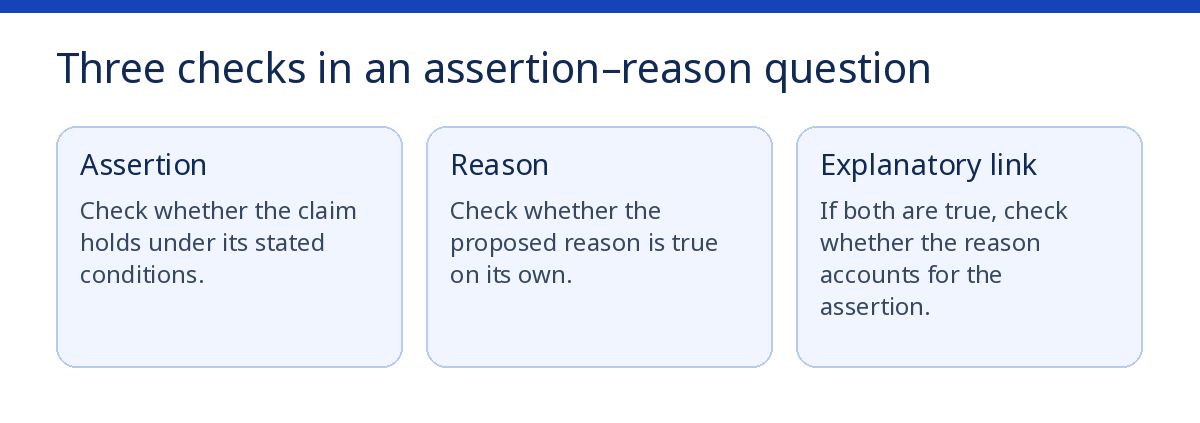
Make three separate judgements: is the assertion true, is the reason true, and, if both are true, does the reason actually explain the assertion? Two statements may concern the same device or phenomenon without one accounting for the other. Use this distinction when revisiting the paper’s assertion–reason items rather than judging the pair by whether the terms sound familiar.
Pay particular attention to qualifiers. A statement about power in an ideal transformer assumes no power loss in the model. A statement about junction depletion width needs to account for the applied bias, not treat the width as fixed. Before opening a worked explanation, try stating the condition that makes each claim valid in your own words.
Turn the worked explanations into a second attempt
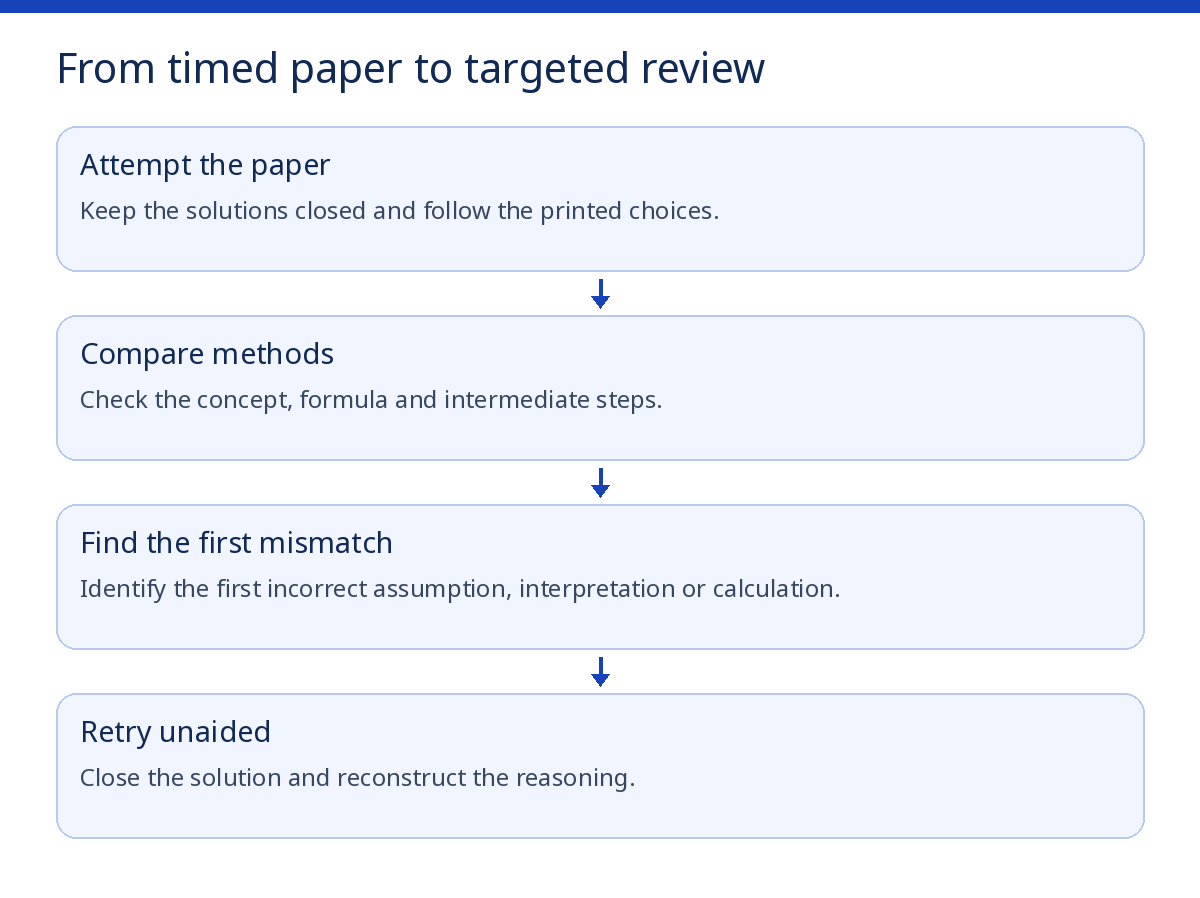
Keep the solutions closed during the timed attempt and follow the printed directions on internal choices. Afterwards, use the question links to revisit uncertain answers as well as incorrect ones. Compare your reasoning with the explanation’s concept, formula and intermediate steps. A correct final choice can still hide a mistaken assumption, while a wrong result can come from an arithmetic or sign error after a sound setup.
For each question worth revisiting, mark the first point where your reasoning went off track. Then close the explanation and redo the question from that point without copying its steps. Save unattempted internal choices for a separate practice round: they give you more material to work through without changing the conditions of your first full-paper attempt.
Spotted an error? Report a correction. Practise this in the app: notes, formula sheets and mind maps.













































































































































































Loading comments…