CBSE Class 12 Physics 2025 Previous Year Paper: Set 55/6/2
CBSEPhysics2025 Previous Year Paper
Paper code: 55/6/2 · 2025Use the complete English-language CBSE Class 12 Physics 2025 main examination paper, Set 55/6/2, for a three-hour board practice session. Then use the worked solutions to check not just your final answers, but also your choice of model, diagram and method.
This set is one of the year's papers. See every set from 2025, grouped by series.
What this year-wise paper contains
This resource is organised around one complete examination paper rather than a collection of questions sorted by chapter. It retains the original English questions, options and diagrams, so you can practise switching between topics without a chapter heading telling you which principle to use. The file also includes worked explanations for the printed internal choices. Its question-number links let you move between the paper and a particular solution during review.
The paper carries 70 marks, allows three hours and does not permit calculators. For a timed attempt, stay in the question-paper portion of the file. Use the links only after you finish, so that seeing a solution method does not influence the rest of your attempt.

Physics 2025 | Class 12 | Previous Year Paper | Code 55/6/2
In the StudentCurio app
Complete CBSE Class 12 Physics paper for 2025, Set 55/6/2, with worked solutions covering the syllabus. Includes a solution on AC generators, LCR circuits and transformers, helping students practise board-exam questions and review solution methods.
How the five sections change what you need to show
Section A contains 16 one-mark multiple-choice questions, including four assertion–reason items. Section B has five two-mark very short answers, and Section C has seven three-mark short answers. Section D has two four-mark case studies, while Section E has three five-mark long answers. The paper has 33 compulsory questions and no overall choice. Internal choices appear in some questions outside Section A; an alternative replaces the corresponding branch, not the whole question or another numbered item.
Match your written response to the task. A graph question may require both a labelled plot and an explanation of what can be read from it. A longer question can combine a labelled diagram, an explanation of the principle and a separate calculation. Track those parts individually rather than treating a correct calculation as a complete response.
Follow the topic shifts across the set
The paper moves between electric circuits, magnetic effects, induction, optics, semiconductors, and atomic and nuclear physics. It also draws on electromagnetic waves and the dual nature of radiation and matter. The same broad topic can demand different kinds of reasoning. Current electricity appears in a graph relating terminal voltage to current and in a derivation involving current density and relaxation time. The graph asks you to connect features of a plot to physical quantities; the derivation asks you to connect a microscopic model of conduction to a measurable quantity.
Optics likewise ranges from interference and refraction to image formation in optical instruments. In review, sort errors by what the question required: interpreting a diagram, identifying a condition, linking equations or explaining a physical effect. That is more informative than recording only the chapter name.
Case-study reading: identify what changes
One case study follows doped semiconductors through p–n junction formation, biasing and rectification. Keep the stages separate: doping changes carrier concentrations, diffusion and drift matter when the junction forms, and an external bias changes the conditions at the junction. When a subpart shifts from the junction to a rectifier, check whether it is asking about the junction itself or about the circuit output.
The capacitor case study connects plate geometry, the intervening medium, dielectric polarisation and stored energy. It also uses capacitor combinations. Before choosing a relation, identify whether the subpart is about changing a single capacitor or analysing several connected capacitors. For an energy comparison, establish whether the setup holds charge or potential difference fixed; a change in capacitance alone does not tell you how the stored energy changes.
Common mix-ups in alternating-current questions
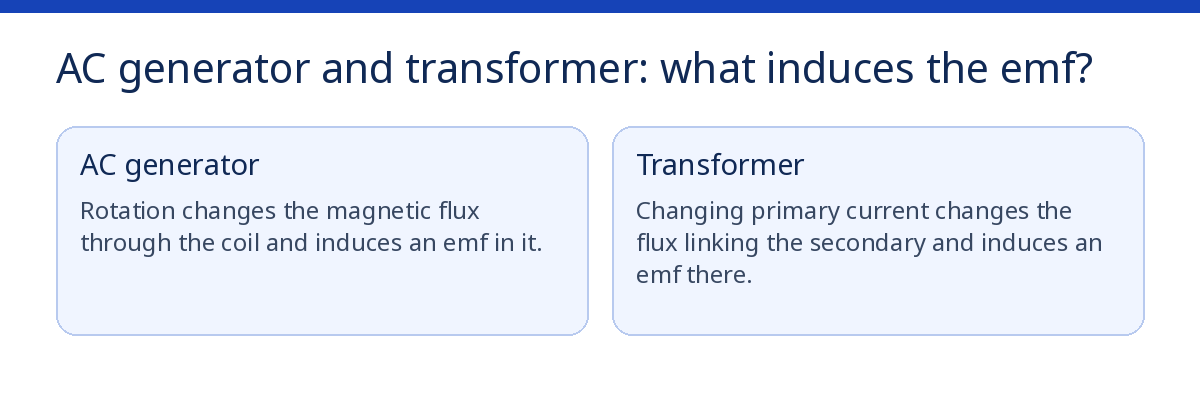
The long-answer alternatives distinguish an AC generator, which induces an emf as magnetic flux changes, from a transformer, in which changing current in the primary induces an emf in the secondary through mutual induction. Use the labelled diagrams to connect each component to its role. Naming induction in both cases is not a substitute for explaining what changes and where the emf is induced.
In a series LCR circuit under sinusoidal steady-state conditions, the same current passes through all three elements, but the voltages across them are not generally in phase. Treat their RMS magnitudes as phasor magnitudes rather than adding them as ordinary positive numbers. Also distinguish the peak coefficient in an instantaneous sinusoidal expression from an RMS value. The numerical AC examples are not quoted here because some symbols and units are incomplete in the text extraction.
Quick self-check before opening a solution
For an assertion–reason item, make three separate judgements: is the assertion true, is the reason true, and, if both are true, does the reason actually explain the assertion? Read the response codes printed in this set rather than relying on a code order remembered from another paper. For a diagram or derivation, ask whether you can name the condition that makes your chosen relation applicable.
When you open a worked solution, use its formula, concept and step-by-step explanation as three checkpoints. Find the first place your reasoning diverged, even if your final answer happened to match. If you left an internal alternative unattempted, try it separately after marking the timed paper. That lets you test a second method without changing the record of how you handled the original choice.
Spotted an error? Report a correction. Practise this in the app: notes, formula sheets and mind maps.













































































































































































Loading comments…