CBSE Class 12 Physics 2025 Previous Year Paper: Set 55/4/1
CBSEPhysics2025 Previous Year Paper
Paper code: 55/4/1 · 2025Use the complete English-language 2025 CBSE Class 12 Physics main examination paper as a three-hour mock. Then use the worked solutions to check how you chose a physical principle, interpreted a diagram or graph, and justified your reasoning.
This set is one of the year's papers. See every set from 2025, grouped by series.
Know the structure before you start
Set 55/4/1 is a full 70-mark board paper with 33 questions across five sections. Section A has 16 one-mark questions, including assertion–reason items. Section B has five two-mark very short answers, and Section C has seven three-mark short answers. Section D has two four-mark case studies, while Section E has three five-mark long answers.
The paper gives no overall choice: attempt every question number, choosing one alternative where a printed internal choice is offered. There is no internal choice in Section A. For a mock attempt, set aside the full three hours, work without a calculator, and keep the solutions closed. Note where you slow down: reading a circuit, recalling a relation, or writing a justification. Each points to a different revision need.

Physics 2025 | Class 12 | Previous Year Paper | Code 55/4/1
In the StudentCurio app
Complete CBSE Class 12 Physics 2025 board paper (set 55/4/1) with worked solutions, covering the syllabus in multiple-choice, assertion–reason, case-study and written formats, including optics questions on lenses, prisms, interference and diffraction. Helps students practise a full exam paper and review solution methods.
Read circuits, fields and graphs before using equations
The electricity questions move between bulb circuits, current density, resistivity, and a battery with internal resistance. In a circuit diagram, trace the conducting paths before comparing currents or brightness. An open key removes a path; it does not automatically stop current everywhere. In the battery alternative, distinguish emf from terminal potential difference: the latter depends on the current when the battery supplies a load and has internal resistance.
The paper also tests whether you can distinguish a quantity from what a graph tells you about it. On a current–time graph, the signed area over an interval represents net charge transferred, not the height of the graph at one instant. For questions about magnetic fields from wires, mark the directions of the individual fields before combining them: field superposition is vector addition.
Optics: choose the model before the formula
The optics questions span lens curvature, lenses in contact, minimum deviation in a prism, double-slit interference and single-slit diffraction. In a lens problem, label the object and image positions and use one sign convention throughout. In particular, a screen displacement between two setups is not itself the image distance in either setup. For a prism, distinguish the minimum-deviation condition from a general ray path; the symmetric path applies at minimum deviation, not at every angle of incidence.
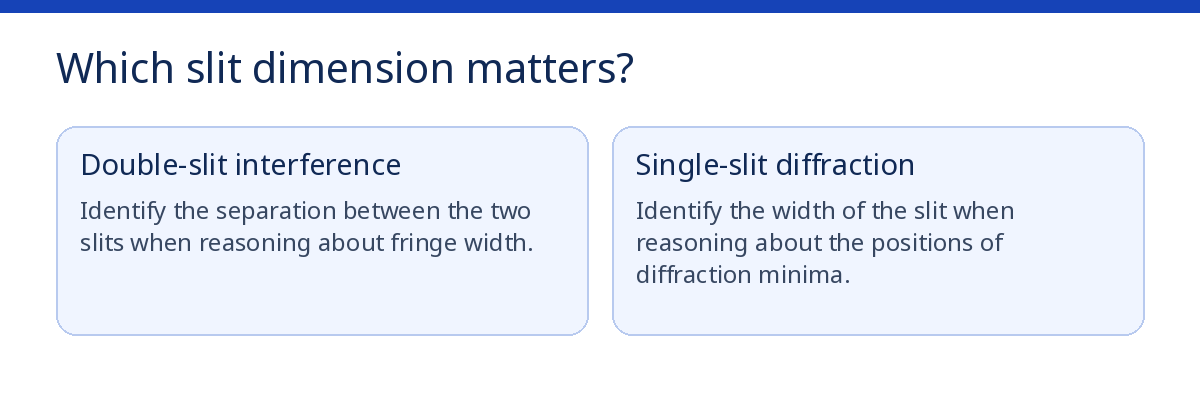
For wave optics, first decide whether the relevant dimension is the separation between two slits or the width of one slit. That distinction determines which pattern and relation to use. When the paper changes the medium around a double-slit setup, separate quantities set by the light source from quantities that depend on propagation in the medium before reasoning about the pattern.
Common mix-ups in alternating current and induction
An rms current is not the instantaneous maximum. The conversion applies to a sinusoidal current, not to an arbitrary waveform. In the series resonance questions, distinguish the cancellation of inductive and capacitive reactances from the disappearance of resistance. With resistance present in a series LCR circuit, the impedance at resonance is the resistance. A phasor diagram helps you track which quantity leads or lags rather than relying on a remembered sign alone.
For induction, do not infer an emf merely from the presence of a magnetic field. The relevant quantity is the rate of change of magnetic flux. When reviewing the moving-loop question, compare the flux and emf graphs over the same time intervals. A nonzero but constant flux does not imply a nonzero induced emf.
Case studies: extract the physical setup from the passage
The two case studies cover a dielectric-filled capacitor arrangement and the Bohr model of hydrogen. For the capacitor passage, redraw the connections before using any capacitance relation. Plates connected to the same terminal are at the same potential; the electrical connections, not just the order of the plates in the drawing, determine how to model the arrangement. Also check whether a subpart keeps the voltage source connected or explicitly changes the setup.
In the hydrogen passage, distinguish quantities that describe a single orbit from quantities that describe a transition between states. Orbital speed and total energy characterize a state in the model; an emitted photon relates to an energy difference. Keeping those roles separate helps you interpret what each subpart is asking without carrying an assumption from one subpart into the next.
Quick self-check: can you explain the link?
For an assertion–reason item, judge the truth of the assertion and the reason separately, then decide whether the reason explains the assertion. Two true statements about the same topic do not necessarily explain each other. Use the codes printed in this paper rather than relying on the option order from another test.
Try the same distinction in written explanations. In photoelectric emission, can you explain why the onset of emission and the maximum kinetic energy are different questions? In semiconductor physics, can you distinguish the labels majority and minority carriers from the mechanisms of drift and diffusion at a p–n junction? These checks help you see whether you can explain a mechanism, not just recognise its vocabulary.
Use the worked solutions to diagnose your first wrong step
The file retains the original English questions, options and diagrams, and its question-number links let you go directly to the corresponding worked solution. The explanations identify the formula and concept used and show the steps, including for printed internal alternatives. Compare your reasoning with the worked method before checking the result. If you went wrong, mark the first point of divergence: the diagram, the choice of principle, a sign or unit, or the calculation itself.
After the mock, try the internal alternatives you did not choose to test a different method without changing the conditions of your first attempt. Use the PDF for exact question wording, signs and units. This guide omits numerical details from isolated passages where the text extract does not reliably preserve them.
Spotted an error? Report a correction. Practise this in the app: notes, formula sheets and mind maps.













































































































































































Loading comments…